

152
3 – Transport in ionic solids
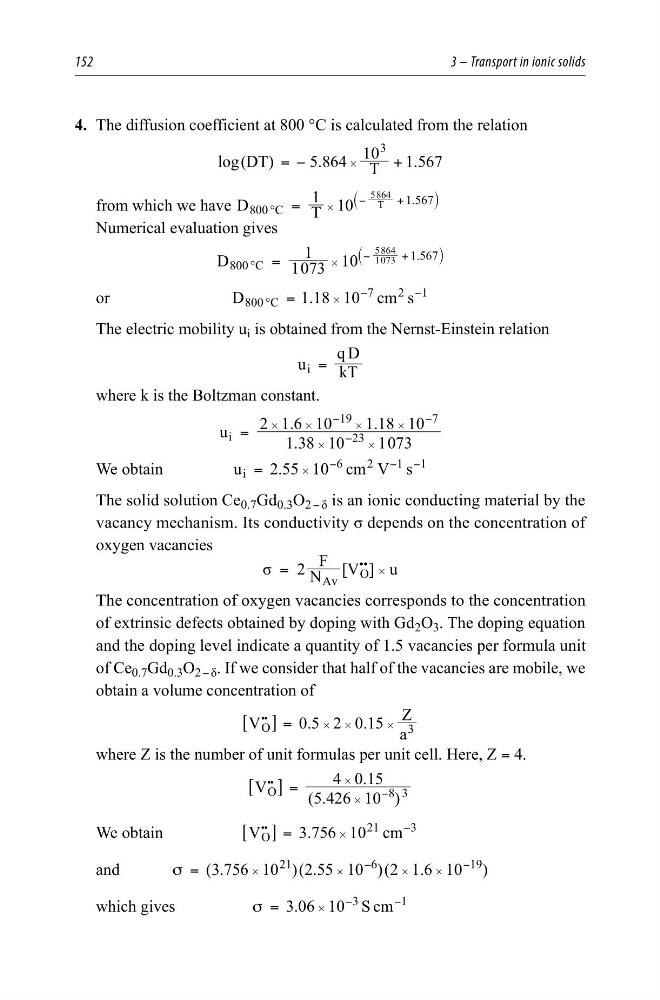
4. The diffusion coefficient at 800 °C is calculated from the relation
( )
.
.
log DT
T
5 864
10
1 567
3
= −
+
#
from which we have D
T
1
10
.
C
800
1 567
°
T
5864
=
−
+
#
`
j
Numerical evaluation gives
D
1073
1
10
.
C
800
1 567
°
1073
5864
=
−
+
#
`
j
or
.
D
c m s
1 18 10
C
800
7
2 1
°
#
=
−
−
The electric mobility u i is obtained from the Nernst-Einstein relation
u
kT
q D
i =
where k is the Boltzman constant.
.
.
.
u
1 38 10
1073
2 1 6 10
118 10
i
23
19
7
#
#
#
=
−
−
−
#
#
#
We obtain
.
u
c m V s
2 55 10
i
6
2
1 1
#
=
−
− −
The solid solution Ce 0.7 Gd 0.3 O 2 − δ is an ionic conducting material by the
vacancy mechanism. Its conductivity σ depends on the concentration of
oxygen vacancies
σ = 2 N
F
Av
[V
••
O ] # u
The concentration of oxygen vacancies corresponds to the concentration
of extrinsic defects obtained by doping with Gd 2 O 3 . The doping equation
and the doping level indicate a quantity of 1.5 vacancies per formula unit
of Ce 0.7 Gd 0.3 O 2 − δ . If we consider that half of the vacancies are mobile, we
obtain a volume concentration of
.
.
V
a
Z
0 5 2 0 15
O
3
=
::
#
#
#
6 @
where Z is the number of unit formulas per unit cell. Here, Z = 4.
( .
)
.
V
5 426 10
4 0 15
O
8 3
#
=
::
−
#
6 @
We obtain
.
V
c m
3 756 10
O
21
3
#
=
::
−
6 @
and
(3.756 10 )(2.55 10 )(2 1.6 10 )
21
6
1 9
#
#
#
σ =
−
−
#
which gives
3.06 10 S cm
3
1
#
σ =
−
−
3 – Transport in ionic solids
4. The diffusion coefficient at 800 °C is calculated from the relation
( )
.
.
log DT
T
5 864
10
1 567
3
= −
+
#
from which we have D
T
1
10
.
C
800
1 567
°
T
5864
=
−
+
#
`
j
Numerical evaluation gives
D
1073
1
10
.
C
800
1 567
°
1073
5864
=
−
+
#
`
j
or
.
D
c m s
1 18 10
C
800
7
2 1
°
#
=
−
−
The electric mobility u i is obtained from the Nernst-Einstein relation
u
kT
q D
i =
where k is the Boltzman constant.
.
.
.
u
1 38 10
1073
2 1 6 10
118 10
i
23
19
7
#
#
#
=
−
−
−
#
#
#
We obtain
.
u
c m V s
2 55 10
i
6
2
1 1
#
=
−
− −
The solid solution Ce 0.7 Gd 0.3 O 2 − δ is an ionic conducting material by the
vacancy mechanism. Its conductivity σ depends on the concentration of
oxygen vacancies
σ = 2 N
F
Av
[V
••
O ] # u
The concentration of oxygen vacancies corresponds to the concentration
of extrinsic defects obtained by doping with Gd 2 O 3 . The doping equation
and the doping level indicate a quantity of 1.5 vacancies per formula unit
of Ce 0.7 Gd 0.3 O 2 − δ . If we consider that half of the vacancies are mobile, we
obtain a volume concentration of
.
.
V
a
Z
0 5 2 0 15
O
3
=
::
#
#
#
6 @
where Z is the number of unit formulas per unit cell. Here, Z = 4.
( .
)
.
V
5 426 10
4 0 15
O
8 3
#
=
::
−
#
6 @
We obtain
.
V
c m
3 756 10
O
21
3
#
=
::
−
6 @
and
(3.756 10 )(2.55 10 )(2 1.6 10 )
21
6
1 9
#
#
#
σ =
−
−
#
which gives
3.06 10 S cm
3
1
#
σ =
−
−