

Solutions to exercises
141
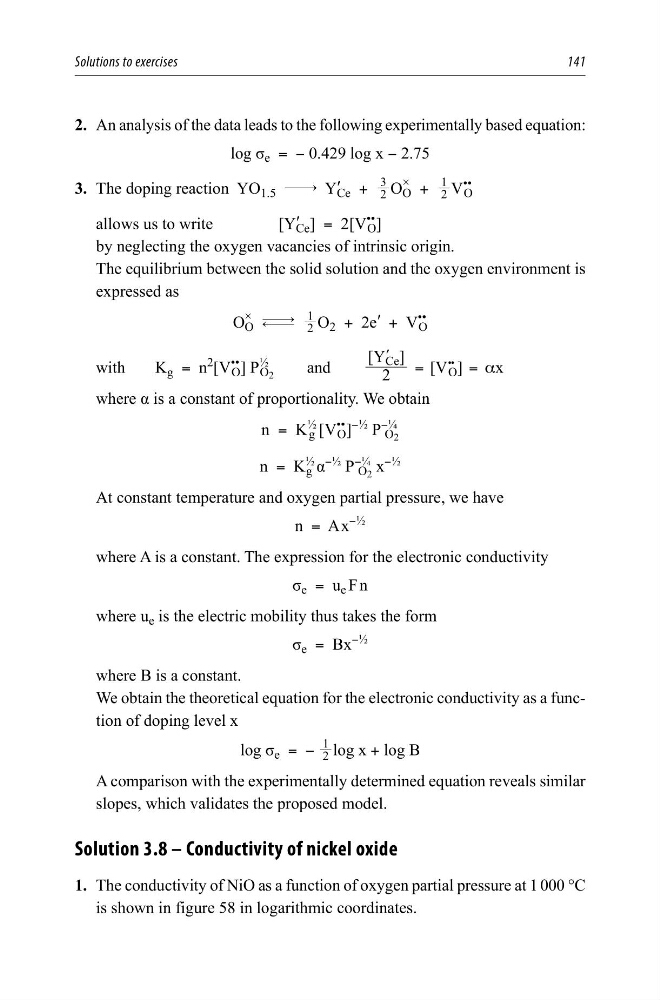
2. An analysis of the data leads to the following experimentally based equation:
log σ e = − 0.429 log x − 2.75
3. The doping reaction YO 1.5 $ Y ′
Ce + 2
3
O
#
O + 2
1
V
••
O
allows us to write
[Y ′
Ce ] = 2[V
••
O ]
by neglecting the oxygen vacancies of intrinsic origin.
The equilibrium between the solid solution and the oxygen environment is
expressed as
O
#
O m 2
1
O 2 + 2e ′ + V
••
O
with
K g = n
2
[V
••
O ] P
½
O 2
and
2
[Y ]
[V ]
x
Ce
O
α
=
=
::
l
where α is a constant of proportionality. We obtain
n = K
½
g [V
••
O ]
−½
P
−¼
O 2
n = K
½
g α
−½
P
−¼
O 2 x
−½
At constant temperature and oxygen partial pressure, we have
n = A x
−½
where A is a constant. The expression for the electronic conductivity
σ e = u e F n
where u e is the electric mobility thus takes the form
σ e = Bx
−½
where B is a constant.
We obtain the theoretical equation for the electronic conductivity as a function of doping level x
log σ e = − 2
1
log x + log B
A comparison with the experimentally determined equation reveals similar
slopes, which validates the proposed model.
Solution 3.8 – Conductivity of nickel oxide
1. The conductivity of NiO as a function of oxygen partial pressure at 1 000 °C
is shown in figure 58 in logarithmic coordinates.
141
2. An analysis of the data leads to the following experimentally based equation:
log σ e = − 0.429 log x − 2.75
3. The doping reaction YO 1.5 $ Y ′
Ce + 2
3
O
#
O + 2
1
V
••
O
allows us to write
[Y ′
Ce ] = 2[V
••
O ]
by neglecting the oxygen vacancies of intrinsic origin.
The equilibrium between the solid solution and the oxygen environment is
expressed as
O
#
O m 2
1
O 2 + 2e ′ + V
••
O
with
K g = n
2
[V
••
O ] P
½
O 2
and
2
[Y ]
[V ]
x
Ce
O
α
=
=
::
l
where α is a constant of proportionality. We obtain
n = K
½
g [V
••
O ]
−½
P
−¼
O 2
n = K
½
g α
−½
P
−¼
O 2 x
−½
At constant temperature and oxygen partial pressure, we have
n = A x
−½
where A is a constant. The expression for the electronic conductivity
σ e = u e F n
where u e is the electric mobility thus takes the form
σ e = Bx
−½
where B is a constant.
We obtain the theoretical equation for the electronic conductivity as a function of doping level x
log σ e = − 2
1
log x + log B
A comparison with the experimentally determined equation reveals similar
slopes, which validates the proposed model.
Solution 3.8 – Conductivity of nickel oxide
1. The conductivity of NiO as a function of oxygen partial pressure at 1 000 °C
is shown in figure 58 in logarithmic coordinates.