

Exercises
117
Tables 30 and 31 give the variation ΔE in the emf for this cell for various
hydrogen partial pressures and temperatures, respectively.
Table 30 – emf of cell
for various hydrogen
partial pressures at 800 °C.
Table 31 – emf of cell at various
temperatures for a hydrogen
partial pressure of 10
−2
bar.
a. Derive the equation for the emf as a function of hydrogen partial pressure
(P H 2, 1 = P H 2 ,c ) and temperature T.
b. Indicate the conditions for which the equation is valid.
c. Compare the experimental results with theory and draw your conclusions.
2. Another way to estimate the ionic transport number in this conductor is to
make the following cell:
(+) H 2 ,Pt / SrZr 1−x Y x O 3−α / Pt,Ar (−)
a. Explain how, by applying a continuous current across the cell, we can
determine the type of the conduction and the ionic transport number.
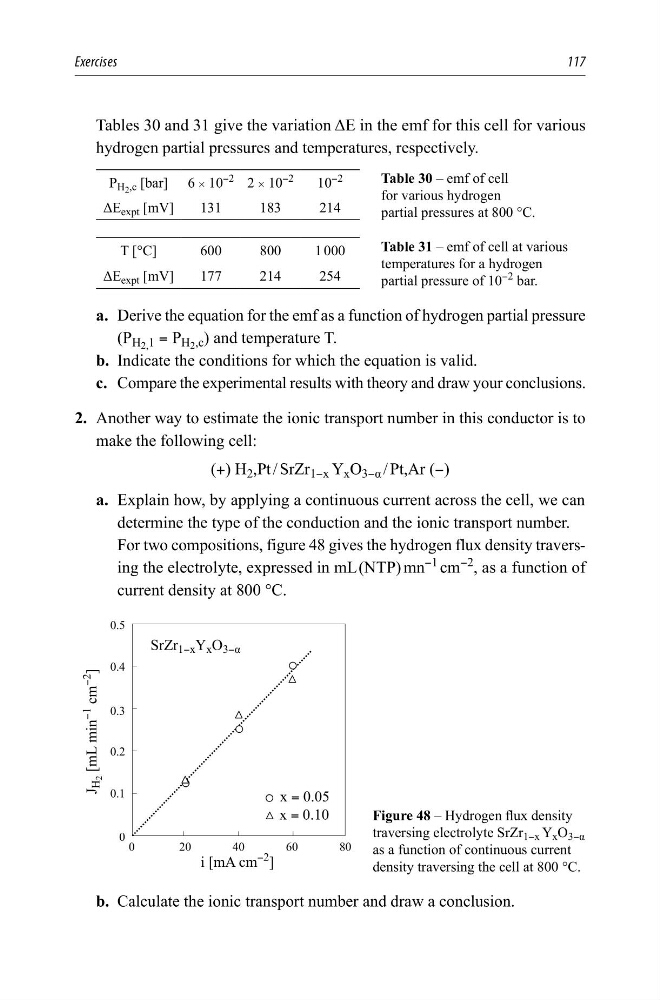
For two compositions, figure 48 gives the hydrogen flux density traversing the electrolyte, expressed in mL (NTP) mn
−1
cm
−2
, as a function of
current density at 800 °C.
Figure 48 – Hydrogen flux density
traversing electrolyte SrZr 1−x Y x O 3−α
as a function of continuous current
density traversing the cell at 800 °C.
b. Calculate the ionic transport number and draw a conclusion.
P H 2 ,c [bar] 6 # 10
−2
2 # 10
−2
10
−2
ΔE expt [mV]
131
183
214
T [°C]
600
800
1 000
ΔE expt [mV]
177
214
254
6U=U <[ < [ 2 <Į
[
[
L>P$FP
<
@
-
+
>P/PLQ
<
FP
<
@
117
Tables 30 and 31 give the variation ΔE in the emf for this cell for various
hydrogen partial pressures and temperatures, respectively.
Table 30 – emf of cell
for various hydrogen
partial pressures at 800 °C.
Table 31 – emf of cell at various
temperatures for a hydrogen
partial pressure of 10
−2
bar.
a. Derive the equation for the emf as a function of hydrogen partial pressure
(P H 2, 1 = P H 2 ,c ) and temperature T.
b. Indicate the conditions for which the equation is valid.
c. Compare the experimental results with theory and draw your conclusions.
2. Another way to estimate the ionic transport number in this conductor is to
make the following cell:
(+) H 2 ,Pt / SrZr 1−x Y x O 3−α / Pt,Ar (−)
a. Explain how, by applying a continuous current across the cell, we can
determine the type of the conduction and the ionic transport number.
For two compositions, figure 48 gives the hydrogen flux density traversing the electrolyte, expressed in mL (NTP) mn
−1
cm
−2
, as a function of
current density at 800 °C.
Figure 48 – Hydrogen flux density
traversing electrolyte SrZr 1−x Y x O 3−α
as a function of continuous current
density traversing the cell at 800 °C.
b. Calculate the ionic transport number and draw a conclusion.
P H 2 ,c [bar] 6 # 10
−2
2 # 10
−2
10
−2
ΔE expt [mV]
131
183
214
T [°C]
600
800
1 000
ΔE expt [mV]
177
214
254
6U=U <[ < [ 2 <Į
[
[
L>P$FP
<
@
-
+
>P/PLQ
<
FP
<
@