

Exercises
115
3. Based on the “weak electrolyte” model applied to amorphous ionic conductors, relate the emf to the conductivity of the cations M
+
in G1H and G2H.
Assume that the mobilities are identical and independent of concentration.
4. The measurements made at various temperatures reveal a linear relationship between ΔE and T. The extrapolation of the curve ΔE(T) intercepts the
ordinate axis at 100 mV. Given that the equation for the conductivity as a
function of temperature is
T e
0
RT
E a
σ
σ
=
−
where σ 0 is a constant and E a is the activation energy, what is the difference
ΔE a between activation energies of conduction (expressed in eV and in
kJ mol
−1
) in the two vitreous phases?
Exercise 3.13 – High-temperature protonic conductor SrZrO 3
A – Point defects in the presence of oxygen
1. In the absence of water vapor, stoichiometric SrZrO 3 exhibits Schottky disorder. Write the internal equilibrium reactions (ionic and electronic defects)
and the expressions for the corresponding equilibrium constants.
2. Write the equilibrium reaction when gaseous oxygen is present in the environment and the expression for the corresponding equilibrium constant.
B – Point defects in the presence of water vapor
In the presence of water vapor, we observe an increase in the electrical conductivity due to the onset of conduction by interstitial protons.
1. Write the equilibrium reaction for SrZrO 3 with water vapor and give the
expression for the corresponding equilibrium constant.
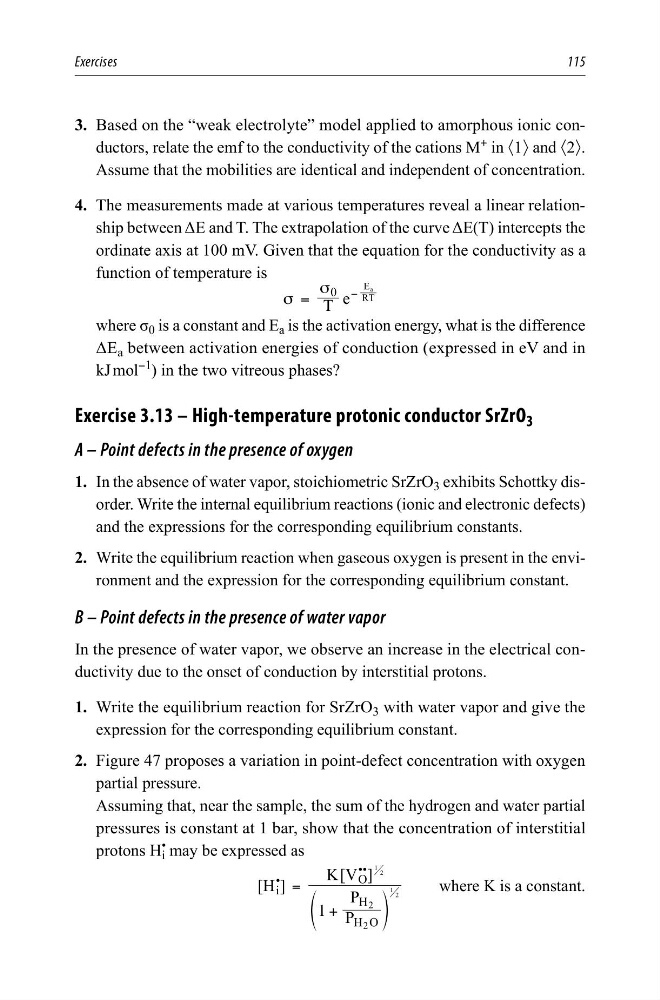
2. Figure 47 proposes a variation in point-defect concentration with oxygen
partial pressure.
Assuming that, near the sample, the sum of the hydrogen and water partial
pressures is constant at 1 bar, show that the concentration of interstitial
protons H
•
i may be expressed as
[ ]
[ ]
H
P
P
K V
1
i
H O
H
O
•
••
2
2
1 2
1 2
=
+
e
o
where K is a constant.
115
3. Based on the “weak electrolyte” model applied to amorphous ionic conductors, relate the emf to the conductivity of the cations M
+
in G1H and G2H.
Assume that the mobilities are identical and independent of concentration.
4. The measurements made at various temperatures reveal a linear relationship between ΔE and T. The extrapolation of the curve ΔE(T) intercepts the
ordinate axis at 100 mV. Given that the equation for the conductivity as a
function of temperature is
T e
0
RT
E a
σ
σ
=
−
where σ 0 is a constant and E a is the activation energy, what is the difference
ΔE a between activation energies of conduction (expressed in eV and in
kJ mol
−1
) in the two vitreous phases?
Exercise 3.13 – High-temperature protonic conductor SrZrO 3
A – Point defects in the presence of oxygen
1. In the absence of water vapor, stoichiometric SrZrO 3 exhibits Schottky disorder. Write the internal equilibrium reactions (ionic and electronic defects)
and the expressions for the corresponding equilibrium constants.
2. Write the equilibrium reaction when gaseous oxygen is present in the environment and the expression for the corresponding equilibrium constant.
B – Point defects in the presence of water vapor
In the presence of water vapor, we observe an increase in the electrical conductivity due to the onset of conduction by interstitial protons.
1. Write the equilibrium reaction for SrZrO 3 with water vapor and give the
expression for the corresponding equilibrium constant.
2. Figure 47 proposes a variation in point-defect concentration with oxygen
partial pressure.
Assuming that, near the sample, the sum of the hydrogen and water partial
pressures is constant at 1 bar, show that the concentration of interstitial
protons H
•
i may be expressed as
[ ]
[ ]
H
P
P
K V
1
i
H O
H
O
•
••
2
2
1 2
1 2
=
+
e
o
where K is a constant.