

108
3 – Transport in ionic solids
a. calculate the concentration of potassium vacancies, V ′
K , in a pure crystal
at 440 °C;
b. deduce the cationic conductivity;
c. calculate the enthalpy of formation of Schottky pair.
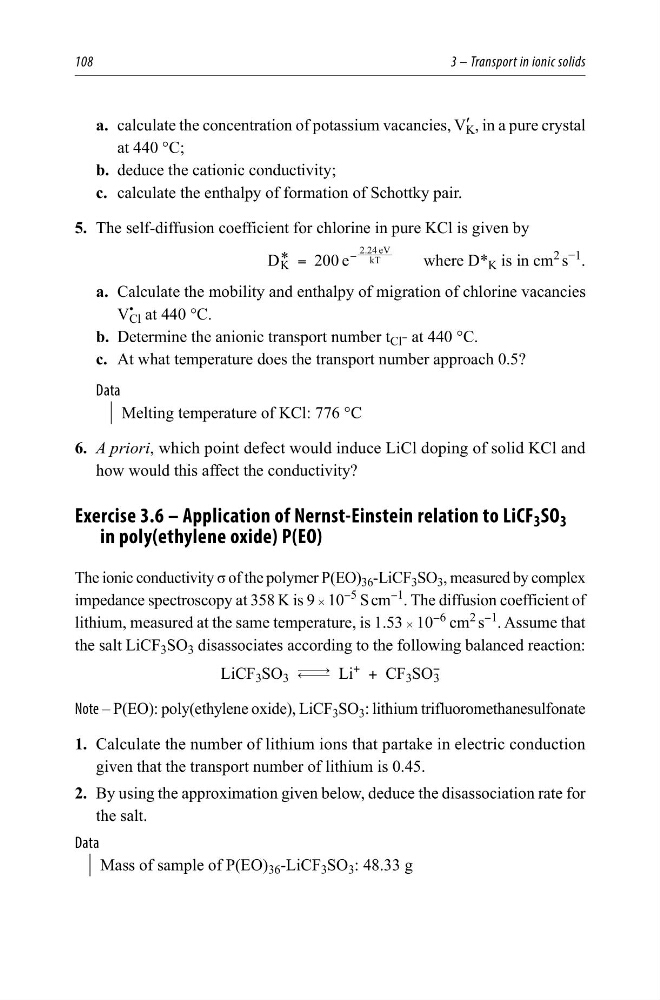
5. The self-diffusion coefficient for chlorine in pure KCl is given by
D
e
200
K
.
kT
eV
2 24
=
−
*
where D* K is in cm
2
s
−1
.
a. Calculate the mobility and enthalpy of migration of chlorine vacancies
V
•
Cl at 440 °C.
b. Determine the anionic transport number t Cl
− at 440 °C.
c. At what temperature does the transport number approach 0.5?
Data
Melting temperature of KCl: 776 °C
6. A priori, which point defect would induce LiCl doping of solid KCl and
how would this affect the conductivity?
Exercise 3.6 – Application of Nernst-Einstein relation to LiCF 3 SO 3
in poly(ethylene oxide) P(EO)
The ionic conductivity σ of the polymer P(EO) 36 -LiCF 3 SO 3 , measured by complex
impedance spectroscopy at 358 K is 9 # 10
−5
S cm
−1
. The diffusion coefficient of
lithium, measured at the same temperature, is 1.53 # 10
−6
cm
2
s
−1
. Assume that
the salt LiCF 3 SO 3 disassociates according to the following balanced reaction:
LiCF 3 SO 3 m Li
+ + CF 3 SO
−
3
Note – P(EO): poly(ethylene oxide), LiCF 3 SO 3 : lithium trifluoromethanesulfonate
1. Calculate the number of lithium ions that partake in electric conduction
given that the transport number of lithium is 0.45.
2. By using the approximation given below, deduce the disassociation rate for
the salt.
Data
Mass of sample of P(EO) 36 -LiCF 3 SO 3 : 48.33 g
3 – Transport in ionic solids
a. calculate the concentration of potassium vacancies, V ′
K , in a pure crystal
at 440 °C;
b. deduce the cationic conductivity;
c. calculate the enthalpy of formation of Schottky pair.
5. The self-diffusion coefficient for chlorine in pure KCl is given by
D
e
200
K
.
kT
eV
2 24
=
−
*
where D* K is in cm
2
s
−1
.
a. Calculate the mobility and enthalpy of migration of chlorine vacancies
V
•
Cl at 440 °C.
b. Determine the anionic transport number t Cl
− at 440 °C.
c. At what temperature does the transport number approach 0.5?
Data
Melting temperature of KCl: 776 °C
6. A priori, which point defect would induce LiCl doping of solid KCl and
how would this affect the conductivity?
Exercise 3.6 – Application of Nernst-Einstein relation to LiCF 3 SO 3
in poly(ethylene oxide) P(EO)
The ionic conductivity σ of the polymer P(EO) 36 -LiCF 3 SO 3 , measured by complex
impedance spectroscopy at 358 K is 9 # 10
−5
S cm
−1
. The diffusion coefficient of
lithium, measured at the same temperature, is 1.53 # 10
−6
cm
2
s
−1
. Assume that
the salt LiCF 3 SO 3 disassociates according to the following balanced reaction:
LiCF 3 SO 3 m Li
+ + CF 3 SO
−
3
Note – P(EO): poly(ethylene oxide), LiCF 3 SO 3 : lithium trifluoromethanesulfonate
1. Calculate the number of lithium ions that partake in electric conduction
given that the transport number of lithium is 0.45.
2. By using the approximation given below, deduce the disassociation rate for
the salt.
Data
Mass of sample of P(EO) 36 -LiCF 3 SO 3 : 48.33 g