

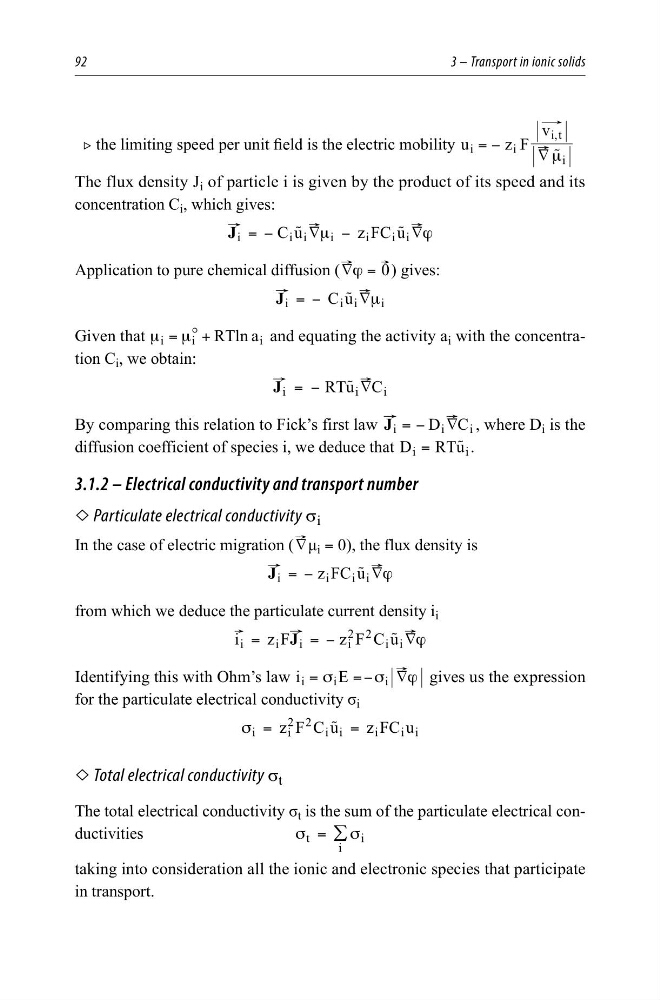
92
3 – Transport in ionic solids
2 the limiting speed per unit field is the electric mobility u
z F
v
i
i
i
i,t
d μ
= −
u
The flux density J i of particle i is given by the product of its speed and its
concentration C i , which gives:
C u
z FC u
J i
i i
i
i
i i
d
d
μ
ϕ
= −
−
u
u
Application to pure chemical diffusion (
0
dϕ = ) gives:
C u
J i
i i
i
dμ
= −
u
Given that
RTln a
i
i
i
μ μ
= +
°
and equating the activity a i with the concentration C i , we obtain:
RTu C
J i
i
i
d
= −
u
By comparing this relation to Fick’s first law
D C
J i
i
i
d
= −
, where D i is the
diffusion coefficient of species i, we deduce that
.
D RTu
i
i
=
u
3.1.2 – Electrical conductivity and transport number
L Particulate electrical conductivity σ i
In the case of electric migration (d μ i = 0), the flux density is
z FC u
J i
i
i i dϕ
= −
u
from which we deduce the particulate current density i i
J
i
z F
z F C u
i
i
i
i
2 2 i i dϕ
=
= −
u
Identifying this with Ohm’s law i
E
i
i
i d
σ
σ ϕ
=
=−
gives us the expression
for the particulate electrical conductivity σ i
z F C u
z FC u
i
i
2 2 i i
i
i i
σ =
=
u
L Total electrical conductivity σ t
The total electrical conductivity σ t is the sum of the particulate electrical conductivities
t
i
i
σ
σ
= /
taking into consideration all the ionic and electronic species that participate
in transport.
3 – Transport in ionic solids
2 the limiting speed per unit field is the electric mobility u
z F
v
i
i
i
i,t
d μ
= −
u
The flux density J i of particle i is given by the product of its speed and its
concentration C i , which gives:
C u
z FC u
J i
i i
i
i
i i
d
d
μ
ϕ
= −
−
u
u
Application to pure chemical diffusion (
0
dϕ = ) gives:
C u
J i
i i
i
dμ
= −
u
Given that
RTln a
i
i
i
μ μ
= +
°
and equating the activity a i with the concentration C i , we obtain:
RTu C
J i
i
i
d
= −
u
By comparing this relation to Fick’s first law
D C
J i
i
i
d
= −
, where D i is the
diffusion coefficient of species i, we deduce that
.
D RTu
i
i
=
u
3.1.2 – Electrical conductivity and transport number
L Particulate electrical conductivity σ i
In the case of electric migration (d μ i = 0), the flux density is
z FC u
J i
i
i i dϕ
= −
u
from which we deduce the particulate current density i i
J
i
z F
z F C u
i
i
i
i
2 2 i i dϕ
=
= −
u
Identifying this with Ohm’s law i
E
i
i
i d
σ
σ ϕ
=
=−
gives us the expression
for the particulate electrical conductivity σ i
z F C u
z FC u
i
i
2 2 i i
i
i i
σ =
=
u
L Total electrical conductivity σ t
The total electrical conductivity σ t is the sum of the particulate electrical conductivities
t
i
i
σ
σ
= /
taking into consideration all the ionic and electronic species that participate
in transport.