

88
2 – Methods and techniques
2 electronic current i
F
F
e
e
e
d
d
σ
μ
ϕ
=
−
^
h
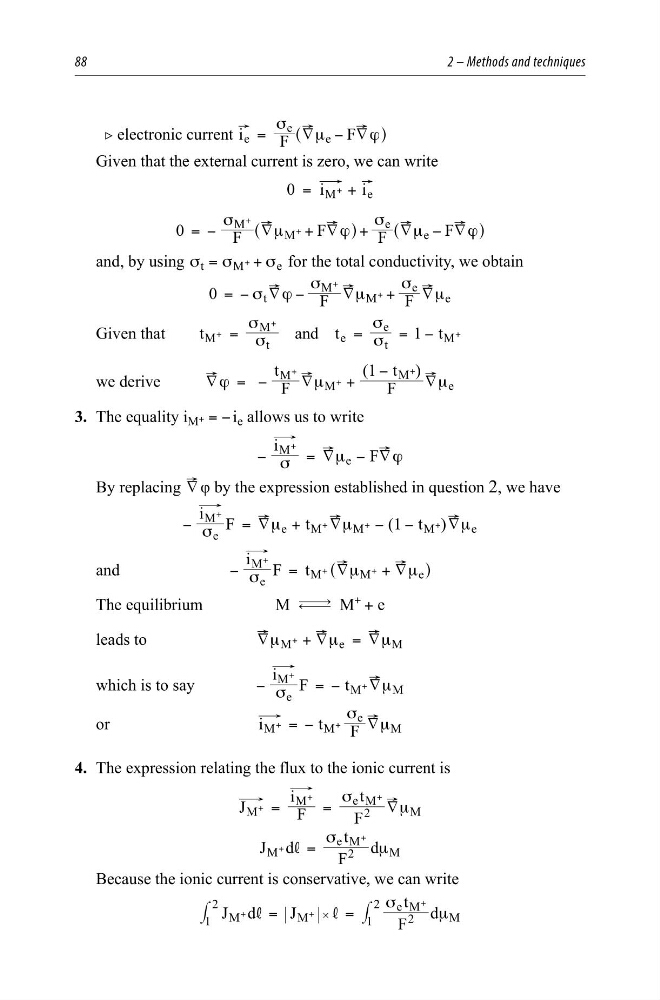
Given that the external current is zero, we can write
i
i
0
M
e
=
+
+
0
F
F
F
F
M
M
e
e
d
d
d
d
σ
μ
ϕ
σ
μ
ϕ
= −
+
+
−
+
+
^
^
h
h
and, by using t
M
e
σ σ
σ
=
+
+
for the total conductivity, we obtain
0
F
F
t
M
M
e
e
d
d
d
σ ϕ
σ
μ
σ μ
= −
−
+
+
+
Given that
t
a nd t
1 t
M
t
M
e
t
e
M
σ
σ
σ
σ
=
=
= −
+
+
+
we derive
F
t
F
(1 t )
M
M
M
e
d
d
d
ϕ
μ
μ
= −
+
−
+
+
+
3. The equality i M + = − i e allows us to write
i
F
M
e
d
d
σ
μ
ϕ
−
=
−
+
By replacing d φ by the expression established in question 2, we have
i F
t
(1 t )
e
M
e
M
M
M
e
d
d
d
σ
μ
μ
μ
−
=
+
− −
+
+
+
+
and
i F t
e
M
M
M
e
d
d
σ
μ
μ
−
=
+
+
+
+
^
h
The equilibrium
M m M
+ + e
leads to
M
e
M
d
d
d
μ
μ
μ
+
=
+
which is to say
i F
t
e
M
M
M
d
σ
μ
−
= −
+
+
or
i
t
F
M
M
e
M
d
σ μ
= −
+
+
4. The expression relating the flux to the ionic current is
J
F
i
F
t
M
M
2
e M
M
d
σ
μ
=
=
+
+
+
J d
F
t d
M
2
e M
M
,
σ
μ
=
+
+
Because the ionic current is conservative, we can write
J d
J
F
t d
M
1
2
M
2
e M
1
2
M
,
,
σ
μ
=
=
#
+
+
+
#
#
2 – Methods and techniques
2 electronic current i
F
F
e
e
e
d
d
σ
μ
ϕ
=
−
^
h
Given that the external current is zero, we can write
i
i
0
M
e
=
+
+
0
F
F
F
F
M
M
e
e
d
d
d
d
σ
μ
ϕ
σ
μ
ϕ
= −
+
+
−
+
+
^
^
h
h
and, by using t
M
e
σ σ
σ
=
+
+
for the total conductivity, we obtain
0
F
F
t
M
M
e
e
d
d
d
σ ϕ
σ
μ
σ μ
= −
−
+
+
+
Given that
t
a nd t
1 t
M
t
M
e
t
e
M
σ
σ
σ
σ
=
=
= −
+
+
+
we derive
F
t
F
(1 t )
M
M
M
e
d
d
d
ϕ
μ
μ
= −
+
−
+
+
+
3. The equality i M + = − i e allows us to write
i
F
M
e
d
d
σ
μ
ϕ
−
=
−
+
By replacing d φ by the expression established in question 2, we have
i F
t
(1 t )
e
M
e
M
M
M
e
d
d
d
σ
μ
μ
μ
−
=
+
− −
+
+
+
+
and
i F t
e
M
M
M
e
d
d
σ
μ
μ
−
=
+
+
+
+
^
h
The equilibrium
M m M
+ + e
leads to
M
e
M
d
d
d
μ
μ
μ
+
=
+
which is to say
i F
t
e
M
M
M
d
σ
μ
−
= −
+
+
or
i
t
F
M
M
e
M
d
σ μ
= −
+
+
4. The expression relating the flux to the ionic current is
J
F
i
F
t
M
M
2
e M
M
d
σ
μ
=
=
+
+
+
J d
F
t d
M
2
e M
M
,
σ
μ
=
+
+
Because the ionic current is conservative, we can write
J d
J
F
t d
M
1
2
M
2
e M
1
2
M
,
,
σ
μ
=
=
#
+
+
+
#
#