

81
2.5. Axial symmetry
section we discuss the field aberrations individually.
The aberrations represented by the terms proportional to C and
c in (2.216, 2.217) represent isotropic astigmatism and anisotropic
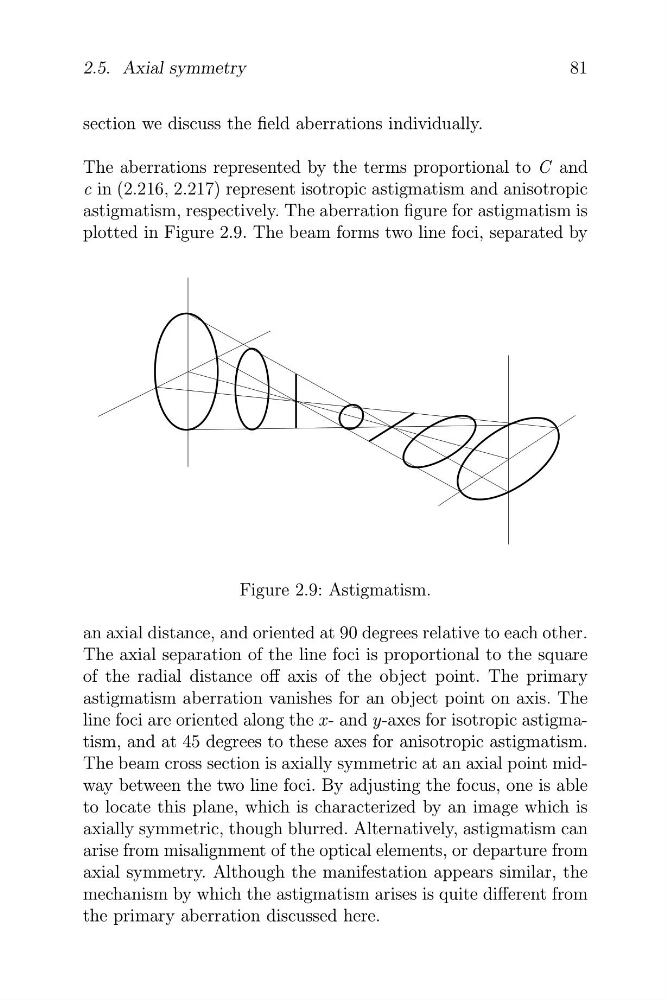
astigmatism, respectively. The aberration figure for astigmatism is
plotted in Figure 2.9. The beam forms two line foci, separated by
Figure 2.9: Astigmatism.
an axial distance, and oriented at 90 degrees relative to each other.
The axial separation of the line foci is proportional to the square
of the radial distance off axis of the object point. The primary
astigmatism aberration vanishes for an object point on axis. The
line foci are oriented along the x- and y-axes for isotropic astigmatism, and at 45 degrees to these axes for anisotropic astigmatism.
The beam cross section is axially symmetric at an axial point midway between the two line foci. By adjusting the focus, one is able
to locate this plane, which is characterized by an image which is
axially symmetric, though blurred. Alternatively, astigmatism can
arise from misalignment of the optical elements, or departure from
axial symmetry. Although the manifestation appears similar, the
mechanism by which the astigmatism arises is quite different from
the primary aberration discussed here.
2.5. Axial symmetry
section we discuss the field aberrations individually.
The aberrations represented by the terms proportional to C and
c in (2.216, 2.217) represent isotropic astigmatism and anisotropic
astigmatism, respectively. The aberration figure for astigmatism is
plotted in Figure 2.9. The beam forms two line foci, separated by
Figure 2.9: Astigmatism.
an axial distance, and oriented at 90 degrees relative to each other.
The axial separation of the line foci is proportional to the square
of the radial distance off axis of the object point. The primary
astigmatism aberration vanishes for an object point on axis. The
line foci are oriented along the x- and y-axes for isotropic astigmatism, and at 45 degrees to these axes for anisotropic astigmatism.
The beam cross section is axially symmetric at an axial point midway between the two line foci. By adjusting the focus, one is able
to locate this plane, which is characterized by an image which is
axially symmetric, though blurred. Alternatively, astigmatism can
arise from misalignment of the optical elements, or departure from
axial symmetry. Although the manifestation appears similar, the
mechanism by which the astigmatism arises is quite different from
the primary aberration discussed here.