

�
�
�
�
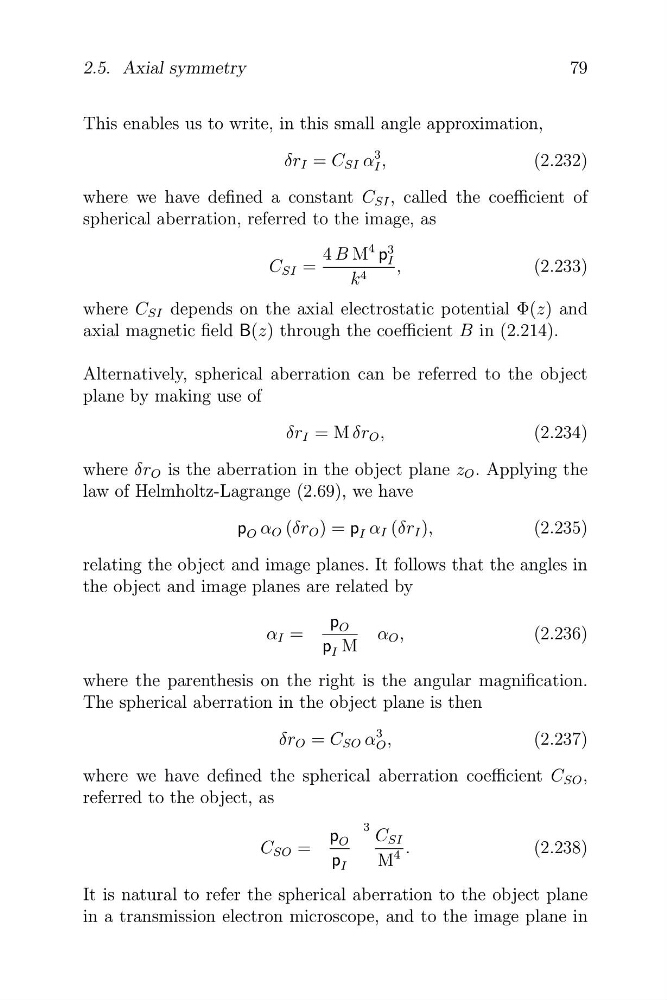
This enables us to write, in this small angle approximation,
δr I = C SI α I
3 ,
(2.232)
where we have defined a constant C SI , called the coefficient of
spherical aberration, referred to the image, as
4 B M
4 p I
3
C SI =
,
(2.233)
k 4
where C SI depends on the axial electrostatic potential Φ(z) and
axial magnetic field B(z) through the coefficient B in (2.214).
Alternatively, spherical aberration can be referred to the object
plane by making use of
δr I = M δr O ,
(2.234)
where δr O is the aberration in the object plane z O . Applying the
law of Helmholtz-Lagrange (2.69), we have
p O α O (δr O ) = p I α I (δr I ),
(2.235)
relating the object and image planes. It follows that the angles in
the object and image planes are related by
p O
α I =
α O ,
(2.236)
p I M
where the parenthesis on the right is the angular magnification.
The spherical aberration in the object plane is then
δr O = C SO α
3
(2.237)
O ,
where we have defined the spherical aberration coefficient C SO ,
referred to the object, as
C SO =
p O
p I
3 C SI
M
4 .
(2.238)
It is natural to refer the spherical aberration to the object plane
in a transmission electron microscope, and to the image plane in
79
2.5. Axial symmetry
�
�
�
This enables us to write, in this small angle approximation,
δr I = C SI α I
3 ,
(2.232)
where we have defined a constant C SI , called the coefficient of
spherical aberration, referred to the image, as
4 B M
4 p I
3
C SI =
,
(2.233)
k 4
where C SI depends on the axial electrostatic potential Φ(z) and
axial magnetic field B(z) through the coefficient B in (2.214).
Alternatively, spherical aberration can be referred to the object
plane by making use of
δr I = M δr O ,
(2.234)
where δr O is the aberration in the object plane z O . Applying the
law of Helmholtz-Lagrange (2.69), we have
p O α O (δr O ) = p I α I (δr I ),
(2.235)
relating the object and image planes. It follows that the angles in
the object and image planes are related by
p O
α I =
α O ,
(2.236)
p I M
where the parenthesis on the right is the angular magnification.
The spherical aberration in the object plane is then
δr O = C SO α
3
(2.237)
O ,
where we have defined the spherical aberration coefficient C SO ,
referred to the object, as
C SO =
p O
p I
3 C SI
M
4 .
(2.238)
It is natural to refer the spherical aberration to the object plane
in a transmission electron microscope, and to the image plane in
79
2.5. Axial symmetry