

+ −
1
4
B
u
�
uu
� )
i (¯ u − ¯
� 2 � 2
+ −
1
8
p u ¯ u
+ −
1
8
p
−1 Φ
�� (1 + Φ) ¯ u
� �
uu¯ u
1
1
−3 Φ
�� 2
2 2
+
p
−1 Φ
IV (1 + Φ) − p
u ¯ u
64
32
1 B
��
�
+ 32
i (¯ u − ¯
� ) ¯
uu
u
uu
+ . . . ,
(2.151)
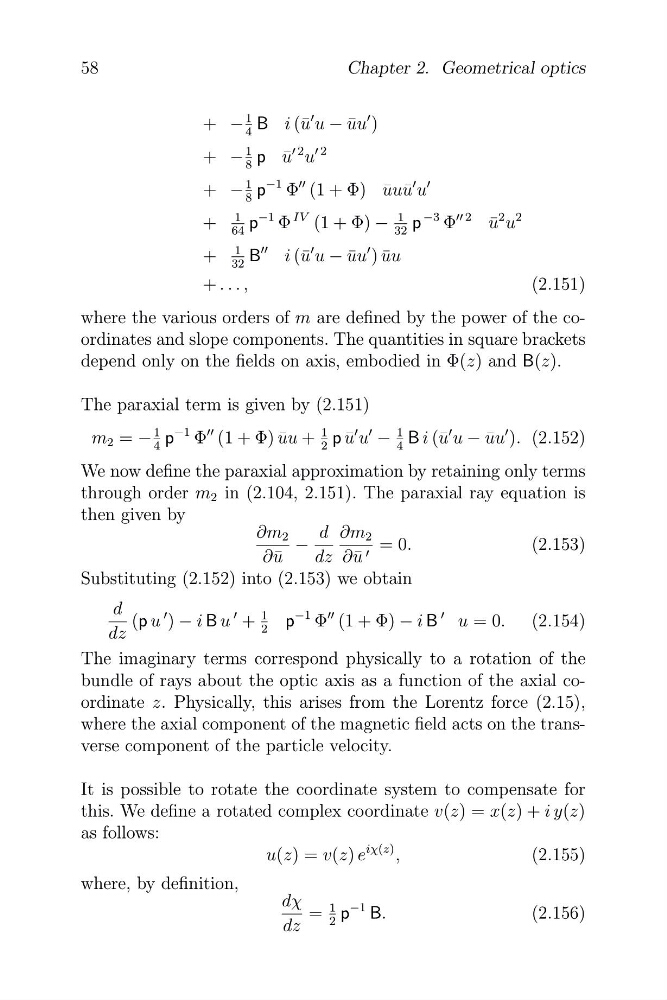
where the various orders of m are defined by the power of the coordinates and slope components. The quantities in square brackets
depend only on the fields on axis, embodied in Φ(z) and B(z).
The paraxial term is given by (2.151)
1
�
�
m 2 = −
1 p
−1 Φ
�� (1 + Φ) ¯
u u
� −
1 B i (¯ u u − ¯
� ). (2.152)
uu + p ¯
uu
4
2
4
We now define the paraxial approximation by retaining only terms
through order m 2 in (2.104, 2.151). The paraxial ray equation is
then given by
∂m 2
d ∂m 2
−
�
= 0.
(2.153)
∂u ¯
dz ∂u ¯
Substituting (2.152) into (2.153) we obtain
d (p u
� ) − i B u
� +
1
2
p
−1 Φ
�� (1 + Φ) − i B
� u = 0. (2.154)
dz
The imaginary terms correspond physically to a rotation of the
bundle of rays about the optic axis as a function of the axial coordinate z. Physically, this arises from the Lorentz force (2.15),
where the axial component of the magnetic field acts on the transverse component of the particle velocity.
It is possible to rotate the coordinate system to compensate for
this. We define a rotated complex coordinate v(z) = x(z) + i y(z)
as follows:
iχ(z)
u(z) = v(z) e
,
(2.155)
where, by definition,
−1 B.
dχ =
1
2
p
(2.156)
dz
58
Chapter 2. Geometrical optics
1
4
B
u
�
uu
� )
i (¯ u − ¯
� 2 � 2
+ −
1
8
p u ¯ u
+ −
1
8
p
−1 Φ
�� (1 + Φ) ¯ u
� �
uu¯ u
1
1
−3 Φ
�� 2
2 2
+
p
−1 Φ
IV (1 + Φ) − p
u ¯ u
64
32
1 B
��
�
+ 32
i (¯ u − ¯
� ) ¯
uu
u
uu
+ . . . ,
(2.151)
where the various orders of m are defined by the power of the coordinates and slope components. The quantities in square brackets
depend only on the fields on axis, embodied in Φ(z) and B(z).
The paraxial term is given by (2.151)
1
�
�
m 2 = −
1 p
−1 Φ
�� (1 + Φ) ¯
u u
� −
1 B i (¯ u u − ¯
� ). (2.152)
uu + p ¯
uu
4
2
4
We now define the paraxial approximation by retaining only terms
through order m 2 in (2.104, 2.151). The paraxial ray equation is
then given by
∂m 2
d ∂m 2
−
�
= 0.
(2.153)
∂u ¯
dz ∂u ¯
Substituting (2.152) into (2.153) we obtain
d (p u
� ) − i B u
� +
1
2
p
−1 Φ
�� (1 + Φ) − i B
� u = 0. (2.154)
dz
The imaginary terms correspond physically to a rotation of the
bundle of rays about the optic axis as a function of the axial coordinate z. Physically, this arises from the Lorentz force (2.15),
where the axial component of the magnetic field acts on the transverse component of the particle velocity.
It is possible to rotate the coordinate system to compensate for
this. We define a rotated complex coordinate v(z) = x(z) + i y(z)
as follows:
iχ(z)
u(z) = v(z) e
,
(2.155)
where, by definition,
−1 B.
dχ =
1
2
p
(2.156)
dz
58
Chapter 2. Geometrical optics