

49
2.4. General curvilinear axis
Physically, this means that the transverse component of canonical momentum is perpendicular to the contour lines of constant
optical path W ab in any transverse plane. Again, the coordinates
x j (z) and slopes x j
� (z) in (2.104) should be regarded as completely
general. In the following sections it will prove expedient to move
freely between alternative coordinate systems.
2.4.2 Natural units
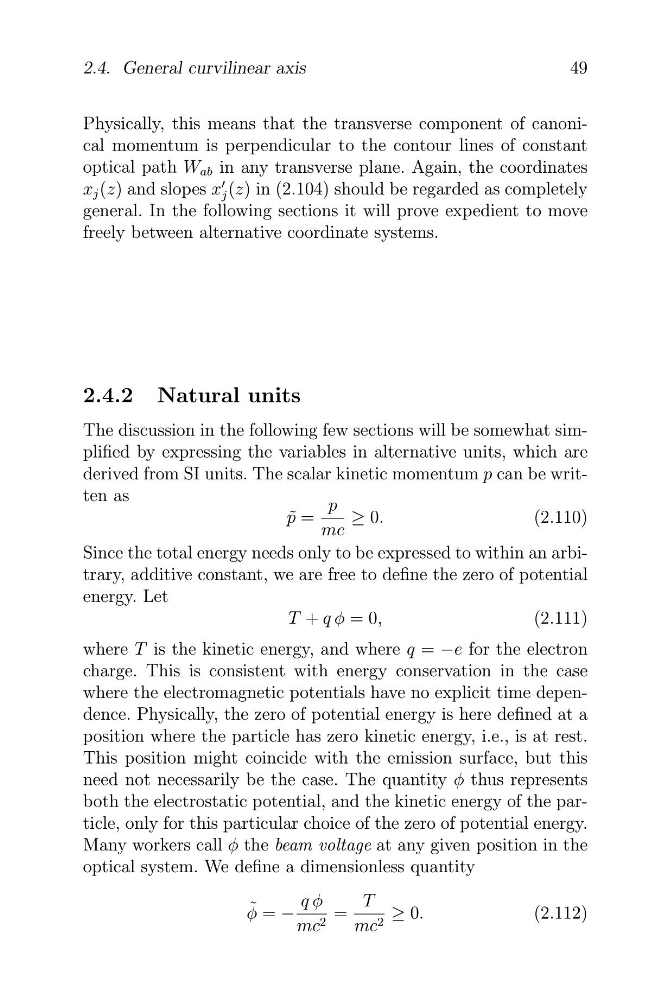
The discussion in the following few sections will be somewhat simplified by expressing the variables in alternative units, which are
derived from SI units. The scalar kinetic momentum p can be written as
p
p ˜ =
≥ 0.
(2.110)
mc
Since the total energy needs only to be expressed to within an arbitrary, additive constant, we are free to define the zero of potential
energy. Let
T + q φ = 0,
(2.111)
where T is the kinetic energy, and where q = −e for the electron
charge. This is consistent with energy conservation in the case
where the electromagnetic potentials have no explicit time dependence. Physically, the zero of potential energy is here defined at a
position where the particle has zero kinetic energy, i.e., is at rest.
This position might coincide with the emission surface, but this
need not necessarily be the case. The quantity φ thus represents
both the electrostatic potential, and the kinetic energy of the particle, only for this particular choice of the zero of potential energy.
Many workers call φ the beam voltage at any given position in the
optical system. We define a dimensionless quantity
q φ
T
˜
φ = − 2 =
2
≥ 0.
(2.112)
mc
mc
2.4. General curvilinear axis
Physically, this means that the transverse component of canonical momentum is perpendicular to the contour lines of constant
optical path W ab in any transverse plane. Again, the coordinates
x j (z) and slopes x j
� (z) in (2.104) should be regarded as completely
general. In the following sections it will prove expedient to move
freely between alternative coordinate systems.
2.4.2 Natural units
The discussion in the following few sections will be somewhat simplified by expressing the variables in alternative units, which are
derived from SI units. The scalar kinetic momentum p can be written as
p
p ˜ =
≥ 0.
(2.110)
mc
Since the total energy needs only to be expressed to within an arbitrary, additive constant, we are free to define the zero of potential
energy. Let
T + q φ = 0,
(2.111)
where T is the kinetic energy, and where q = −e for the electron
charge. This is consistent with energy conservation in the case
where the electromagnetic potentials have no explicit time dependence. Physically, the zero of potential energy is here defined at a
position where the particle has zero kinetic energy, i.e., is at rest.
This position might coincide with the emission surface, but this
need not necessarily be the case. The quantity φ thus represents
both the electrostatic potential, and the kinetic energy of the particle, only for this particular choice of the zero of potential energy.
Many workers call φ the beam voltage at any given position in the
optical system. We define a dimensionless quantity
q φ
T
˜
φ = − 2 =
2
≥ 0.
(2.112)
mc
mc