

�
�
31
2.1. Relativistic classical mechanics
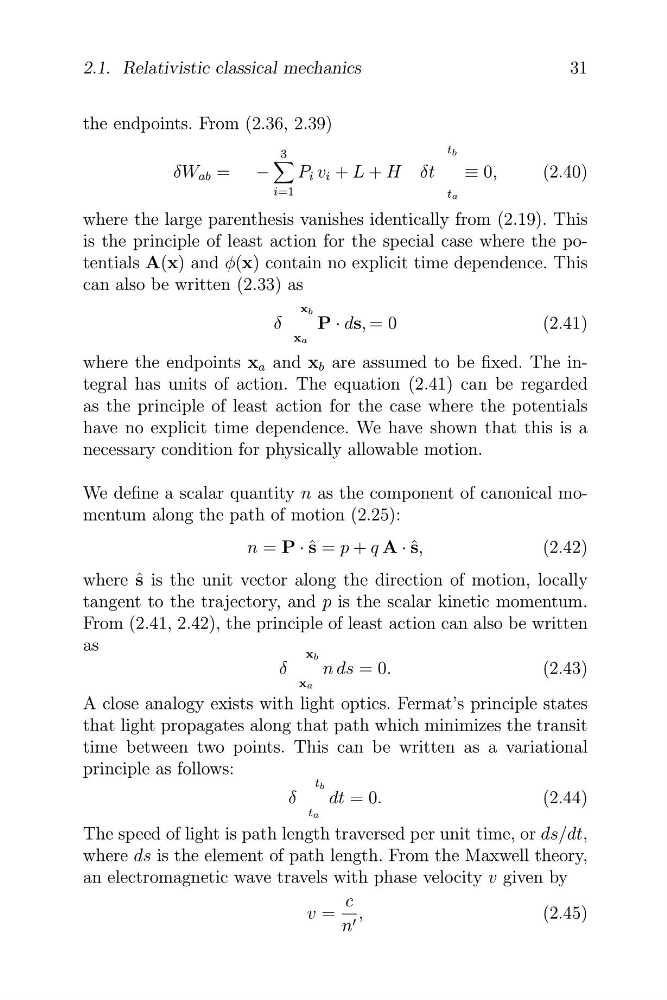
the endpoints. From (2.36, 2.39)
t b
3
4
δW ab = −
P i v i + L + H δt
≡ 0,
(2.40)
i=1
ta
where the large parenthesis vanishes identically from (2.19). This
is the principle of least action for the special case where the potentials A(x) and φ(x) contain no explicit time dependence. This
can also be written (2.33) as
x b
δ
P · ds, = 0
(2.41)
xa
where the endpoints x a and x b are assumed to be fixed. The integral has units of action. The equation (2.41) can be regarded
as the principle of least action for the case where the potentials
have no explicit time dependence. We have shown that this is a
necessary condition for physically allowable motion.
We define a scalar quantity n as the component of canonical momentum along the path of motion (2.25):
n = P · ˆ s = p + q A · ˆ s,
(2.42)
where ˆ s is the unit vector along the direction of motion, locally
tangent to the trajectory, and p is the scalar kinetic momentum.
From (2.41, 2.42), the principle of least action can also be written
as
x b
δ
n ds = 0.
(2.43)
xa
A close analogy exists with light optics. Fermat’s principle states
that light propagates along that path which minimizes the transit
time between two points. This can be written as a variational
principle as follows:
t b
δ
dt = 0.
(2.44)
ta
The speed of light is path length traversed per unit time, or ds/dt,
where ds is the element of path length. From the Maxwell theory,
an electromagnetic wave travels with phase velocity v given by
c
v = � ,
(2.45)
n
�
31
2.1. Relativistic classical mechanics
the endpoints. From (2.36, 2.39)
t b
3
4
δW ab = −
P i v i + L + H δt
≡ 0,
(2.40)
i=1
ta
where the large parenthesis vanishes identically from (2.19). This
is the principle of least action for the special case where the potentials A(x) and φ(x) contain no explicit time dependence. This
can also be written (2.33) as
x b
δ
P · ds, = 0
(2.41)
xa
where the endpoints x a and x b are assumed to be fixed. The integral has units of action. The equation (2.41) can be regarded
as the principle of least action for the case where the potentials
have no explicit time dependence. We have shown that this is a
necessary condition for physically allowable motion.
We define a scalar quantity n as the component of canonical momentum along the path of motion (2.25):
n = P · ˆ s = p + q A · ˆ s,
(2.42)
where ˆ s is the unit vector along the direction of motion, locally
tangent to the trajectory, and p is the scalar kinetic momentum.
From (2.41, 2.42), the principle of least action can also be written
as
x b
δ
n ds = 0.
(2.43)
xa
A close analogy exists with light optics. Fermat’s principle states
that light propagates along that path which minimizes the transit
time between two points. This can be written as a variational
principle as follows:
t b
δ
dt = 0.
(2.44)
ta
The speed of light is path length traversed per unit time, or ds/dt,
where ds is the element of path length. From the Maxwell theory,
an electromagnetic wave travels with phase velocity v given by
c
v = � ,
(2.45)
n