

28
Chapter 2. Geometrical optics
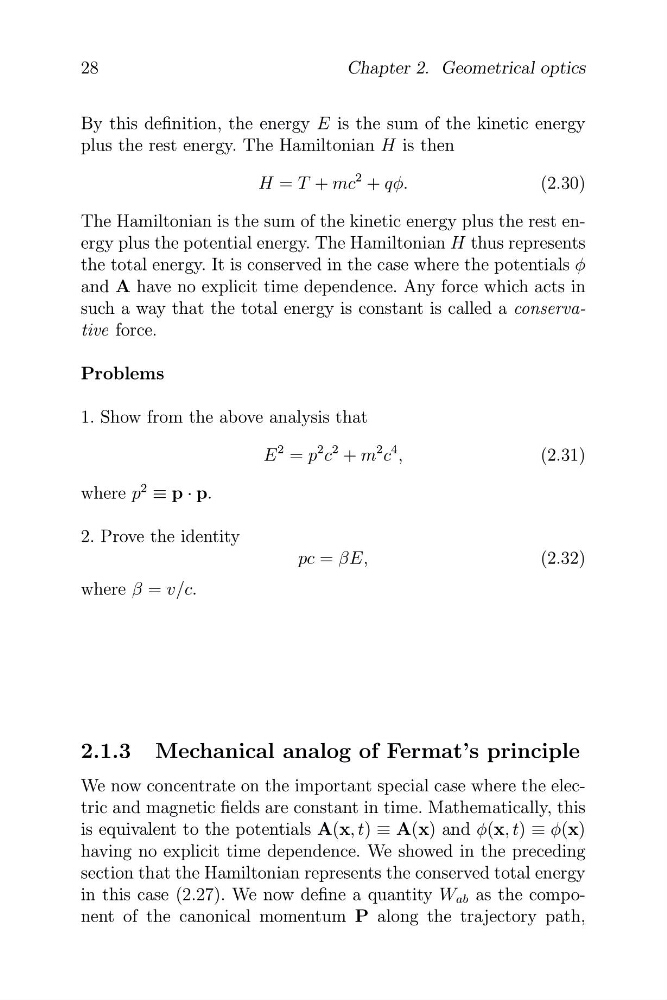
By this definition, the energy E is the sum of the kinetic energy
plus the rest energy. The Hamiltonian H is then
H = T + mc
2 + qφ.
(2.30)
The Hamiltonian is the sum of the kinetic energy plus the rest energy plus the potential energy. The Hamiltonian H thus represents
the total energy. It is conserved in the case where the potentials φ
and A have no explicit time dependence. Any force which acts in
such a way that the total energy is constant is called a conservative force.
Problems
1. Show from the above analysis that
E
2 = p
2 c
2 + m
2 c
4 ,
(2.31)
where p
2 ≡ p · p.
2. Prove the identity
pc = βE,
(2.32)
where β = v/c.
2.1.3 Mechanical analog of Fermat’s principle
We now concentrate on the important special case where the electric and magnetic fields are constant in time. Mathematically, this
is equivalent to the potentials A(x, t) ≡ A(x) and φ(x, t) ≡ φ(x)
having no explicit time dependence. We showed in the preceding
section that the Hamiltonian represents the conserved total energy
in this case (2.27). We now define a quantity W ab as the component of the canonical momentum P along the trajectory path,
Chapter 2. Geometrical optics
By this definition, the energy E is the sum of the kinetic energy
plus the rest energy. The Hamiltonian H is then
H = T + mc
2 + qφ.
(2.30)
The Hamiltonian is the sum of the kinetic energy plus the rest energy plus the potential energy. The Hamiltonian H thus represents
the total energy. It is conserved in the case where the potentials φ
and A have no explicit time dependence. Any force which acts in
such a way that the total energy is constant is called a conservative force.
Problems
1. Show from the above analysis that
E
2 = p
2 c
2 + m
2 c
4 ,
(2.31)
where p
2 ≡ p · p.
2. Prove the identity
pc = βE,
(2.32)
where β = v/c.
2.1.3 Mechanical analog of Fermat’s principle
We now concentrate on the important special case where the electric and magnetic fields are constant in time. Mathematically, this
is equivalent to the potentials A(x, t) ≡ A(x) and φ(x, t) ≡ φ(x)
having no explicit time dependence. We showed in the preceding
section that the Hamiltonian represents the conserved total energy
in this case (2.27). We now define a quantity W ab as the component of the canonical momentum P along the trajectory path,