

�
�
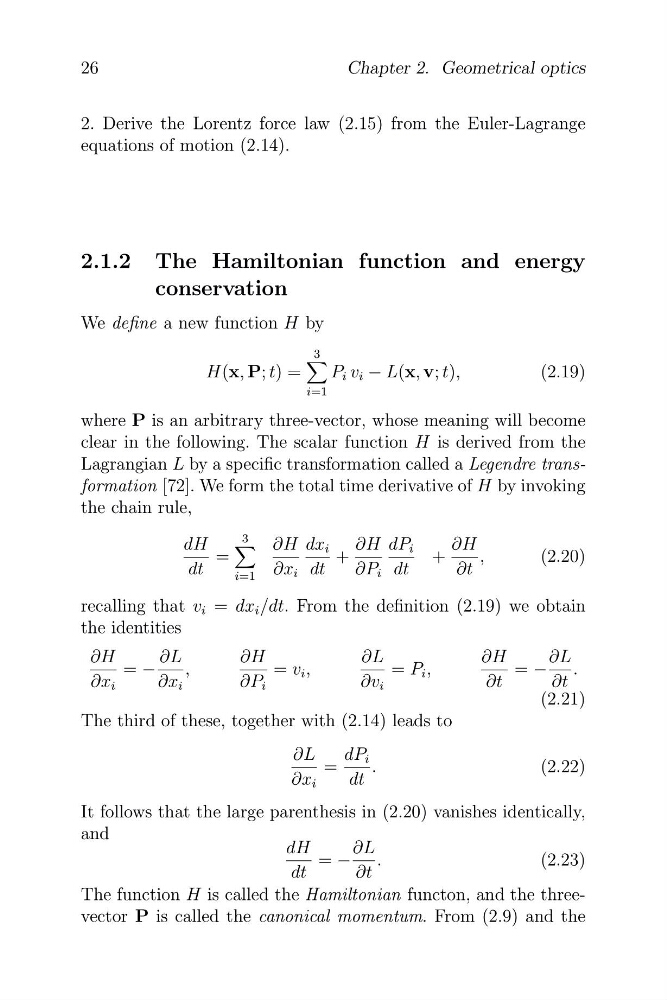
2.1.2 The Hamiltonian function and energy
conservation
We define a new function H by
3
4
H(x, P; t) =
P i v i − L(x, v; t),
(2.19)
i=1
where P is an arbitrary three-vector, whose meaning will become
clear in the following. The scalar function H is derived from the
Lagrangian L by a specific transformation called a Legendre transformation [72]. We form the total time derivative of H by invoking
the chain rule,
4
dH
3
∂H dx i ∂H dP i
∂H
=
+
+
,
(2.20)
dt
i=1 ∂x i dt
∂P i dt
∂t
recalling that v i = dx i /dt. From the definition (2.19) we obtain
the identities
∂H
∂L
∂H
∂L
∂H
∂L
= −
,
= v i ,
= P i ,
= − .
∂x i
∂x i
∂P i
∂v i
∂t
∂t
(2.21)
The third of these, together with (2.14) leads to
∂L
dP i
=
.
(2.22)
∂x i
dt
It follows that the large parenthesis in (2.20) vanishes identically,
and
dH
∂L
= − .
(2.23)
dt
∂t
The function H is called the Hamiltonian functon, and the threevector P is called the canonical momentum. From (2.9) and the
26
Chapter 2. Geometrical optics
2. Derive the Lorentz force law (2.15) from the Euler-Lagrange
equations of motion (2.14).
�
2.1.2 The Hamiltonian function and energy
conservation
We define a new function H by
3
4
H(x, P; t) =
P i v i − L(x, v; t),
(2.19)
i=1
where P is an arbitrary three-vector, whose meaning will become
clear in the following. The scalar function H is derived from the
Lagrangian L by a specific transformation called a Legendre transformation [72]. We form the total time derivative of H by invoking
the chain rule,
4
dH
3
∂H dx i ∂H dP i
∂H
=
+
+
,
(2.20)
dt
i=1 ∂x i dt
∂P i dt
∂t
recalling that v i = dx i /dt. From the definition (2.19) we obtain
the identities
∂H
∂L
∂H
∂L
∂H
∂L
= −
,
= v i ,
= P i ,
= − .
∂x i
∂x i
∂P i
∂v i
∂t
∂t
(2.21)
The third of these, together with (2.14) leads to
∂L
dP i
=
.
(2.22)
∂x i
dt
It follows that the large parenthesis in (2.20) vanishes identically,
and
dH
∂L
= − .
(2.23)
dt
∂t
The function H is called the Hamiltonian functon, and the threevector P is called the canonical momentum. From (2.9) and the
26
Chapter 2. Geometrical optics
2. Derive the Lorentz force law (2.15) from the Euler-Lagrange
equations of motion (2.14).