

�
�
�
�
�
�
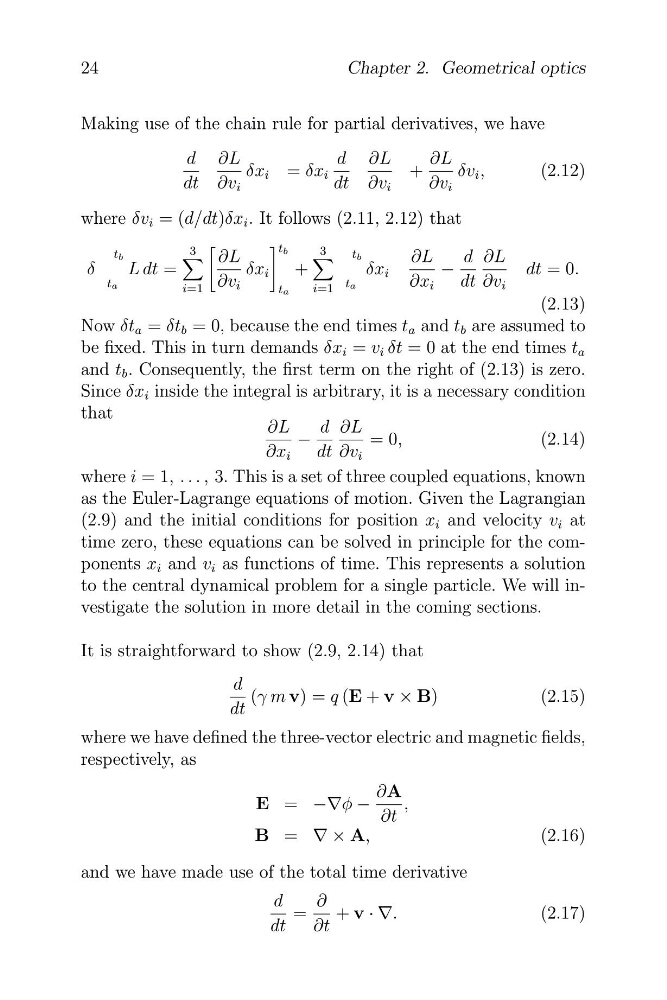
Making use of the chain rule for partial derivatives, we have
d ∂L
d ∂L
∂L
δx i = δx i
+
δv i ,
(2.12)
dt ∂v i
dt ∂v i
∂v i
where δv i = (d/dt)δx i . It follows (2.11, 2.12) that
t b
3
3
t b
4
4 t b
∂L
∂L
d ∂L
δ
L dt =
δx i +
δx i
−
dt = 0.
ta
∂v i
ta
∂x i dt ∂v i
i=1
ta
i=1
(2.13)
Now δt a = δt b = 0, because the end times t a and t b are assumed to
be fixed. This in turn demands δx i = v i δt = 0 at the end times t a
and t b . Consequently, the first term on the right of (2.13) is zero.
Since δx i inside the integral is arbitrary, it is a necessary condition
that
∂L
d ∂L
−
= 0,
(2.14)
∂x i dt ∂v i
where i = 1, . . . , 3. This is a set of three coupled equations, known
as the Euler-Lagrange equations of motion. Given the Lagrangian
(2.9) and the initial conditions for position x i and velocity v i at
time zero, these equations can be solved in principle for the components x i and v i as functions of time. This represents a solution
to the central dynamical problem for a single particle. We will investigate the solution in more detail in the coming sections.
It is straightforward to show (2.9, 2.14) that
d (γ m v) = q (E + v × B)
(2.15)
dt
where we have defined the three-vector electric and magnetic fields,
respectively, as
∂A
E = −vφ −
,
∂t
B = v × A,
(2.16)
and we have made use of the total time derivative
d
∂
=
+ v · v.
(2.17)
dt
∂t
24
Chapter 2. Geometrical optics
�
�
�
�
�
Making use of the chain rule for partial derivatives, we have
d ∂L
d ∂L
∂L
δx i = δx i
+
δv i ,
(2.12)
dt ∂v i
dt ∂v i
∂v i
where δv i = (d/dt)δx i . It follows (2.11, 2.12) that
t b
3
3
t b
4
4 t b
∂L
∂L
d ∂L
δ
L dt =
δx i +
δx i
−
dt = 0.
ta
∂v i
ta
∂x i dt ∂v i
i=1
ta
i=1
(2.13)
Now δt a = δt b = 0, because the end times t a and t b are assumed to
be fixed. This in turn demands δx i = v i δt = 0 at the end times t a
and t b . Consequently, the first term on the right of (2.13) is zero.
Since δx i inside the integral is arbitrary, it is a necessary condition
that
∂L
d ∂L
−
= 0,
(2.14)
∂x i dt ∂v i
where i = 1, . . . , 3. This is a set of three coupled equations, known
as the Euler-Lagrange equations of motion. Given the Lagrangian
(2.9) and the initial conditions for position x i and velocity v i at
time zero, these equations can be solved in principle for the components x i and v i as functions of time. This represents a solution
to the central dynamical problem for a single particle. We will investigate the solution in more detail in the coming sections.
It is straightforward to show (2.9, 2.14) that
d (γ m v) = q (E + v × B)
(2.15)
dt
where we have defined the three-vector electric and magnetic fields,
respectively, as
∂A
E = −vφ −
,
∂t
B = v × A,
(2.16)
and we have made use of the total time derivative
d
∂
=
+ v · v.
(2.17)
dt
∂t
24
Chapter 2. Geometrical optics