

300
Chapter 5. Electron emission from solids
+e is called an image charge, and the attractive force is called
the image force. This was first understood by Nordheim [66]. The
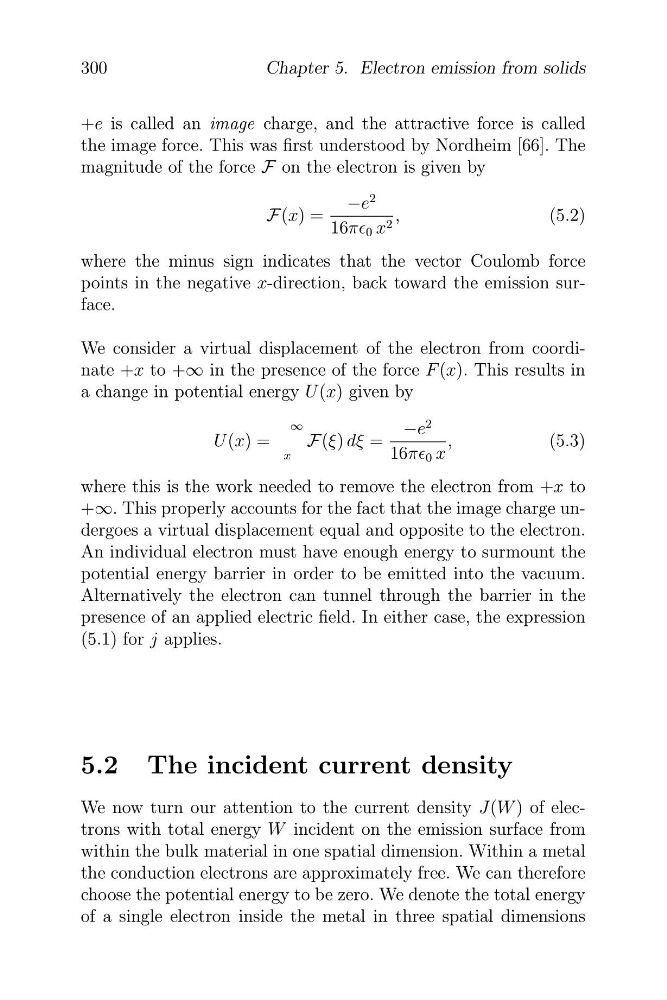
magnitude of the force F on the electron is given by
−e
2
F(x) =
2
,
(5.2)
16πf 0 x
where the minus sign indicates that the vector Coulomb force
points in the negative x-direction, back toward the emission surface.
We consider a virtual displacement of the electron from coordinate +x to +∞ in the presence of the force F (x). This results in
a change in potential energy U (x) given by
∞
−e
2
U (x) =
F(ξ) dξ =
,
(5.3)
x
16πf 0 x
where this is the work needed to remove the electron from +x to
+∞. This properly accounts for the fact that the image charge undergoes a virtual displacement equal and opposite to the electron.
An individual electron must have enough energy to surmount the
potential energy barrier in order to be emitted into the vacuum.
Alternatively the electron can tunnel through the barrier in the
presence of an applied electric field. In either case, the expression
(5.1) for j applies.
5.2 The incident current density
We now turn our attention to the current density J(W ) of electrons with total energy W incident on the emission surface from
within the bulk material in one spatial dimension. Within a metal
the conduction electrons are approximately free. We can therefore
choose the potential energy to be zero. We denote the total energy
of a single electron inside the metal in three spatial dimensions
Chapter 5. Electron emission from solids
+e is called an image charge, and the attractive force is called
the image force. This was first understood by Nordheim [66]. The
magnitude of the force F on the electron is given by
−e
2
F(x) =
2
,
(5.2)
16πf 0 x
where the minus sign indicates that the vector Coulomb force
points in the negative x-direction, back toward the emission surface.
We consider a virtual displacement of the electron from coordinate +x to +∞ in the presence of the force F (x). This results in
a change in potential energy U (x) given by
∞
−e
2
U (x) =
F(ξ) dξ =
,
(5.3)
x
16πf 0 x
where this is the work needed to remove the electron from +x to
+∞. This properly accounts for the fact that the image charge undergoes a virtual displacement equal and opposite to the electron.
An individual electron must have enough energy to surmount the
potential energy barrier in order to be emitted into the vacuum.
Alternatively the electron can tunnel through the barrier in the
presence of an applied electric field. In either case, the expression
(5.1) for j applies.
5.2 The incident current density
We now turn our attention to the current density J(W ) of electrons with total energy W incident on the emission surface from
within the bulk material in one spatial dimension. Within a metal
the conduction electrons are approximately free. We can therefore
choose the potential energy to be zero. We denote the total energy
of a single electron inside the metal in three spatial dimensions