

�
�
�
�
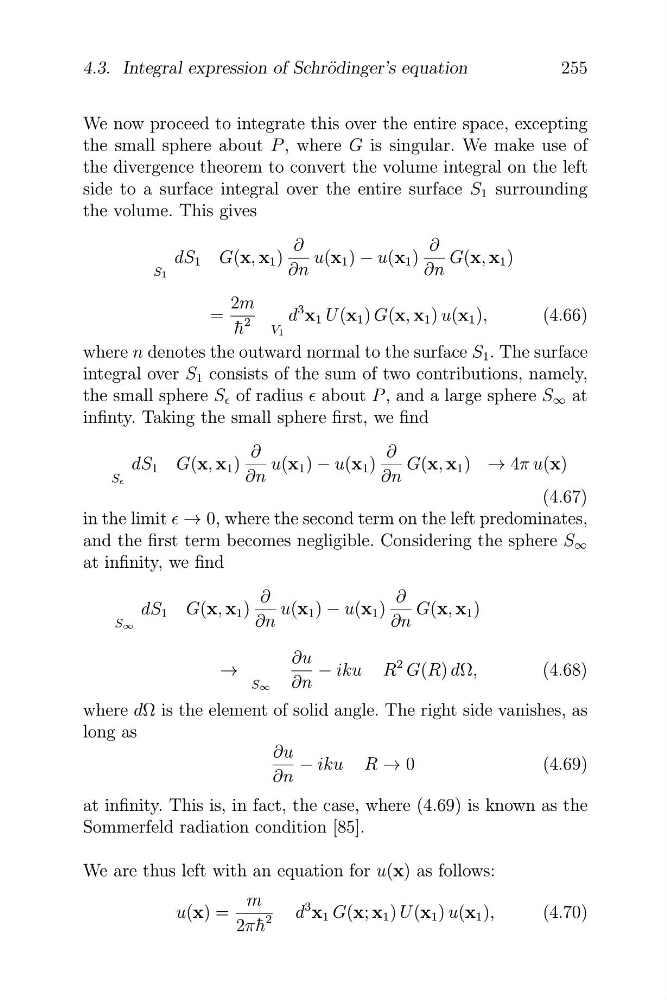
We now proceed to integrate this over the entire space, excepting
the small sphere about P , where G is singular. We make use of
the divergence theorem to convert the volume integral on the left
side to a surface integral over the entire surface S 1 surrounding
the volume. This gives
∂
∂
dS 1 G(x, x 1 )
u(x 1 ) − u(x 1 )
G(x, x 1 )
S 1
∂n
∂n
2m
d
3
=
x 1 U (x 1 ) G(x, x 1 ) u(x 1 ),
(4.66)
h
2
¯
V 1
where n denotes the outward normal to the surface S 1 . The surface
integral over S 1 consists of the sum of two contributions, namely,
the small sphere S E of radius f about P , and a large sphere S ∞ at
infinty. Taking the small sphere first, we find
∂
∂
dS 1 G(x, x 1 )
u(x 1 ) − u(x 1 )
G(x, x 1 ) → 4π u(x)
S�
∂n
∂n
(4.67)
in the limit f → 0, where the second term on the left predominates,
and the first term becomes negligible. Considering the sphere S ∞
at infinity, we find
∂
∂
dS 1 G(x, x 1 )
u(x 1 ) − u(x 1 )
G(x, x 1 )
S∞
∂n
∂n
→
∂u − iku R
2 G(R) dΩ,
(4.68)
S∞
∂n
where dΩ is the element of solid angle. The right side vanishes, as
long as
∂u − iku R → 0
(4.69)
∂n
at infinity. This is, in fact, the case, where (4.69) is known as the
Sommerfeld radiation condition [85].
We are thus left with an equation for u(x) as follows:
m
d
3
u(x) =
x 1 G(x; x 1 ) U (x 1 ) u(x 1 ),
(4.70)
h
2
2π¯
4.3. Integral expression of Schr¨ odinger’s equation
255
�
�
�
We now proceed to integrate this over the entire space, excepting
the small sphere about P , where G is singular. We make use of
the divergence theorem to convert the volume integral on the left
side to a surface integral over the entire surface S 1 surrounding
the volume. This gives
∂
∂
dS 1 G(x, x 1 )
u(x 1 ) − u(x 1 )
G(x, x 1 )
S 1
∂n
∂n
2m
d
3
=
x 1 U (x 1 ) G(x, x 1 ) u(x 1 ),
(4.66)
h
2
¯
V 1
where n denotes the outward normal to the surface S 1 . The surface
integral over S 1 consists of the sum of two contributions, namely,
the small sphere S E of radius f about P , and a large sphere S ∞ at
infinty. Taking the small sphere first, we find
∂
∂
dS 1 G(x, x 1 )
u(x 1 ) − u(x 1 )
G(x, x 1 ) → 4π u(x)
S�
∂n
∂n
(4.67)
in the limit f → 0, where the second term on the left predominates,
and the first term becomes negligible. Considering the sphere S ∞
at infinity, we find
∂
∂
dS 1 G(x, x 1 )
u(x 1 ) − u(x 1 )
G(x, x 1 )
S∞
∂n
∂n
→
∂u − iku R
2 G(R) dΩ,
(4.68)
S∞
∂n
where dΩ is the element of solid angle. The right side vanishes, as
long as
∂u − iku R → 0
(4.69)
∂n
at infinity. This is, in fact, the case, where (4.69) is known as the
Sommerfeld radiation condition [85].
We are thus left with an equation for u(x) as follows:
m
d
3
u(x) =
x 1 G(x; x 1 ) U (x 1 ) u(x 1 ),
(4.70)
h
2
2π¯
4.3. Integral expression of Schr¨ odinger’s equation
255