

4.3. Integral expression of Schr¨ odinger’s equation
253
and H is the eigenvalue for the conserved total energy.
We now proceed to apply this formalism to the scattering problem.
The spatial part u(x) satisfies
v
2 u(x) + k
2 u(x) =
2m U (x) u(x),
(4.57)
h
2
¯
where U (x) = qφ(x) is the potential energy associated with the
scattering center, and
2mH
k
2 =
.
(4.58)
h
2
¯
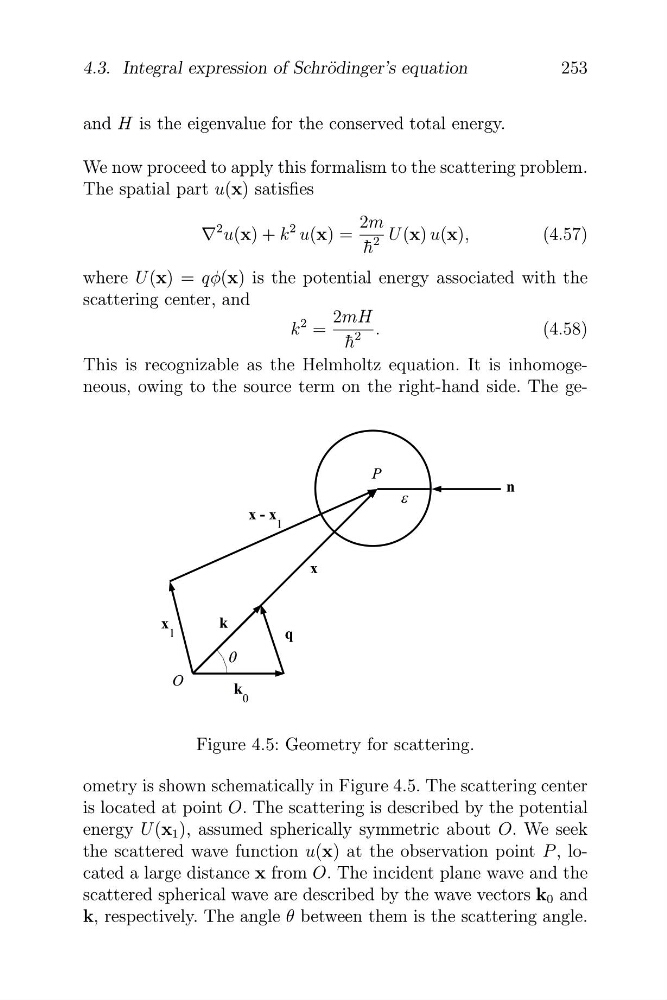
This is recognizable as the Helmholtz equation. It is inhomogeneous, owing to the source term on the right-hand side. The geFigure 4.5: Geometry for scattering.
ometry is shown schematically in Figure 4.5. The scattering center
is located at point O. The scattering is described by the potential
energy U (x 1 ), assumed spherically symmetric about O. We seek
the scattered wave function u(x) at the observation point P , located a large distance x from O. The incident plane wave and the
scattered spherical wave are described by the wave vectors k 0 and
k, respectively. The angle θ between them is the scattering angle.
253
and H is the eigenvalue for the conserved total energy.
We now proceed to apply this formalism to the scattering problem.
The spatial part u(x) satisfies
v
2 u(x) + k
2 u(x) =
2m U (x) u(x),
(4.57)
h
2
¯
where U (x) = qφ(x) is the potential energy associated with the
scattering center, and
2mH
k
2 =
.
(4.58)
h
2
¯
This is recognizable as the Helmholtz equation. It is inhomogeneous, owing to the source term on the right-hand side. The geFigure 4.5: Geometry for scattering.
ometry is shown schematically in Figure 4.5. The scattering center
is located at point O. The scattering is described by the potential
energy U (x 1 ), assumed spherically symmetric about O. We seek
the scattered wave function u(x) at the observation point P , located a large distance x from O. The incident plane wave and the
scattered spherical wave are described by the wave vectors k 0 and
k, respectively. The angle θ between them is the scattering angle.