

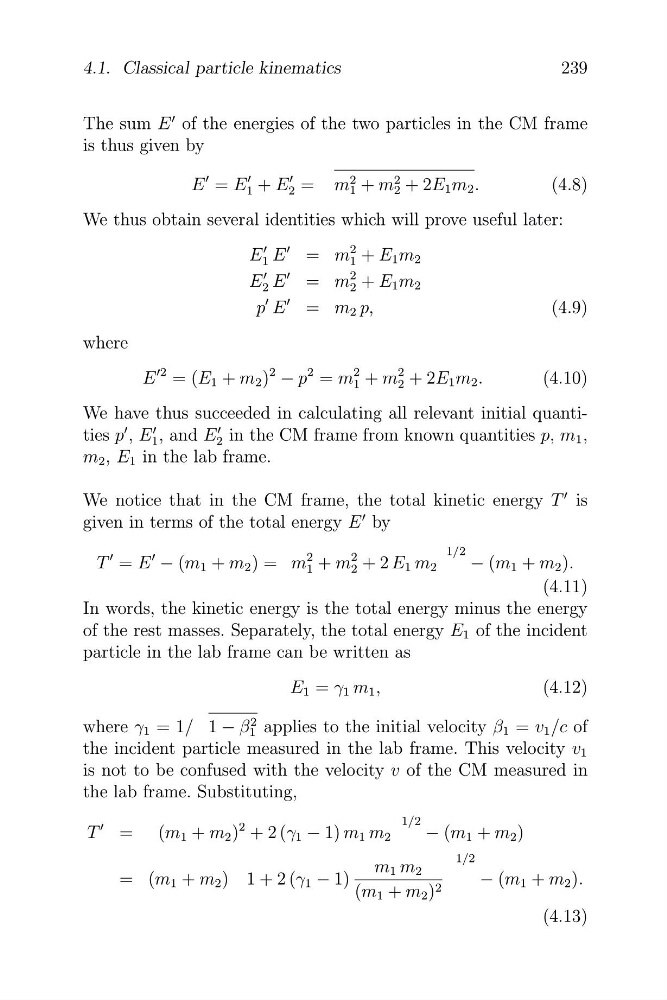
The sum E
� of the energies of the two particles in the CM frame
is thus given by
E
� = E 1
� + E 2
� = m 1
2 + m 2
2 + 2E 1 m 2 .
(4.8)
We thus obtain several identities which will prove useful later:
E
�
2
1 E
� = m 1 + E 1 m 2
E
� E
�
2
= m 2 + E 1 m 2
2
� E
�
p
= m 2 p,
(4.9)
where
2
2
2
E
�2 = (E 1 + m 2 )
2 − p = m 1 + m 2 + 2E 1 m 2 .
(4.10)
We have thus succeeded in calculating all relevant initial quantities p
� , E 1
� , and E 2
� in the CM frame from known quantities p, m 1 ,
m 2 , E 1 in the lab frame.
We notice that in the CM frame, the total kinetic energy T
� is
given in terms of the total energy E
� by
T
� = E
� − (m 1 + m 2 ) = m 1
2 + m 2
2 + 2 E 1 m 2
1/2 − (m 1 + m 2 ).
(4.11)
In words, the kinetic energy is the total energy minus the energy
of the rest masses. Separately, the total energy E 1 of the incident
particle in the lab frame can be written as
E 1 = γ 1 m 1 ,
(4.12)
where γ 1 = 1/ 1 − β 1
2 applies to the initial velocity β 1 = v 1 /c of
the incident particle measured in the lab frame. This velocity v 1
is not to be confused with the velocity v of the CM measured in
the lab frame. Substituting,
T
� = (m 1 + m 2 )
2 + 2 (γ 1 − 1) m 1 m 2
1/2 − (m 1 + m 2 )
1/2
m 1 m 2
= (m 1 + m 2 ) 1 + 2 (γ 1 − 1)
− (m 1 + m 2 ).
(m 1 + m 2 ) 2
(4.13)
239
4.1. Classical particle kinematics
� of the energies of the two particles in the CM frame
is thus given by
E
� = E 1
� + E 2
� = m 1
2 + m 2
2 + 2E 1 m 2 .
(4.8)
We thus obtain several identities which will prove useful later:
E
�
2
1 E
� = m 1 + E 1 m 2
E
� E
�
2
= m 2 + E 1 m 2
2
� E
�
p
= m 2 p,
(4.9)
where
2
2
2
E
�2 = (E 1 + m 2 )
2 − p = m 1 + m 2 + 2E 1 m 2 .
(4.10)
We have thus succeeded in calculating all relevant initial quantities p
� , E 1
� , and E 2
� in the CM frame from known quantities p, m 1 ,
m 2 , E 1 in the lab frame.
We notice that in the CM frame, the total kinetic energy T
� is
given in terms of the total energy E
� by
T
� = E
� − (m 1 + m 2 ) = m 1
2 + m 2
2 + 2 E 1 m 2
1/2 − (m 1 + m 2 ).
(4.11)
In words, the kinetic energy is the total energy minus the energy
of the rest masses. Separately, the total energy E 1 of the incident
particle in the lab frame can be written as
E 1 = γ 1 m 1 ,
(4.12)
where γ 1 = 1/ 1 − β 1
2 applies to the initial velocity β 1 = v 1 /c of
the incident particle measured in the lab frame. This velocity v 1
is not to be confused with the velocity v of the CM measured in
the lab frame. Substituting,
T
� = (m 1 + m 2 )
2 + 2 (γ 1 − 1) m 1 m 2
1/2 − (m 1 + m 2 )
1/2
m 1 m 2
= (m 1 + m 2 ) 1 + 2 (γ 1 − 1)
− (m 1 + m 2 ).
(m 1 + m 2 ) 2
(4.13)
239
4.1. Classical particle kinematics