

237
4.1. Classical particle kinematics
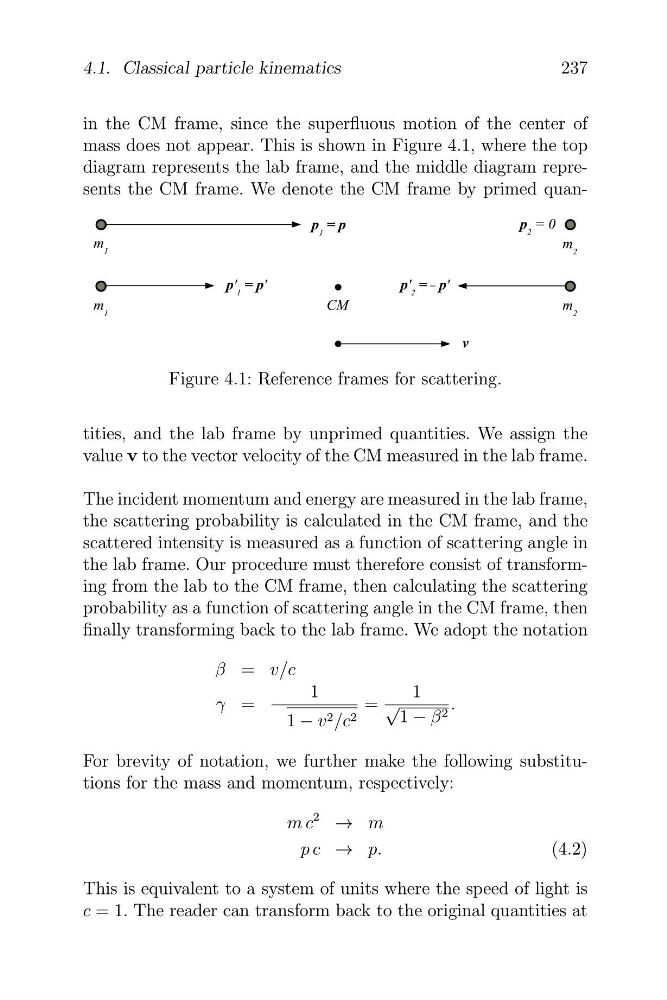
in the CM frame, since the superfluous motion of the center of
mass does not appear. This is shown in Figure 4.1, where the top
diagram represents the lab frame, and the middle diagram represents the CM frame. We denote the CM frame by primed quan–
Figure 4.1: Reference frames for scattering.
tities, and the lab frame by unprimed quantities. We assign the
value v to the vector velocity of the CM measured in the lab frame.
The incident momentum and energy are measured in the lab frame,
the scattering probability is calculated in the CM frame, and the
scattered intensity is measured as a function of scattering angle in
the lab frame. Our procedure must therefore consist of transforming from the lab to the CM frame, then calculating the scattering
probability as a function of scattering angle in the CM frame, then
finally transforming back to the lab frame. We adopt the notation
β = v/c
1
1
γ =
= √
.
1 − β 2
1 − v 2 /c 2
For brevity of notation, we further make the following substitutions for the mass and momentum, respectively:
m c
2 → m
p c → p.
(4.2)
This is equivalent to a system of units where the speed of light is
c = 1. The reader can transform back to the original quantities at
4.1. Classical particle kinematics
in the CM frame, since the superfluous motion of the center of
mass does not appear. This is shown in Figure 4.1, where the top
diagram represents the lab frame, and the middle diagram represents the CM frame. We denote the CM frame by primed quan–
Figure 4.1: Reference frames for scattering.
tities, and the lab frame by unprimed quantities. We assign the
value v to the vector velocity of the CM measured in the lab frame.
The incident momentum and energy are measured in the lab frame,
the scattering probability is calculated in the CM frame, and the
scattered intensity is measured as a function of scattering angle in
the lab frame. Our procedure must therefore consist of transforming from the lab to the CM frame, then calculating the scattering
probability as a function of scattering angle in the CM frame, then
finally transforming back to the lab frame. We adopt the notation
β = v/c
1
1
γ =
= √
.
1 − β 2
1 − v 2 /c 2
For brevity of notation, we further make the following substitutions for the mass and momentum, respectively:
m c
2 → m
p c → p.
(4.2)
This is equivalent to a system of units where the speed of light is
c = 1. The reader can transform back to the original quantities at