

�
�
�
�
�
�
�
� �
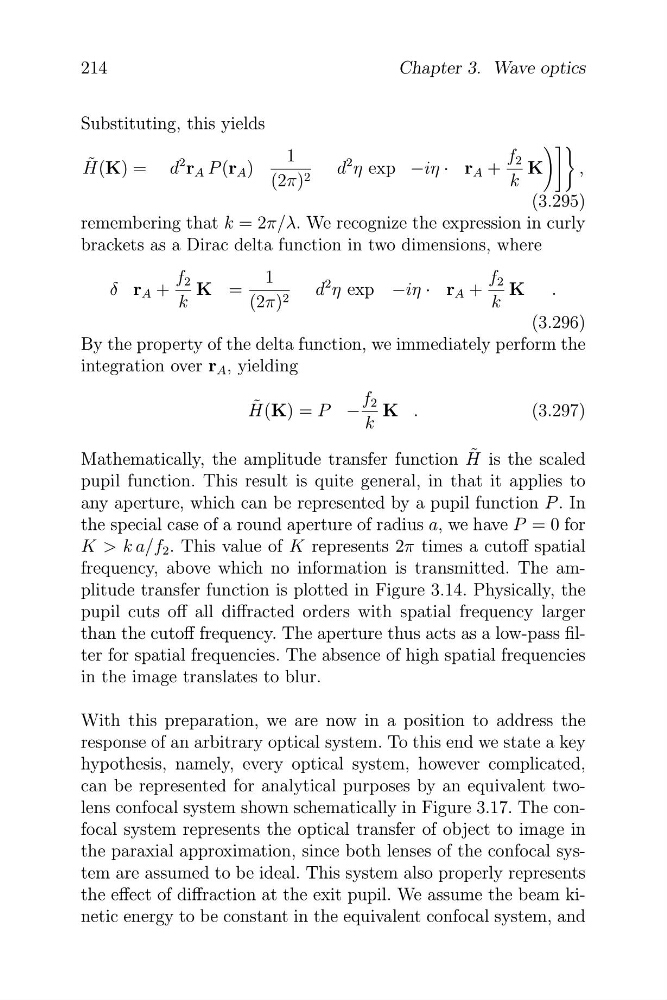
Substituting, this yields
1
f 2
H ˜ (K) = d
2 r A P (r A )
d
2 η exp −iη · r A + K
,
(2π) 2
k
(3.295)
remembering that k = 2π/λ. We recognize the expression in curly
brackets as a Dirac delta function in two dimensions, where
f 2
1
f 2
δ r A + K =
d
2 η exp −iη · r A + K .
k
(2π) 2
k
(3.296)
By the property of the delta function, we immediately perform the
integration over r A , yielding
f 2
˜
H(K) = P − K .
(3.297)
k
214
Chapter 3. Wave optics
˜
Mathematically, the amplitude transfer function H is the scaled
pupil function. This result is quite general, in that it applies to
any aperture, which can be represented by a pupil function P . In
the special case of a round aperture of radius a, we have P = 0 for
K > k a/f 2 . This value of K represents 2π times a cutoff spatial
frequency, above which no information is transmitted. The amplitude transfer function is plotted in Figure 3.14. Physically, the
pupil cuts off all diffracted orders with spatial frequency larger
than the cutoff frequency. The aperture thus acts as a low-pass filter for spatial frequencies. The absence of high spatial frequencies
in the image translates to blur.
With this preparation, we are now in a position to address the
response of an arbitrary optical system. To this end we state a key
hypothesis, namely, every optical system, however complicated,
can be represented for analytical purposes by an equivalent twolens confocal system shown schematically in Figure 3.17. The confocal system represents the optical transfer of object to image in
the paraxial approximation, since both lenses of the confocal system are assumed to be ideal. This system also properly represents
the effect of diffraction at the exit pupil. We assume the beam kinetic energy to be constant in the equivalent confocal system, and
�
�
�
�
�
�
� �
Substituting, this yields
1
f 2
H ˜ (K) = d
2 r A P (r A )
d
2 η exp −iη · r A + K
,
(2π) 2
k
(3.295)
remembering that k = 2π/λ. We recognize the expression in curly
brackets as a Dirac delta function in two dimensions, where
f 2
1
f 2
δ r A + K =
d
2 η exp −iη · r A + K .
k
(2π) 2
k
(3.296)
By the property of the delta function, we immediately perform the
integration over r A , yielding
f 2
˜
H(K) = P − K .
(3.297)
k
214
Chapter 3. Wave optics
˜
Mathematically, the amplitude transfer function H is the scaled
pupil function. This result is quite general, in that it applies to
any aperture, which can be represented by a pupil function P . In
the special case of a round aperture of radius a, we have P = 0 for
K > k a/f 2 . This value of K represents 2π times a cutoff spatial
frequency, above which no information is transmitted. The amplitude transfer function is plotted in Figure 3.14. Physically, the
pupil cuts off all diffracted orders with spatial frequency larger
than the cutoff frequency. The aperture thus acts as a low-pass filter for spatial frequencies. The absence of high spatial frequencies
in the image translates to blur.
With this preparation, we are now in a position to address the
response of an arbitrary optical system. To this end we state a key
hypothesis, namely, every optical system, however complicated,
can be represented for analytical purposes by an equivalent twolens confocal system shown schematically in Figure 3.17. The confocal system represents the optical transfer of object to image in
the paraxial approximation, since both lenses of the confocal system are assumed to be ideal. This system also properly represents
the effect of diffraction at the exit pupil. We assume the beam kinetic energy to be constant in the equivalent confocal system, and