

where we have made use of the expression for the magnification M
above.
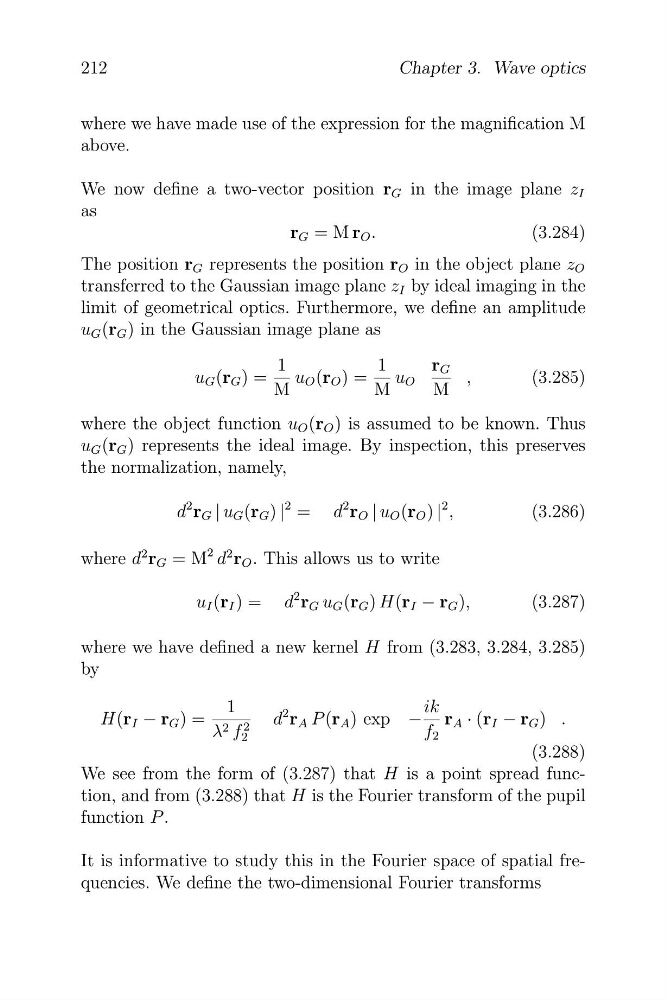
We now define a two-vector position r G in the image plane z I
as
r G = M r O .
(3.284)
The position r G represents the position r O in the object plane z O
transferred to the Gaussian image plane z I by ideal imaging in the
limit of geometrical optics. Furthermore, we define an amplitude
u G (r G ) in the Gaussian image plane as
1
1
r G
u G (r G ) =
u O (r O ) =
u O
,
(3.285)
M
M
M
where the object function u O (r O ) is assumed to be known. Thus
u G (r G ) represents the ideal image. By inspection, this preserves
the normalization, namely,
d
2
d
2
r G | u G (r G ) |
2 =
r O | u O (r O ) |
2 ,
(3.286)
where d
2 r G = M
2 d
2 r O . This allows us to write
u I (r I ) = d
2 r G u G (r G ) H(r I − r G ),
(3.287)
where we have defined a new kernel H from (3.283, 3.284, 3.285)
by
H(r I − r G ) =
1
d
2 r A P (r A ) exp −
ik r A · (r I − r G ) .
λ 2 f
2
2
f 2
(3.288)
We see from the form of (3.287) that H is a point spread function, and from (3.288) that H is the Fourier transform of the pupil
function P .
It is informative to study this in the Fourier space of spatial frequencies. We define the two-dimensional Fourier transforms
212
Chapter 3. Wave optics
above.
We now define a two-vector position r G in the image plane z I
as
r G = M r O .
(3.284)
The position r G represents the position r O in the object plane z O
transferred to the Gaussian image plane z I by ideal imaging in the
limit of geometrical optics. Furthermore, we define an amplitude
u G (r G ) in the Gaussian image plane as
1
1
r G
u G (r G ) =
u O (r O ) =
u O
,
(3.285)
M
M
M
where the object function u O (r O ) is assumed to be known. Thus
u G (r G ) represents the ideal image. By inspection, this preserves
the normalization, namely,
d
2
d
2
r G | u G (r G ) |
2 =
r O | u O (r O ) |
2 ,
(3.286)
where d
2 r G = M
2 d
2 r O . This allows us to write
u I (r I ) = d
2 r G u G (r G ) H(r I − r G ),
(3.287)
where we have defined a new kernel H from (3.283, 3.284, 3.285)
by
H(r I − r G ) =
1
d
2 r A P (r A ) exp −
ik r A · (r I − r G ) .
λ 2 f
2
2
f 2
(3.288)
We see from the form of (3.287) that H is a point spread function, and from (3.288) that H is the Fourier transform of the pupil
function P .
It is informative to study this in the Fourier space of spatial frequencies. We define the two-dimensional Fourier transforms
212
Chapter 3. Wave optics