

�
�
�
�
�
�
�
�
�
�
�
�
object distance Z 1 , the image distance Z 2 , and the lens focal length
f is given for ideal imaging as
1
1
1
Z 2
+
− = 0,
M = − ,
(3.259)
Z 1 Z 2 f
Z 1
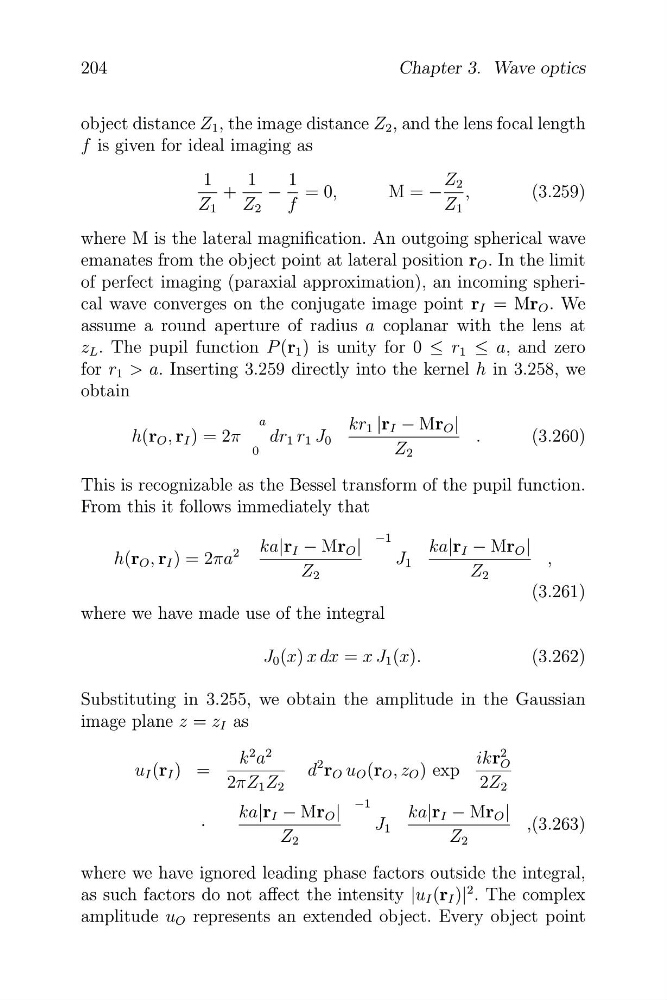
where M is the lateral magnification. An outgoing spherical wave
emanates from the object point at lateral position r O . In the limit
of perfect imaging (paraxial approximation), an incoming spherical wave converges on the conjugate image point r I = Mr O . We
assume a round aperture of radius a coplanar with the lens at
z L . The pupil function P (r 1 ) is unity for 0 ≤ r 1 ≤ a, and zero
for r 1 > a. Inserting 3.259 directly into the kernel h in 3.258, we
obtain
a
kr 1 |r I − Mr O |
h(r O , r I ) = 2π
dr 1 r 1 J 0
.
(3.260)
0
Z 2
This is recognizable as the Bessel transform of the pupil function.
From this it follows immediately that
ka|r I − Mr O |
−1
ka|r I − Mr O |
h(r O , r I ) = 2πa
2
J 1
,
Z 2
Z 2
(3.261)
where we have made use of the integral
J 0 (x) x dx = x J 1 (x).
(3.262)
Substituting in 3.255, we obtain the amplitude in the Gaussian
image plane z = z I as
k
2 a
2
ikr
2
u I (r I ) =
d
2 r O u O (r O , z O ) exp
O
2πZ 1 Z 2
2Z 2
ka|r I − Mr O |
−1
ka|r I − Mr O |
·
J 1
,(3.263)
Z 2
Z 2
where we have ignored leading phase factors outside the integral,
as such factors do not affect the intensity |u I (r I )|
2 . The complex
amplitude u O represents an extended object. Every object point
204
Chapter 3. Wave optics
�
�
�
�
�
�
�
�
�
�
�
object distance Z 1 , the image distance Z 2 , and the lens focal length
f is given for ideal imaging as
1
1
1
Z 2
+
− = 0,
M = − ,
(3.259)
Z 1 Z 2 f
Z 1
where M is the lateral magnification. An outgoing spherical wave
emanates from the object point at lateral position r O . In the limit
of perfect imaging (paraxial approximation), an incoming spherical wave converges on the conjugate image point r I = Mr O . We
assume a round aperture of radius a coplanar with the lens at
z L . The pupil function P (r 1 ) is unity for 0 ≤ r 1 ≤ a, and zero
for r 1 > a. Inserting 3.259 directly into the kernel h in 3.258, we
obtain
a
kr 1 |r I − Mr O |
h(r O , r I ) = 2π
dr 1 r 1 J 0
.
(3.260)
0
Z 2
This is recognizable as the Bessel transform of the pupil function.
From this it follows immediately that
ka|r I − Mr O |
−1
ka|r I − Mr O |
h(r O , r I ) = 2πa
2
J 1
,
Z 2
Z 2
(3.261)
where we have made use of the integral
J 0 (x) x dx = x J 1 (x).
(3.262)
Substituting in 3.255, we obtain the amplitude in the Gaussian
image plane z = z I as
k
2 a
2
ikr
2
u I (r I ) =
d
2 r O u O (r O , z O ) exp
O
2πZ 1 Z 2
2Z 2
ka|r I − Mr O |
−1
ka|r I − Mr O |
·
J 1
,(3.263)
Z 2
Z 2
where we have ignored leading phase factors outside the integral,
as such factors do not affect the intensity |u I (r I )|
2 . The complex
amplitude u O represents an extended object. Every object point
204
Chapter 3. Wave optics