

192
Chapter 3. Wave optics
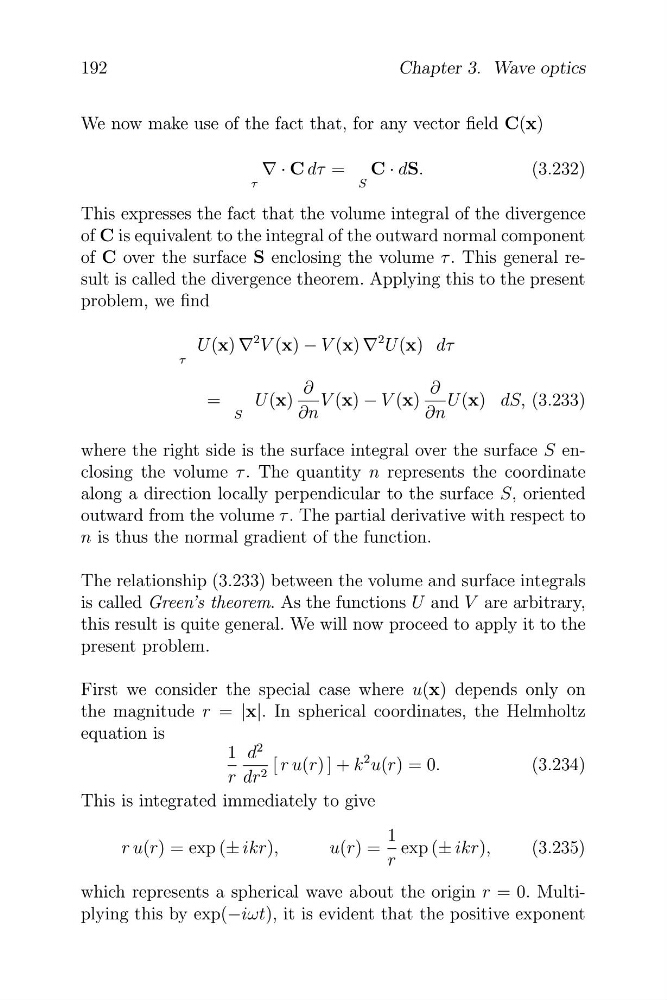
We now make use of the fact that, for any vector field C(x)
v · C dτ = C · dS.
(3.232)
τ
S
This expresses the fact that the volume integral of the divergence
of C is equivalent to the integral of the outward normal component
of C over the surface S enclosing the volume τ . This general result is called the divergence theorem. Applying this to the present
problem, we find
U (x) v
2 V (x) − V (x) v
2 U (x) dτ
τ
∂
∂
=
U (x)
V (x) − V (x)
U (x) dS, (3.233)
S
∂n
∂n
where the right side is the surface integral over the surface S enclosing the volume τ . The quantity n represents the coordinate
along a direction locally perpendicular to the surface S, oriented
outward from the volume τ . The partial derivative with respect to
n is thus the normal gradient of the function.
The relationship (3.233) between the volume and surface integrals
is called Green’s theorem. As the functions U and V are arbitrary,
this result is quite general. We will now proceed to apply it to the
present problem.
First we consider the special case where u(x) depends only on
the magnitude r = |x|. In spherical coordinates, the Helmholtz
equation is
1 d
2
[ r u(r) ] + k
2 u(r) = 0.
(3.234)
r dr 2
This is integrated immediately to give
1
r u(r) = exp (± ikr),
u(r) = exp (± ikr),
(3.235)
r
which represents a spherical wave about the origin r = 0. Multiplying this by exp(−iωt), it is evident that the positive exponent
Chapter 3. Wave optics
We now make use of the fact that, for any vector field C(x)
v · C dτ = C · dS.
(3.232)
τ
S
This expresses the fact that the volume integral of the divergence
of C is equivalent to the integral of the outward normal component
of C over the surface S enclosing the volume τ . This general result is called the divergence theorem. Applying this to the present
problem, we find
U (x) v
2 V (x) − V (x) v
2 U (x) dτ
τ
∂
∂
=
U (x)
V (x) − V (x)
U (x) dS, (3.233)
S
∂n
∂n
where the right side is the surface integral over the surface S enclosing the volume τ . The quantity n represents the coordinate
along a direction locally perpendicular to the surface S, oriented
outward from the volume τ . The partial derivative with respect to
n is thus the normal gradient of the function.
The relationship (3.233) between the volume and surface integrals
is called Green’s theorem. As the functions U and V are arbitrary,
this result is quite general. We will now proceed to apply it to the
present problem.
First we consider the special case where u(x) depends only on
the magnitude r = |x|. In spherical coordinates, the Helmholtz
equation is
1 d
2
[ r u(r) ] + k
2 u(r) = 0.
(3.234)
r dr 2
This is integrated immediately to give
1
r u(r) = exp (± ikr),
u(r) = exp (± ikr),
(3.235)
r
which represents a spherical wave about the origin r = 0. Multiplying this by exp(−iωt), it is evident that the positive exponent