

3.2. Particle motion in a general electromagnetic potential 185
In classical geometrical optics, the beam can be regarded as a
family of closely spaced trajectories. Each individual trajectory
is calculated by solving the Euler–Lagrange equations of motion,
which are in turn derived from Hamilton’s principle of least action.
The collective properties of these trajectories immediately lead to
conservation of phase space volume, which in turn leads to the law
of Helmholtz–Lagrange and brightness conservation, as derived in
Chapter 2.
In quantum mechanical wave optics, one starts with a surface of
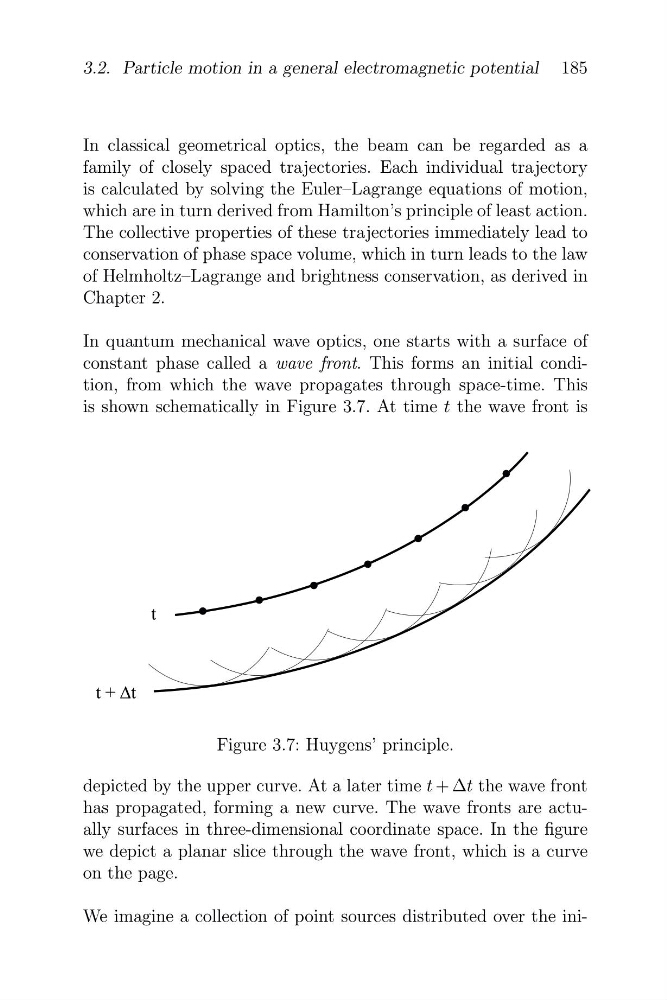
constant phase called a wave front. This forms an initial condition, from which the wave propagates through space-time. This
is shown schematically in Figure 3.7. At time t the wave front is
Figure 3.7: Huygens’ principle.
depicted by the upper curve. At a later time t + Δt the wave front
has propagated, forming a new curve. The wave fronts are actually surfaces in three-dimensional coordinate space. In the figure
we depict a planar slice through the wave front, which is a curve
on the page.
We imagine a collection of point sources distributed over the ini
In classical geometrical optics, the beam can be regarded as a
family of closely spaced trajectories. Each individual trajectory
is calculated by solving the Euler–Lagrange equations of motion,
which are in turn derived from Hamilton’s principle of least action.
The collective properties of these trajectories immediately lead to
conservation of phase space volume, which in turn leads to the law
of Helmholtz–Lagrange and brightness conservation, as derived in
Chapter 2.
In quantum mechanical wave optics, one starts with a surface of
constant phase called a wave front. This forms an initial condition, from which the wave propagates through space-time. This
is shown schematically in Figure 3.7. At time t the wave front is
Figure 3.7: Huygens’ principle.
depicted by the upper curve. At a later time t + Δt the wave front
has propagated, forming a new curve. The wave fronts are actually surfaces in three-dimensional coordinate space. In the figure
we depict a planar slice through the wave front, which is a curve
on the page.
We imagine a collection of point sources distributed over the ini