

�
�
z b only occurs when the path difference is less than the coherence
length of the wave packet.
Since the electrostatic potential φ(x, t) depends explicitly on time,
we must use the time-dependent formulation. The wave function
ψ(x b , t b ) is given (3.132, 3.145) by
i t b
ψ(x b , t b ) = ψ(x a , t a ) exp
L(x, v; t) dt ,
(3.201)
h ¯ ta
where L(x, v; t) is the classical Lagrangian given by (2.9) as
L(x, v; t) = −m c
2
1 − v 2 /c 2 + q v · A(x, t) − q φ(x, t). (3.202)
The magnetic vector potential A is assumed to be zero in this
case. The amplitude ψ(x b , t b ) is again the sum of the amplitudes
for the two alternative paths (3.192, 3.193), with the respective
phases given by
1 t b
θ I = ¯
h ta
L I dt I
t b
1
θ II =
L II dt II .
(3.203)
h ¯ ta
178
Chapter 3. Wave optics
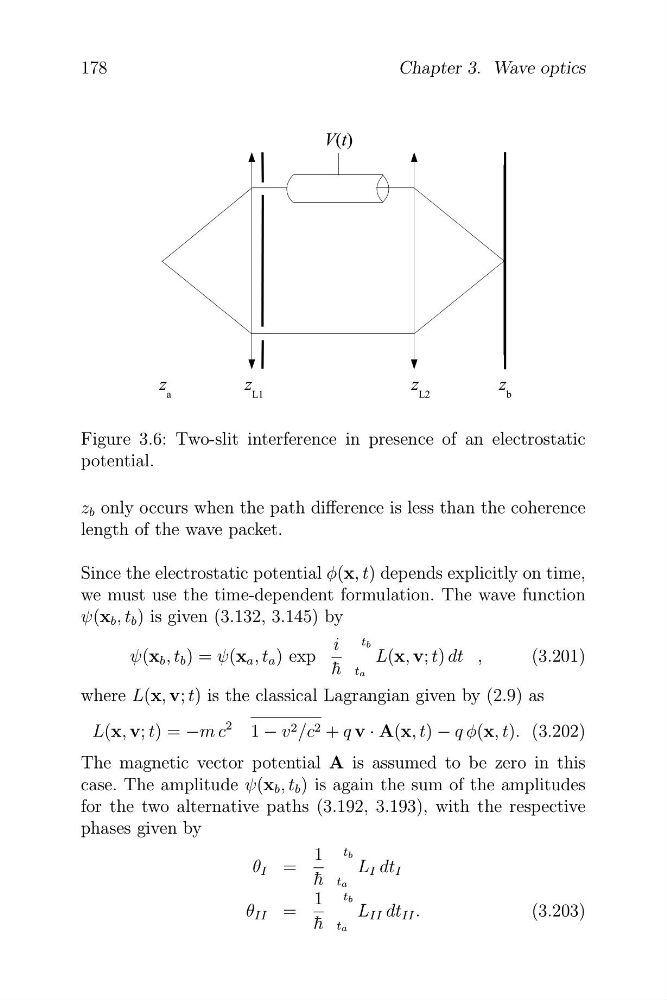
Figure 3.6: Two-slit interference in presence of an electrostatic
potential.
�
z b only occurs when the path difference is less than the coherence
length of the wave packet.
Since the electrostatic potential φ(x, t) depends explicitly on time,
we must use the time-dependent formulation. The wave function
ψ(x b , t b ) is given (3.132, 3.145) by
i t b
ψ(x b , t b ) = ψ(x a , t a ) exp
L(x, v; t) dt ,
(3.201)
h ¯ ta
where L(x, v; t) is the classical Lagrangian given by (2.9) as
L(x, v; t) = −m c
2
1 − v 2 /c 2 + q v · A(x, t) − q φ(x, t). (3.202)
The magnetic vector potential A is assumed to be zero in this
case. The amplitude ψ(x b , t b ) is again the sum of the amplitudes
for the two alternative paths (3.192, 3.193), with the respective
phases given by
1 t b
θ I = ¯
h ta
L I dt I
t b
1
θ II =
L II dt II .
(3.203)
h ¯ ta
178
Chapter 3. Wave optics
Figure 3.6: Two-slit interference in presence of an electrostatic
potential.