

4
Introduction: The optical nature of a charged particle beam
design energy of the Large Hadron Collider (LHC) at CERN, the
world’s most energetic particle accelerator, located on the FranceSwitzerland border. Incidentally, the beam must be in a vacuum
chamber in all useful particle beam instruments, since the particles would immediately be absorbed in air at normal atmospheric
pressure, regardless of their energy.
A charged particle beam is conceptually similar in many respects
to a beam of light. It is therefore interesting to think about charged
particle optics in an analogous way to light optics. This forms a
central theme in the present study. For example, electric and magnetic fields can be configured to form a lens, which focuses the
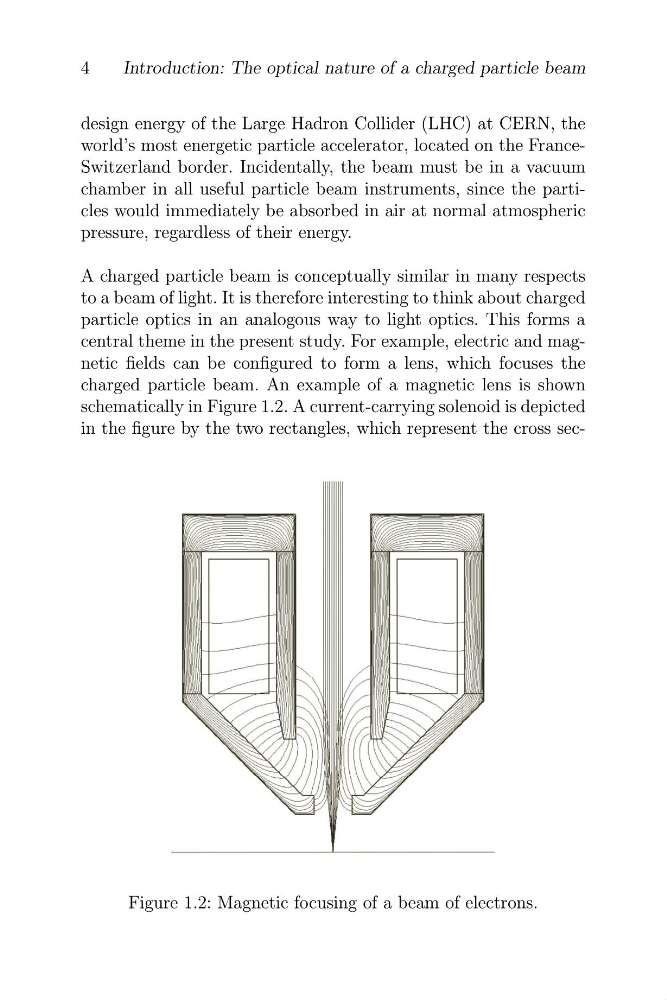
charged particle beam. An example of a magnetic lens is shown
schematically in Figure 1.2. A current-carrying solenoid is depicted
in the figure by the two rectangles, which represent the cross secFigure 1.2: Magnetic focusing of a beam of electrons.
Introduction: The optical nature of a charged particle beam
design energy of the Large Hadron Collider (LHC) at CERN, the
world’s most energetic particle accelerator, located on the FranceSwitzerland border. Incidentally, the beam must be in a vacuum
chamber in all useful particle beam instruments, since the particles would immediately be absorbed in air at normal atmospheric
pressure, regardless of their energy.
A charged particle beam is conceptually similar in many respects
to a beam of light. It is therefore interesting to think about charged
particle optics in an analogous way to light optics. This forms a
central theme in the present study. For example, electric and magnetic fields can be configured to form a lens, which focuses the
charged particle beam. An example of a magnetic lens is shown
schematically in Figure 1.2. A current-carrying solenoid is depicted
in the figure by the two rectangles, which represent the cross secFigure 1.2: Magnetic focusing of a beam of electrons.