

3.2. Particle motion in a general electromagnetic potential 173
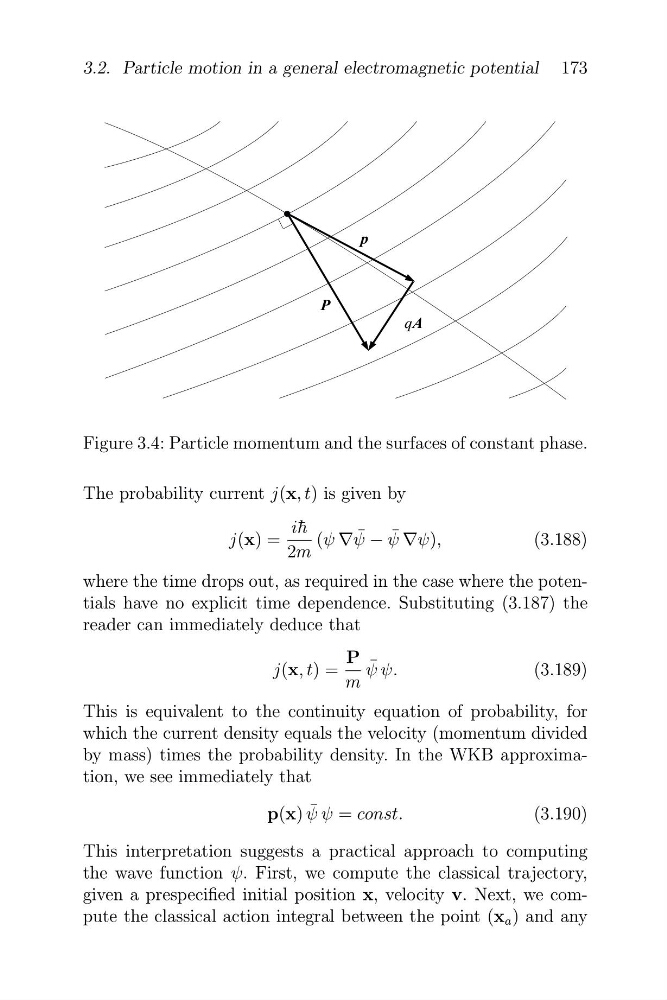
Figure 3.4: Particle momentum and the surfaces of constant phase.
The probability current j(x, t) is given by
¯
j(x) =
ih ¯ (ψ vψ ¯ − ψ vψ),
(3.188)
2m
where the time drops out, as required in the case where the potentials have no explicit time dependence. Substituting (3.187) the
reader can immediately deduce that
P ¯
j(x, t) =
ψ ψ.
(3.189)
m
This is equivalent to the continuity equation of probability, for
which the current density equals the velocity (momentum divided
by mass) times the probability density. In the WKB approximation, we see immediately that
p(x) ¯
(3.190)
ψ ψ = const.
This interpretation suggests a practical approach to computing
the wave function ψ. First, we compute the classical trajectory,
given a prespecified initial position x, velocity v. Next, we compute the classical action integral between the point (x a ) and any
Figure 3.4: Particle momentum and the surfaces of constant phase.
The probability current j(x, t) is given by
¯
j(x) =
ih ¯ (ψ vψ ¯ − ψ vψ),
(3.188)
2m
where the time drops out, as required in the case where the potentials have no explicit time dependence. Substituting (3.187) the
reader can immediately deduce that
P ¯
j(x, t) =
ψ ψ.
(3.189)
m
This is equivalent to the continuity equation of probability, for
which the current density equals the velocity (momentum divided
by mass) times the probability density. In the WKB approximation, we see immediately that
p(x) ¯
(3.190)
ψ ψ = const.
This interpretation suggests a practical approach to computing
the wave function ψ. First, we compute the classical trajectory,
given a prespecified initial position x, velocity v. Next, we compute the classical action integral between the point (x a ) and any