

�
�
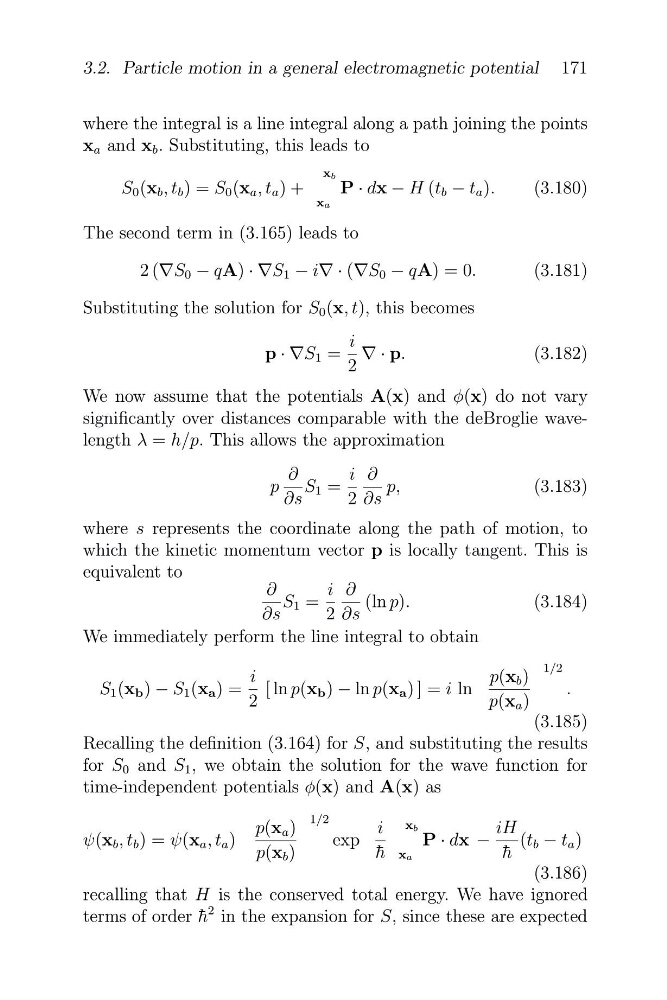
where the integral is a line integral along a path joining the points
x a and x b . Substituting, this leads to
x b
S 0 (x b , t b ) = S 0 (x a , t a ) +
P · dx − H (t b − t a ).
(3.180)
xa
The second term in (3.165) leads to
2 (vS 0 − qA) · vS 1 − iv · (vS 0 − qA) = 0.
(3.181)
Substituting the solution for S 0 (x, t), this becomes
i
p · vS 1 = v · p.
(3.182)
2
We now assume that the potentials A(x) and φ(x) do not vary
significantly over distances comparable with the deBroglie wavelength λ = h/p. This allows the approximation
∂
i ∂
p S 1 =
p,
(3.183)
∂s
2 ∂s
where s represents the coordinate along the path of motion, to
which the kinetic momentum vector p is locally tangent. This is
equivalent to
∂
i ∂
S 1 =
(ln p).
(3.184)
∂s
2 ∂s
We immediately perform the line integral to obtain
1/2
i
p(x b )
S 1 (x b ) − S 1 (x a ) = [ ln p(x b ) − ln p(x a ) ] = i ln
.
2
p(x a )
(3.185)
Recalling the definition (3.164) for S, and substituting the results
for S 0 and S 1 , we obtain the solution for the wave function for
time-independent potentials φ(x) and A(x) as
1/2
p(x a )
i x b
iH
ψ(x b , t b ) = ψ(x a , t a )
exp
P · dx −
(t b − t a )
p(x b )
h ¯ xa
h ¯
(3.186)
recalling that H is the conserved total energy. We have ignored
h
2
terms of order ¯ in the expansion for S, since these are expected
3.2. Particle motion in a general electromagnetic potential 171
�
where the integral is a line integral along a path joining the points
x a and x b . Substituting, this leads to
x b
S 0 (x b , t b ) = S 0 (x a , t a ) +
P · dx − H (t b − t a ).
(3.180)
xa
The second term in (3.165) leads to
2 (vS 0 − qA) · vS 1 − iv · (vS 0 − qA) = 0.
(3.181)
Substituting the solution for S 0 (x, t), this becomes
i
p · vS 1 = v · p.
(3.182)
2
We now assume that the potentials A(x) and φ(x) do not vary
significantly over distances comparable with the deBroglie wavelength λ = h/p. This allows the approximation
∂
i ∂
p S 1 =
p,
(3.183)
∂s
2 ∂s
where s represents the coordinate along the path of motion, to
which the kinetic momentum vector p is locally tangent. This is
equivalent to
∂
i ∂
S 1 =
(ln p).
(3.184)
∂s
2 ∂s
We immediately perform the line integral to obtain
1/2
i
p(x b )
S 1 (x b ) − S 1 (x a ) = [ ln p(x b ) − ln p(x a ) ] = i ln
.
2
p(x a )
(3.185)
Recalling the definition (3.164) for S, and substituting the results
for S 0 and S 1 , we obtain the solution for the wave function for
time-independent potentials φ(x) and A(x) as
1/2
p(x a )
i x b
iH
ψ(x b , t b ) = ψ(x a , t a )
exp
P · dx −
(t b − t a )
p(x b )
h ¯ xa
h ¯
(3.186)
recalling that H is the conserved total energy. We have ignored
h
2
terms of order ¯ in the expansion for S, since these are expected
3.2. Particle motion in a general electromagnetic potential 171