

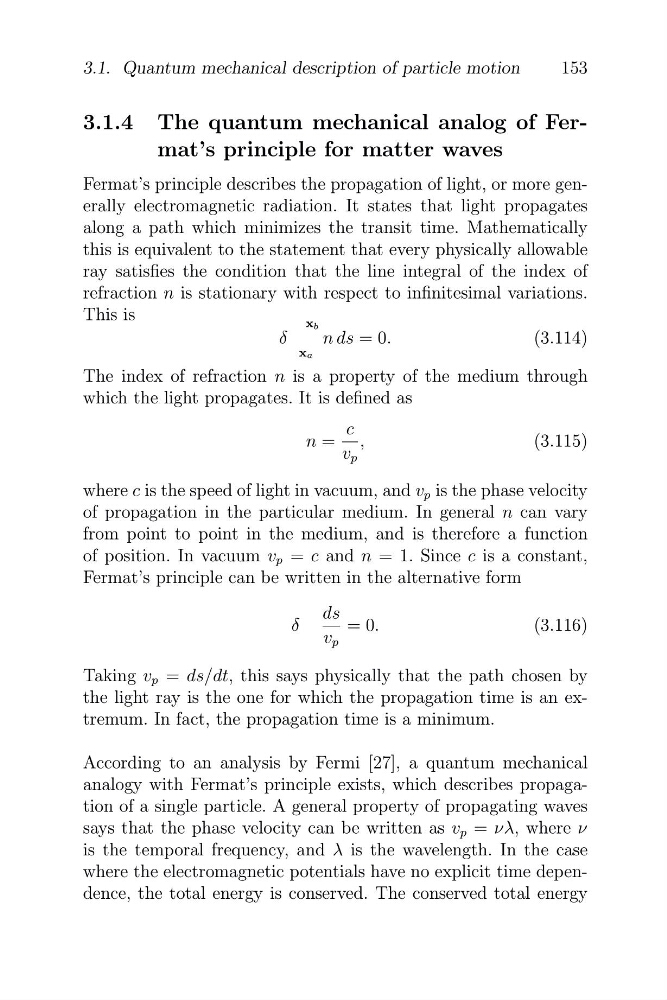
3.1. Quantum mechanical description of particle motion
153
3.1.4 The quantum mechanical analog of Fermat’s principle for matter waves
Fermat’s principle describes the propagation of light, or more generally electromagnetic radiation. It states that light propagates
along a path which minimizes the transit time. Mathematically
this is equivalent to the statement that every physically allowable
ray satisfies the condition that the line integral of the index of
refraction n is stationary with respect to infinitesimal variations.
This is
x b
δ
n ds = 0.
(3.114)
xa
The index of refraction n is a property of the medium through
which the light propagates. It is defined as
c
n = ,
(3.115)
v p
where c is the speed of light in vacuum, and v p is the phase velocity
of propagation in the particular medium. In general n can vary
from point to point in the medium, and is therefore a function
of position. In vacuum v p = c and n = 1. Since c is a constant,
Fermat’s principle can be written in the alternative form
ds
δ
= 0.
(3.116)
v p
Taking v p = ds/dt, this says physically that the path chosen by
the light ray is the one for which the propagation time is an extremum. In fact, the propagation time is a minimum.
According to an analysis by Fermi [27], a quantum mechanical
analogy with Fermat’s principle exists, which describes propagation of a single particle. A general property of propagating waves
says that the phase velocity can be written as v p = νλ, where ν
is the temporal frequency, and λ is the wavelength. In the case
where the electromagnetic potentials have no explicit time dependence, the total energy is conserved. The conserved total energy
153
3.1.4 The quantum mechanical analog of Fermat’s principle for matter waves
Fermat’s principle describes the propagation of light, or more generally electromagnetic radiation. It states that light propagates
along a path which minimizes the transit time. Mathematically
this is equivalent to the statement that every physically allowable
ray satisfies the condition that the line integral of the index of
refraction n is stationary with respect to infinitesimal variations.
This is
x b
δ
n ds = 0.
(3.114)
xa
The index of refraction n is a property of the medium through
which the light propagates. It is defined as
c
n = ,
(3.115)
v p
where c is the speed of light in vacuum, and v p is the phase velocity
of propagation in the particular medium. In general n can vary
from point to point in the medium, and is therefore a function
of position. In vacuum v p = c and n = 1. Since c is a constant,
Fermat’s principle can be written in the alternative form
ds
δ
= 0.
(3.116)
v p
Taking v p = ds/dt, this says physically that the path chosen by
the light ray is the one for which the propagation time is an extremum. In fact, the propagation time is a minimum.
According to an analysis by Fermi [27], a quantum mechanical
analogy with Fermat’s principle exists, which describes propagation of a single particle. A general property of propagating waves
says that the phase velocity can be written as v p = νλ, where ν
is the temporal frequency, and λ is the wavelength. In the case
where the electromagnetic potentials have no explicit time dependence, the total energy is conserved. The conserved total energy