

142
Chapter 3. Wave optics
n y , and n z can take on arbitrarily large values.
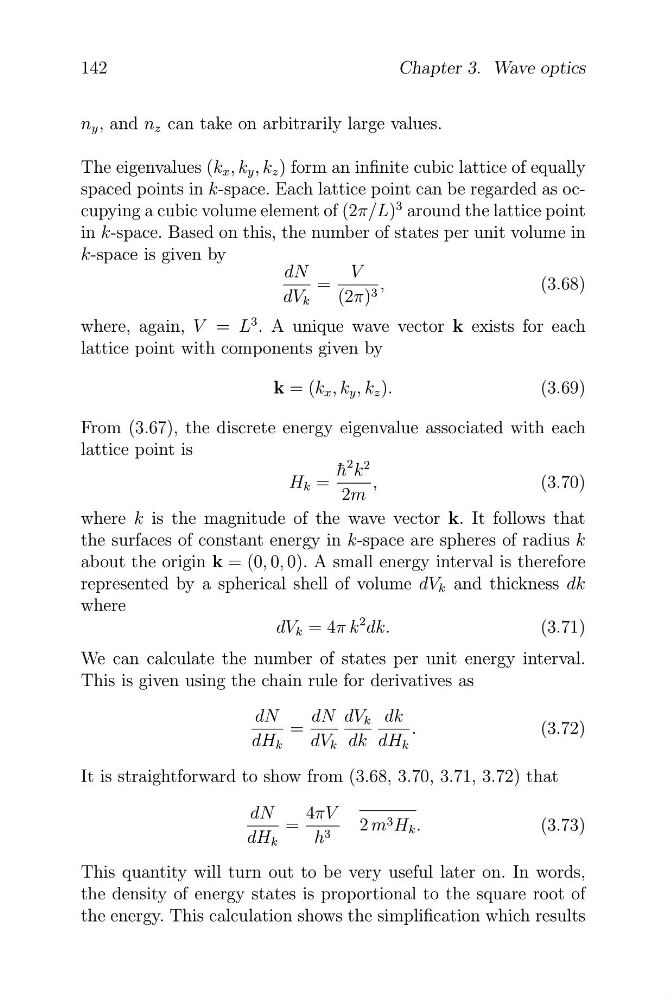
The eigenvalues (k x , k y , k z ) form an infinite cubic lattice of equally
spaced points in k-space. Each lattice point can be regarded as occupying a cubic volume element of (2π/L)
3 around the lattice point
in k-space. Based on this, the number of states per unit volume in
k-space is given by
dN
V
=
,
(3.68)
dV k
(2π) 3
where, again, V = L
3 . A unique wave vector k exists for each
lattice point with components given by
k = (k x , k y , k z ).
(3.69)
From (3.67), the discrete energy eigenvalue associated with each
lattice point is
h
2 k
2
¯
H k =
,
(3.70)
2m
where k is the magnitude of the wave vector k. It follows that
the surfaces of constant energy in k-space are spheres of radius k
about the origin k = (0, 0, 0). A small energy interval is therefore
represented by a spherical shell of volume dV k and thickness dk
where
dV k = 4π k
2 dk.
(3.71)
We can calculate the number of states per unit energy interval.
This is given using the chain rule for derivatives as
dN
dN dV k dk
=
.
(3.72)
dH k
dV k dk dH k
It is straightforward to show from (3.68, 3.70, 3.71, 3.72) that
dN
4πV
=
2 m 3 H k .
(3.73)
dH k
h 3
This quantity will turn out to be very useful later on. In words,
the density of energy states is proportional to the square root of
the energy. This calculation shows the simplification which results
Chapter 3. Wave optics
n y , and n z can take on arbitrarily large values.
The eigenvalues (k x , k y , k z ) form an infinite cubic lattice of equally
spaced points in k-space. Each lattice point can be regarded as occupying a cubic volume element of (2π/L)
3 around the lattice point
in k-space. Based on this, the number of states per unit volume in
k-space is given by
dN
V
=
,
(3.68)
dV k
(2π) 3
where, again, V = L
3 . A unique wave vector k exists for each
lattice point with components given by
k = (k x , k y , k z ).
(3.69)
From (3.67), the discrete energy eigenvalue associated with each
lattice point is
h
2 k
2
¯
H k =
,
(3.70)
2m
where k is the magnitude of the wave vector k. It follows that
the surfaces of constant energy in k-space are spheres of radius k
about the origin k = (0, 0, 0). A small energy interval is therefore
represented by a spherical shell of volume dV k and thickness dk
where
dV k = 4π k
2 dk.
(3.71)
We can calculate the number of states per unit energy interval.
This is given using the chain rule for derivatives as
dN
dN dV k dk
=
.
(3.72)
dH k
dV k dk dH k
It is straightforward to show from (3.68, 3.70, 3.71, 3.72) that
dN
4πV
=
2 m 3 H k .
(3.73)
dH k
h 3
This quantity will turn out to be very useful later on. In words,
the density of energy states is proportional to the square root of
the energy. This calculation shows the simplification which results