

106
Chapter 2. Geometrical optics
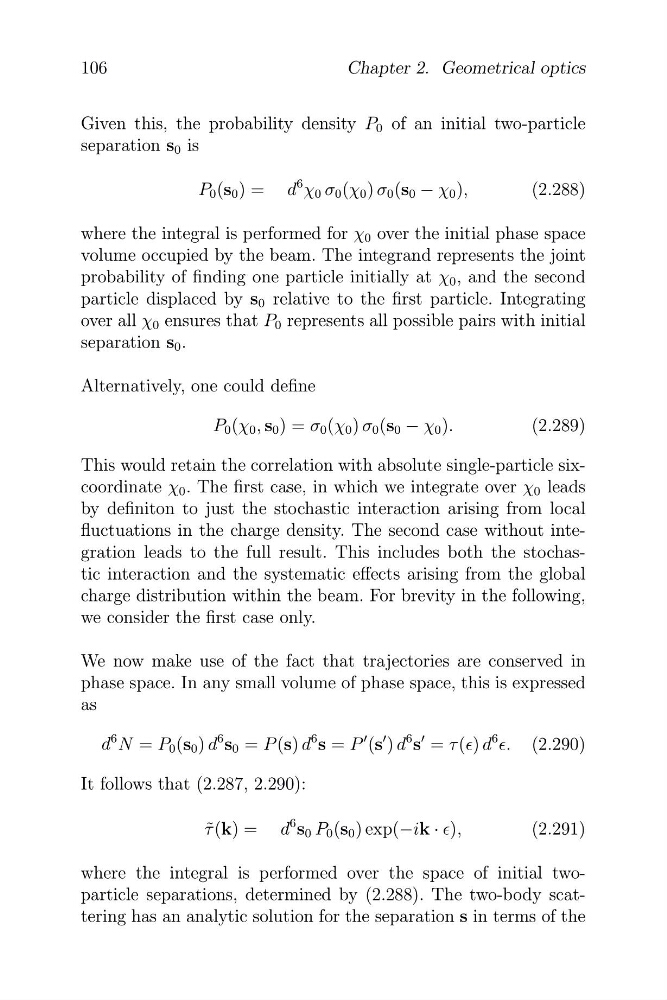
Given this, the probability density P 0 of an initial two-particle
separation s 0 is
P 0 (s 0 ) = d
6 χ 0 σ 0 (χ 0 ) σ 0 (s 0 − χ 0 ),
(2.288)
where the integral is performed for χ 0 over the initial phase space
volume occupied by the beam. The integrand represents the joint
probability of finding one particle initially at χ 0 , and the second
particle displaced by s 0 relative to the first particle. Integrating
over all χ 0 ensures that P 0 represents all possible pairs with initial
separation s 0 .
Alternatively, one could define
P 0 (χ 0 , s 0 ) = σ 0 (χ 0 ) σ 0 (s 0 − χ 0 ).
(2.289)
This would retain the correlation with absolute single-particle sixcoordinate χ 0 . The first case, in which we integrate over χ 0 leads
by definiton to just the stochastic interaction arising from local
fluctuations in the charge density. The second case without integration leads to the full result. This includes both the stochastic interaction and the systematic effects arising from the global
charge distribution within the beam. For brevity in the following,
we consider the first case only.
We now make use of the fact that trajectories are conserved in
phase space. In any small volume of phase space, this is expressed
as
d
6 N = P 0 (s 0 ) d
6 s 0 = P (s) d
6 s = P
� (s
� ) d
6 s
� = τ (f) d
6 f. (2.290)
It follows that (2.287, 2.290):
τ ˜(k) = d
6 s 0 P 0 (s 0 ) exp(−ik · f),
(2.291)
where the integral is performed over the space of initial twoparticle separations, determined by (2.288). The two-body scattering has an analytic solution for the separation s in terms of the
Chapter 2. Geometrical optics
Given this, the probability density P 0 of an initial two-particle
separation s 0 is
P 0 (s 0 ) = d
6 χ 0 σ 0 (χ 0 ) σ 0 (s 0 − χ 0 ),
(2.288)
where the integral is performed for χ 0 over the initial phase space
volume occupied by the beam. The integrand represents the joint
probability of finding one particle initially at χ 0 , and the second
particle displaced by s 0 relative to the first particle. Integrating
over all χ 0 ensures that P 0 represents all possible pairs with initial
separation s 0 .
Alternatively, one could define
P 0 (χ 0 , s 0 ) = σ 0 (χ 0 ) σ 0 (s 0 − χ 0 ).
(2.289)
This would retain the correlation with absolute single-particle sixcoordinate χ 0 . The first case, in which we integrate over χ 0 leads
by definiton to just the stochastic interaction arising from local
fluctuations in the charge density. The second case without integration leads to the full result. This includes both the stochastic interaction and the systematic effects arising from the global
charge distribution within the beam. For brevity in the following,
we consider the first case only.
We now make use of the fact that trajectories are conserved in
phase space. In any small volume of phase space, this is expressed
as
d
6 N = P 0 (s 0 ) d
6 s 0 = P (s) d
6 s = P
� (s
� ) d
6 s
� = τ (f) d
6 f. (2.290)
It follows that (2.287, 2.290):
τ ˜(k) = d
6 s 0 P 0 (s 0 ) exp(−ik · f),
(2.291)
where the integral is performed over the space of initial twoparticle separations, determined by (2.288). The two-body scattering has an analytic solution for the separation s in terms of the