

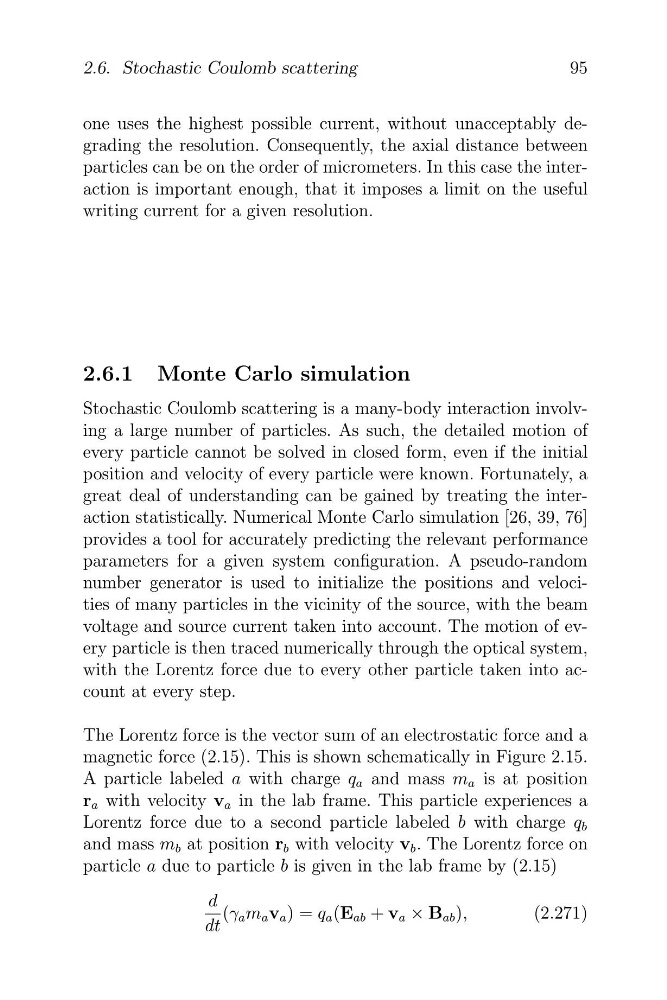
d (γ a m a v a ) = q a (E ab + v a × B ab ),
(2.271)
dt
95
2.6. Stochastic Coulomb scattering
one uses the highest possible current, without unacceptably degrading the resolution. Consequently, the axial distance between
particles can be on the order of micrometers. In this case the interaction is important enough, that it imposes a limit on the useful
writing current for a given resolution.
2.6.1 Monte Carlo simulation
Stochastic Coulomb scattering is a many-body interaction involving a large number of particles. As such, the detailed motion of
every particle cannot be solved in closed form, even if the initial
position and velocity of every particle were known. Fortunately, a
great deal of understanding can be gained by treating the interaction statistically. Numerical Monte Carlo simulation [26, 39, 76]
provides a tool for accurately predicting the relevant performance
parameters for a given system configuration. A pseudo-random
number generator is used to initialize the positions and velocities of many particles in the vicinity of the source, with the beam
voltage and source current taken into account. The motion of every particle is then traced numerically through the optical system,
with the Lorentz force due to every other particle taken into account at every step.
The Lorentz force is the vector sum of an electrostatic force and a
magnetic force (2.15). This is shown schematically in Figure 2.15.
A particle labeled a with charge q a and mass m a is at position
r a with velocity v a in the lab frame. This particle experiences a
Lorentz force due to a second particle labeled b with charge q b
and mass m b at position r b with velocity v b . The Lorentz force on
particle a due to particle b is given in the lab frame by (2.15)
(2.271)
dt
95
2.6. Stochastic Coulomb scattering
one uses the highest possible current, without unacceptably degrading the resolution. Consequently, the axial distance between
particles can be on the order of micrometers. In this case the interaction is important enough, that it imposes a limit on the useful
writing current for a given resolution.
2.6.1 Monte Carlo simulation
Stochastic Coulomb scattering is a many-body interaction involving a large number of particles. As such, the detailed motion of
every particle cannot be solved in closed form, even if the initial
position and velocity of every particle were known. Fortunately, a
great deal of understanding can be gained by treating the interaction statistically. Numerical Monte Carlo simulation [26, 39, 76]
provides a tool for accurately predicting the relevant performance
parameters for a given system configuration. A pseudo-random
number generator is used to initialize the positions and velocities of many particles in the vicinity of the source, with the beam
voltage and source current taken into account. The motion of every particle is then traced numerically through the optical system,
with the Lorentz force due to every other particle taken into account at every step.
The Lorentz force is the vector sum of an electrostatic force and a
magnetic force (2.15). This is shown schematically in Figure 2.15.
A particle labeled a with charge q a and mass m a is at position
r a with velocity v a in the lab frame. This particle experiences a
Lorentz force due to a second particle labeled b with charge q b
and mass m b at position r b with velocity v b . The Lorentz force on
particle a due to particle b is given in the lab frame by (2.15)