

Terahertz Radiators Based on Silicon Carbide Avalanche Transit …
43
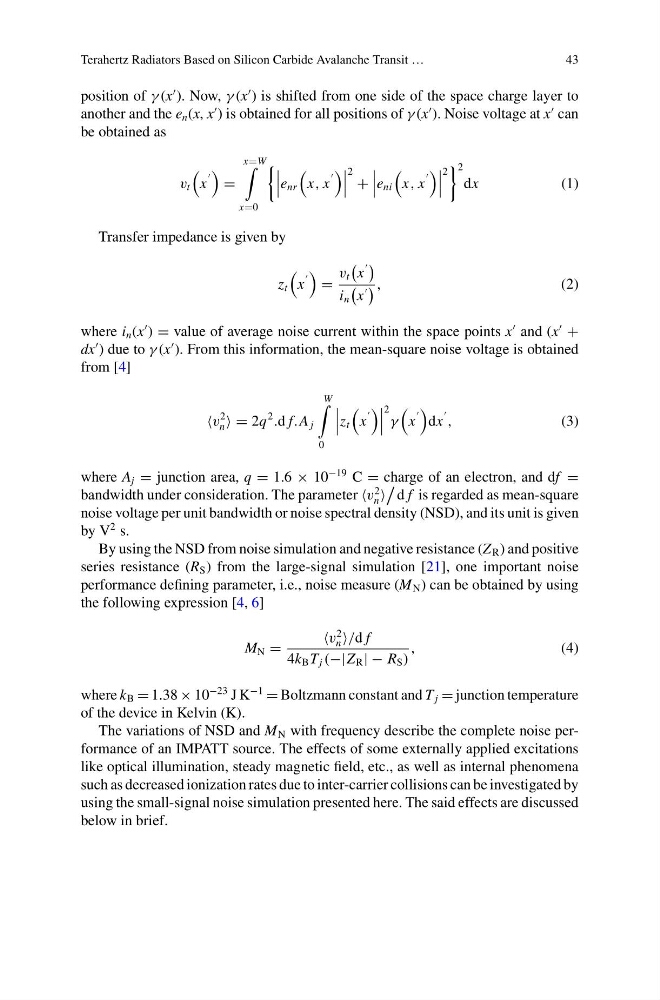
position of γ (x
). Now, γ (x
) is shifted from one side of the space charge layer to
another and the e n (x, x
) is obtained for all positions of γ (x
). Noise voltage at x
can
be obtained as
v t
x
=
x=W
x=0
enr
x, x
2 +
eni
x, x
2
2
dx
(1)
Transfer impedance is given by
z t
x
=
v t
x
i n
x
,
(2)
where i n (x
) = value of average noise current within the space points x
and (x
+
dx
) due to γ (x
). From this information, the mean-square noise voltage is obtained
from [4]
v
2
n = 2q
2
.d f.A j
W
0
zt
x
2 γ
x
dx
,
(3)
where A j = junction area, q = 1.6 × 10
−19 C = charge of an electron, and df =
bandwidth under consideration. The parameter v
2
n
d f is regarded as mean-square
noise voltage per unit bandwidth or noise spectral density (NSD), and its unit is given
by V
2 s.
By using the NSD from noise simulation and negative resistance (Z R ) and positive
series resistance (R S ) from the large-signal simulation [21], one important noise
performance defining parameter, i.e., noise measure (M N ) can be obtained by using
the following expression [4, 6]
M N =
v
2
n /d f
4k B T j (−|Z R | − R S )
,
(4)
where k B = 1.38 × 10
−23 J K
−1
= Boltzmann constant and T j = junction temperature
of the device in Kelvin (K).
The variations of NSD and M N with frequency describe the complete noise performance of an IMPATT source. The effects of some externally applied excitations
like optical illumination, steady magnetic field, etc., as well as internal phenomena
such as decreased ionization rates due to inter-carrier collisions can be investigated by
using the small-signal noise simulation presented here. The said effects are discussed
below in brief.
43
position of γ (x
). Now, γ (x
) is shifted from one side of the space charge layer to
another and the e n (x, x
) is obtained for all positions of γ (x
). Noise voltage at x
can
be obtained as
v t
x
=
x=W
x=0
enr
x, x
2 +
eni
x, x
2
2
dx
(1)
Transfer impedance is given by
z t
x
=
v t
x
i n
x
,
(2)
where i n (x
) = value of average noise current within the space points x
and (x
+
dx
) due to γ (x
). From this information, the mean-square noise voltage is obtained
from [4]
v
2
n = 2q
2
.d f.A j
W
0
zt
x
2 γ
x
dx
,
(3)
where A j = junction area, q = 1.6 × 10
−19 C = charge of an electron, and df =
bandwidth under consideration. The parameter v
2
n
d f is regarded as mean-square
noise voltage per unit bandwidth or noise spectral density (NSD), and its unit is given
by V
2 s.
By using the NSD from noise simulation and negative resistance (Z R ) and positive
series resistance (R S ) from the large-signal simulation [21], one important noise
performance defining parameter, i.e., noise measure (M N ) can be obtained by using
the following expression [4, 6]
M N =
v
2
n /d f
4k B T j (−|Z R | − R S )
,
(4)
where k B = 1.38 × 10
−23 J K
−1
= Boltzmann constant and T j = junction temperature
of the device in Kelvin (K).
The variations of NSD and M N with frequency describe the complete noise performance of an IMPATT source. The effects of some externally applied excitations
like optical illumination, steady magnetic field, etc., as well as internal phenomena
such as decreased ionization rates due to inter-carrier collisions can be investigated by
using the small-signal noise simulation presented here. The said effects are discussed
below in brief.