

170
R. N. Kini and C. P. Vaisakh
is one of the most popular techniques used to produce terahertz (THz) radiation
in table-top spectroscopic systems of the day. A large number of II–VI and III–V
semiconductors emit THz radiation upon femtosecond optical excitation due to various physical mechanisms. Studying the THz emission from these materials not only
reveals the emission mechanisms but also guides the search for efficient broadband
sources of THz radiation. In this chapter, we discuss the influence of isoelectronic
alloying of III–V semiconductors in the THz emission phenomenon.
2 THz Emission from Semiconductors
Femtosecond lasers deliver extraordinary optical energy, setting forth interesting processes in materials. Terahertz emission from semiconductors relies on the transient
phenomenon (fs-ps) powered by ultrafast optical pulses. It either takes a nonlinear
optical route or a transient current route. The nonlinear optical route relies on a
process called optical rectification (OR). OR leads to rapid variation in the electric
polarization in the semiconductor crystal, and the time-varying polarization acts as
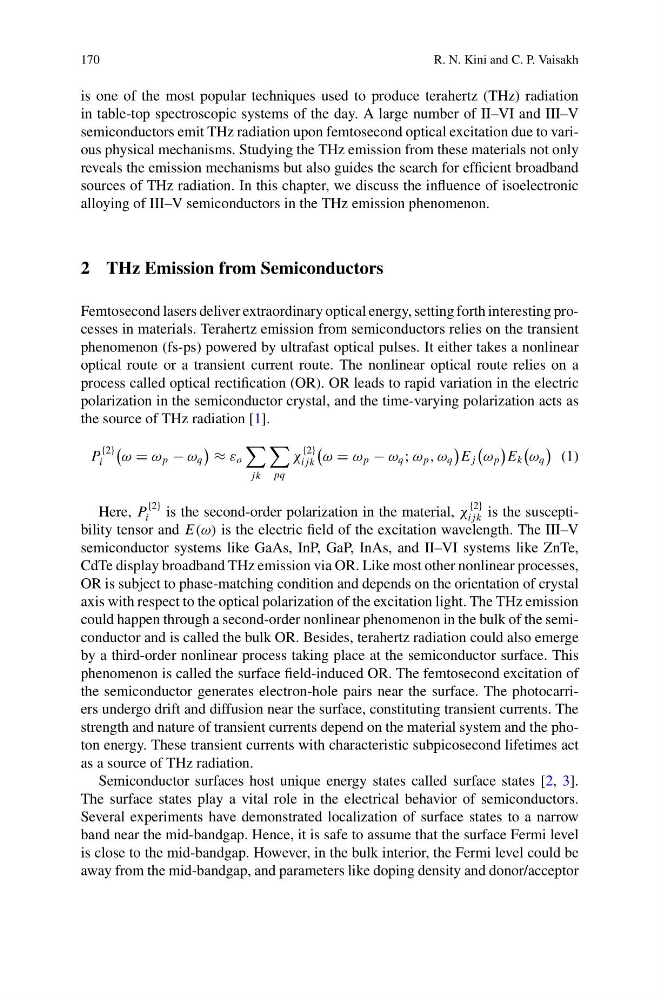
the source of THz radiation [1].
P
{2}
i
ω = ω p − ω q
≈ ε o
jk
pq
χ
{2}
i jk
ω = ω p − ω q ; ω p , ω q
E j
ω p
E k
ω q
(1)
Here, P
{2}
i
is the second-order polarization in the material, χ
{2}
i jk is the susceptibility tensor and E(ω) is the electric field of the excitation wavelength. The III–V
semiconductor systems like GaAs, InP, GaP, InAs, and II–VI systems like ZnTe,
CdTe display broadband THz emission via OR. Like most other nonlinear processes,
OR is subject to phase-matching condition and depends on the orientation of crystal
axis with respect to the optical polarization of the excitation light. The THz emission
could happen through a second-order nonlinear phenomenon in the bulk of the semiconductor and is called the bulk OR. Besides, terahertz radiation could also emerge
by a third-order nonlinear process taking place at the semiconductor surface. This
phenomenon is called the surface field-induced OR. The femtosecond excitation of
the semiconductor generates electron-hole pairs near the surface. The photocarriers undergo drift and diffusion near the surface, constituting transient currents. The
strength and nature of transient currents depend on the material system and the photon energy. These transient currents with characteristic subpicosecond lifetimes act
as a source of THz radiation.
Semiconductor surfaces host unique energy states called surface states [2, 3].
The surface states play a vital role in the electrical behavior of semiconductors.
Several experiments have demonstrated localization of surface states to a narrow
band near the mid-bandgap. Hence, it is safe to assume that the surface Fermi level
is close to the mid-bandgap. However, in the bulk interior, the Fermi level could be
away from the mid-bandgap, and parameters like doping density and donor/acceptor
R. N. Kini and C. P. Vaisakh
is one of the most popular techniques used to produce terahertz (THz) radiation
in table-top spectroscopic systems of the day. A large number of II–VI and III–V
semiconductors emit THz radiation upon femtosecond optical excitation due to various physical mechanisms. Studying the THz emission from these materials not only
reveals the emission mechanisms but also guides the search for efficient broadband
sources of THz radiation. In this chapter, we discuss the influence of isoelectronic
alloying of III–V semiconductors in the THz emission phenomenon.
2 THz Emission from Semiconductors
Femtosecond lasers deliver extraordinary optical energy, setting forth interesting processes in materials. Terahertz emission from semiconductors relies on the transient
phenomenon (fs-ps) powered by ultrafast optical pulses. It either takes a nonlinear
optical route or a transient current route. The nonlinear optical route relies on a
process called optical rectification (OR). OR leads to rapid variation in the electric
polarization in the semiconductor crystal, and the time-varying polarization acts as
the source of THz radiation [1].
P
{2}
i
ω = ω p − ω q
≈ ε o
jk
pq
χ
{2}
i jk
ω = ω p − ω q ; ω p , ω q
E j
ω p
E k
ω q
(1)
Here, P
{2}
i
is the second-order polarization in the material, χ
{2}
i jk is the susceptibility tensor and E(ω) is the electric field of the excitation wavelength. The III–V
semiconductor systems like GaAs, InP, GaP, InAs, and II–VI systems like ZnTe,
CdTe display broadband THz emission via OR. Like most other nonlinear processes,
OR is subject to phase-matching condition and depends on the orientation of crystal
axis with respect to the optical polarization of the excitation light. The THz emission
could happen through a second-order nonlinear phenomenon in the bulk of the semiconductor and is called the bulk OR. Besides, terahertz radiation could also emerge
by a third-order nonlinear process taking place at the semiconductor surface. This
phenomenon is called the surface field-induced OR. The femtosecond excitation of
the semiconductor generates electron-hole pairs near the surface. The photocarriers undergo drift and diffusion near the surface, constituting transient currents. The
strength and nature of transient currents depend on the material system and the photon energy. These transient currents with characteristic subpicosecond lifetimes act
as a source of THz radiation.
Semiconductor surfaces host unique energy states called surface states [2, 3].
The surface states play a vital role in the electrical behavior of semiconductors.
Several experiments have demonstrated localization of surface states to a narrow
band near the mid-bandgap. Hence, it is safe to assume that the surface Fermi level
is close to the mid-bandgap. However, in the bulk interior, the Fermi level could be
away from the mid-bandgap, and parameters like doping density and donor/acceptor