

Advances in Terahertz Imaging
149
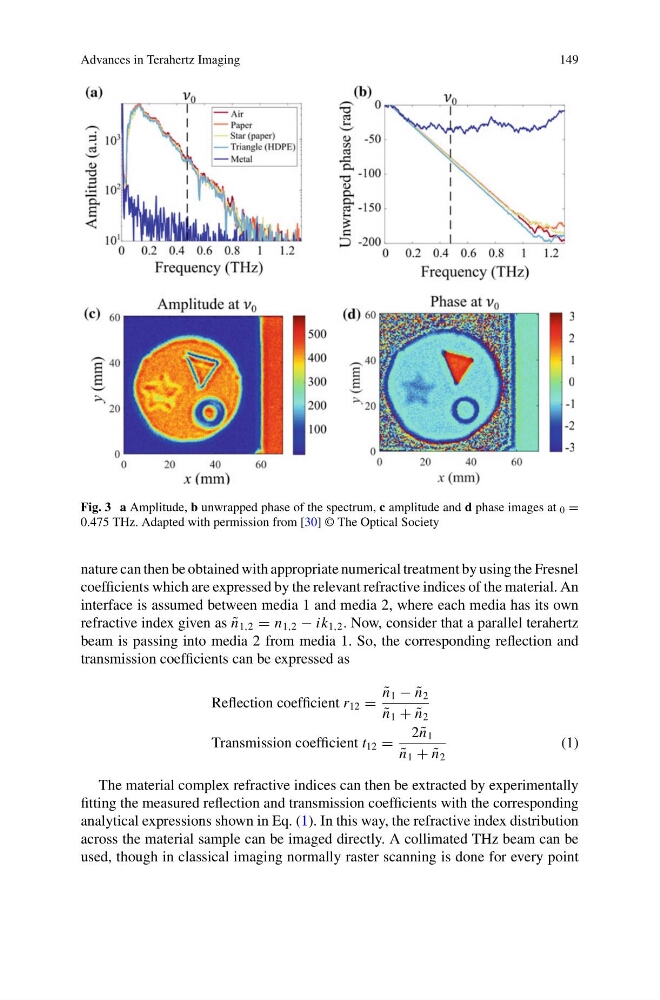
Fig. 3 a Amplitude, b unwrapped phase of the spectrum, c amplitude and d phase images at 0 =
0.475 THz. Adapted with permission from [30] © The Optical Society
nature can then be obtained with appropriate numerical treatment by using the Fresnel
coefficients which are expressed by the relevant refractive indices of the material. An
interface is assumed between media 1 and media 2, where each media has its own
refractive index given as ˜
n 1,2 = n 1,2 − ik 1,2 . Now, consider that a parallel terahertz
beam is passing into media 2 from media 1. So, the corresponding reflection and
transmission coefficients can be expressed as
Reflection coefficient r 12 =
˜
n 1 − ˜
n 2
˜
n 1 + ˜
n 2
Transmission coefficient t 12 =
2 ˜
n 1
˜
n 1 + ˜
n 2
(1)
The material complex refractive indices can then be extracted by experimentally
fitting the measured reflection and transmission coefficients with the corresponding
analytical expressions shown in Eq. (1). In this way, the refractive index distribution
across the material sample can be imaged directly. A collimated THz beam can be
used, though in classical imaging normally raster scanning is done for every point
149
Fig. 3 a Amplitude, b unwrapped phase of the spectrum, c amplitude and d phase images at 0 =
0.475 THz. Adapted with permission from [30] © The Optical Society
nature can then be obtained with appropriate numerical treatment by using the Fresnel
coefficients which are expressed by the relevant refractive indices of the material. An
interface is assumed between media 1 and media 2, where each media has its own
refractive index given as ˜
n 1,2 = n 1,2 − ik 1,2 . Now, consider that a parallel terahertz
beam is passing into media 2 from media 1. So, the corresponding reflection and
transmission coefficients can be expressed as
Reflection coefficient r 12 =
˜
n 1 − ˜
n 2
˜
n 1 + ˜
n 2
Transmission coefficient t 12 =
2 ˜
n 1
˜
n 1 + ˜
n 2
(1)
The material complex refractive indices can then be extracted by experimentally
fitting the measured reflection and transmission coefficients with the corresponding
analytical expressions shown in Eq. (1). In this way, the refractive index distribution
across the material sample can be imaged directly. A collimated THz beam can be
used, though in classical imaging normally raster scanning is done for every point