

146
A. Saha
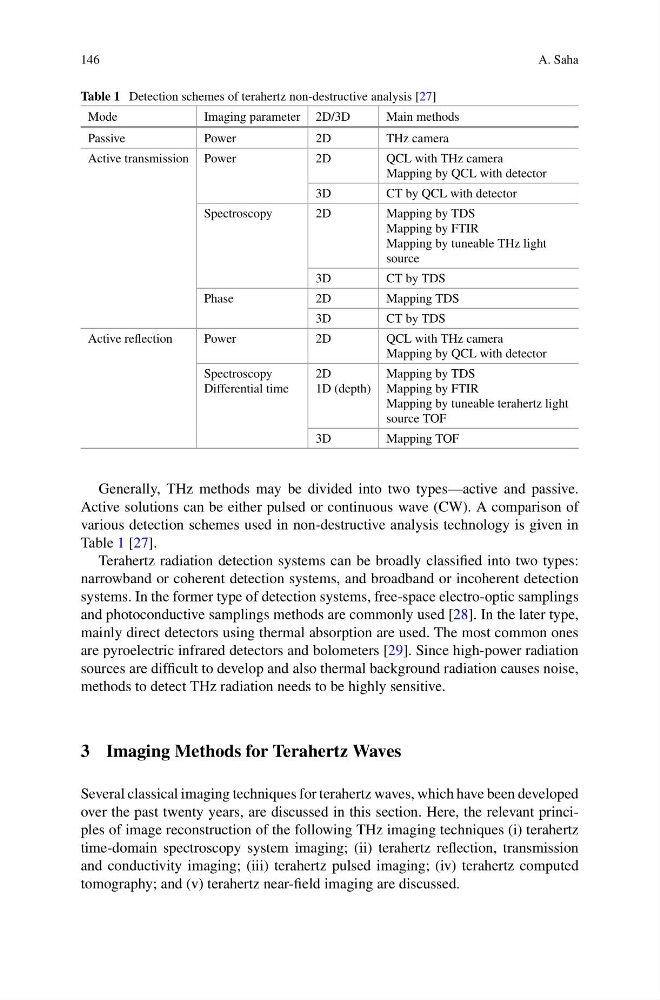
Table 1 Detection schemes of terahertz non-destructive analysis [27]
Mode
Imaging parameter 2D/3D
Main methods
Passive
Power
2D
THz camera
Active transmission Power
2D
QCL with THz camera
Mapping by QCL with detector
3D
CT by QCL with detector
Spectroscopy
2D
Mapping by TDS
Mapping by FTIR
Mapping by tuneable THz light
source
3D
CT by TDS
Phase
2D
Mapping TDS
3D
CT by TDS
Active reflection
Power
2D
QCL with THz camera
Mapping by QCL with detector
Spectroscopy
Differential time
2D
1D (depth)
Mapping by TDS
Mapping by FTIR
Mapping by tuneable terahertz light
source TOF
3D
Mapping TOF
Generally, THz methods may be divided into two types—active and passive.
Active solutions can be either pulsed or continuous wave (CW). A comparison of
various detection schemes used in non-destructive analysis technology is given in
Table 1 [27].
Terahertz radiation detection systems can be broadly classified into two types:
narrowband or coherent detection systems, and broadband or incoherent detection
systems. In the former type of detection systems, free-space electro-optic samplings
and photoconductive samplings methods are commonly used [28]. In the later type,
mainly direct detectors using thermal absorption are used. The most common ones
are pyroelectric infrared detectors and bolometers [29]. Since high-power radiation
sources are difficult to develop and also thermal background radiation causes noise,
methods to detect THz radiation needs to be highly sensitive.
3 Imaging Methods for Terahertz Waves
Several classical imaging techniques for terahertz waves, which have been developed
over the past twenty years, are discussed in this section. Here, the relevant principles of image reconstruction of the following THz imaging techniques (i) terahertz
time-domain spectroscopy system imaging; (ii) terahertz reflection, transmission
and conductivity imaging; (iii) terahertz pulsed imaging; (iv) terahertz computed
tomography; and (v) terahertz near-field imaging are discussed.
A. Saha
Table 1 Detection schemes of terahertz non-destructive analysis [27]
Mode
Imaging parameter 2D/3D
Main methods
Passive
Power
2D
THz camera
Active transmission Power
2D
QCL with THz camera
Mapping by QCL with detector
3D
CT by QCL with detector
Spectroscopy
2D
Mapping by TDS
Mapping by FTIR
Mapping by tuneable THz light
source
3D
CT by TDS
Phase
2D
Mapping TDS
3D
CT by TDS
Active reflection
Power
2D
QCL with THz camera
Mapping by QCL with detector
Spectroscopy
Differential time
2D
1D (depth)
Mapping by TDS
Mapping by FTIR
Mapping by tuneable terahertz light
source TOF
3D
Mapping TOF
Generally, THz methods may be divided into two types—active and passive.
Active solutions can be either pulsed or continuous wave (CW). A comparison of
various detection schemes used in non-destructive analysis technology is given in
Table 1 [27].
Terahertz radiation detection systems can be broadly classified into two types:
narrowband or coherent detection systems, and broadband or incoherent detection
systems. In the former type of detection systems, free-space electro-optic samplings
and photoconductive samplings methods are commonly used [28]. In the later type,
mainly direct detectors using thermal absorption are used. The most common ones
are pyroelectric infrared detectors and bolometers [29]. Since high-power radiation
sources are difficult to develop and also thermal background radiation causes noise,
methods to detect THz radiation needs to be highly sensitive.
3 Imaging Methods for Terahertz Waves
Several classical imaging techniques for terahertz waves, which have been developed
over the past twenty years, are discussed in this section. Here, the relevant principles of image reconstruction of the following THz imaging techniques (i) terahertz
time-domain spectroscopy system imaging; (ii) terahertz reflection, transmission
and conductivity imaging; (iii) terahertz pulsed imaging; (iv) terahertz computed
tomography; and (v) terahertz near-field imaging are discussed.