

144
A. Saha
1 Introduction
In today’s world, the technology of imaging has developed a lot since the invention of
photographic techniques in the mid-1820s. With the passage of time, lots of research
works have been done in this area, and as a result, many novel imaging technologies
have emerged. In modern days, imaging technology has moved far beyond visible
wavelength range. On one hand in X-ray imaging, subatomic wavelengths are used,
whereas on the other hand in radars, wavelengths of several metres are employed. In
fact, for various applications, different parts of the available electromagnetic spectrum are now utilized. However, in this chapter, the focus is only on a small part of
this huge spectrum—the terahertz range.
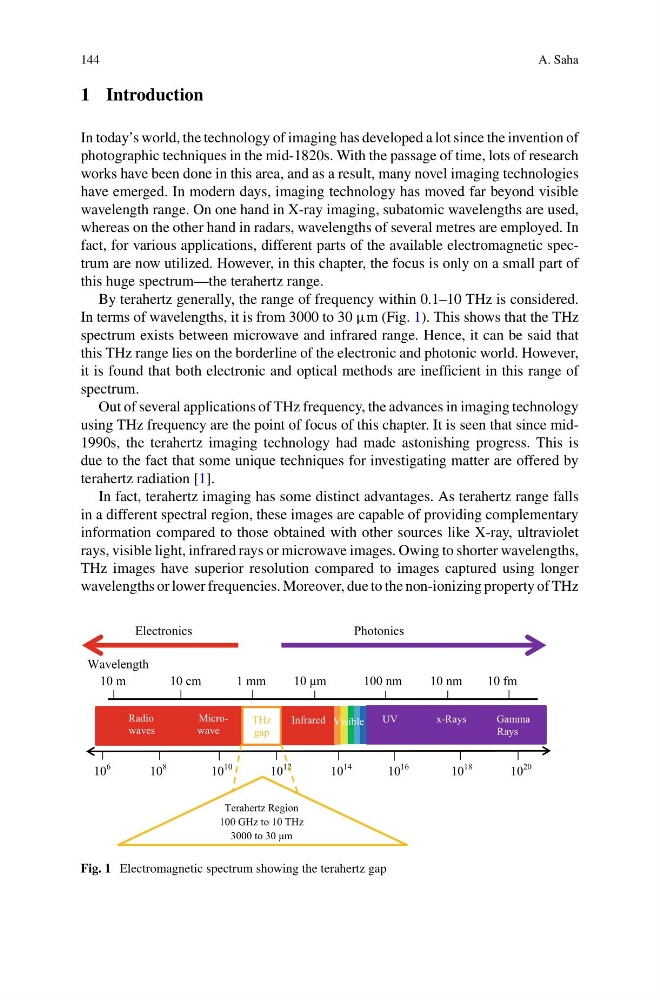
By terahertz generally, the range of frequency within 0.1–10 THz is considered.
In terms of wavelengths, it is from 3000 to 30 μm (Fig. 1). This shows that the THz
spectrum exists between microwave and infrared range. Hence, it can be said that
this THz range lies on the borderline of the electronic and photonic world. However,
it is found that both electronic and optical methods are inefficient in this range of
spectrum.
Out of several applications of THz frequency, the advances in imaging technology
using THz frequency are the point of focus of this chapter. It is seen that since mid1990s, the terahertz imaging technology had made astonishing progress. This is
due to the fact that some unique techniques for investigating matter are offered by
terahertz radiation [1].
In fact, terahertz imaging has some distinct advantages. As terahertz range falls
in a different spectral region, these images are capable of providing complementary
information compared to those obtained with other sources like X-ray, ultraviolet
rays, visible light, infrared rays or microwave images. Owing to shorter wavelengths,
THz images have superior resolution compared to images captured using longer
wavelengths or lower frequencies. Moreover, due to the non-ionizing property of THz
Electronics
Photonics
Wavelength
10 m
10 cm
1 mm
10 μm
100 nm
10 nm
10 fm
10
6
10
8
10
10
10
12
10
14
10
16
10
18
10
20
Radio
Microwaves
wave
THz
gap
Infrared
UV
x-Rays
Gamma
Rays
Visible
Terahertz Region
100 GHz to 10 THz
3000 to 30 μm
Fig. 1 Electromagnetic spectrum showing the terahertz gap
A. Saha
1 Introduction
In today’s world, the technology of imaging has developed a lot since the invention of
photographic techniques in the mid-1820s. With the passage of time, lots of research
works have been done in this area, and as a result, many novel imaging technologies
have emerged. In modern days, imaging technology has moved far beyond visible
wavelength range. On one hand in X-ray imaging, subatomic wavelengths are used,
whereas on the other hand in radars, wavelengths of several metres are employed. In
fact, for various applications, different parts of the available electromagnetic spectrum are now utilized. However, in this chapter, the focus is only on a small part of
this huge spectrum—the terahertz range.
By terahertz generally, the range of frequency within 0.1–10 THz is considered.
In terms of wavelengths, it is from 3000 to 30 μm (Fig. 1). This shows that the THz
spectrum exists between microwave and infrared range. Hence, it can be said that
this THz range lies on the borderline of the electronic and photonic world. However,
it is found that both electronic and optical methods are inefficient in this range of
spectrum.
Out of several applications of THz frequency, the advances in imaging technology
using THz frequency are the point of focus of this chapter. It is seen that since mid1990s, the terahertz imaging technology had made astonishing progress. This is
due to the fact that some unique techniques for investigating matter are offered by
terahertz radiation [1].
In fact, terahertz imaging has some distinct advantages. As terahertz range falls
in a different spectral region, these images are capable of providing complementary
information compared to those obtained with other sources like X-ray, ultraviolet
rays, visible light, infrared rays or microwave images. Owing to shorter wavelengths,
THz images have superior resolution compared to images captured using longer
wavelengths or lower frequencies. Moreover, due to the non-ionizing property of THz
Electronics
Photonics
Wavelength
10 m
10 cm
1 mm
10 μm
100 nm
10 nm
10 fm
10
6
10
8
10
10
10
12
10
14
10
16
10
18
10
20
Radio
Microwaves
wave
THz
gap
Infrared
UV
x-Rays
Gamma
Rays
Visible
Terahertz Region
100 GHz to 10 THz
3000 to 30 μm
Fig. 1 Electromagnetic spectrum showing the terahertz gap