

Data Transmission with Terahertz Communication Systems
133
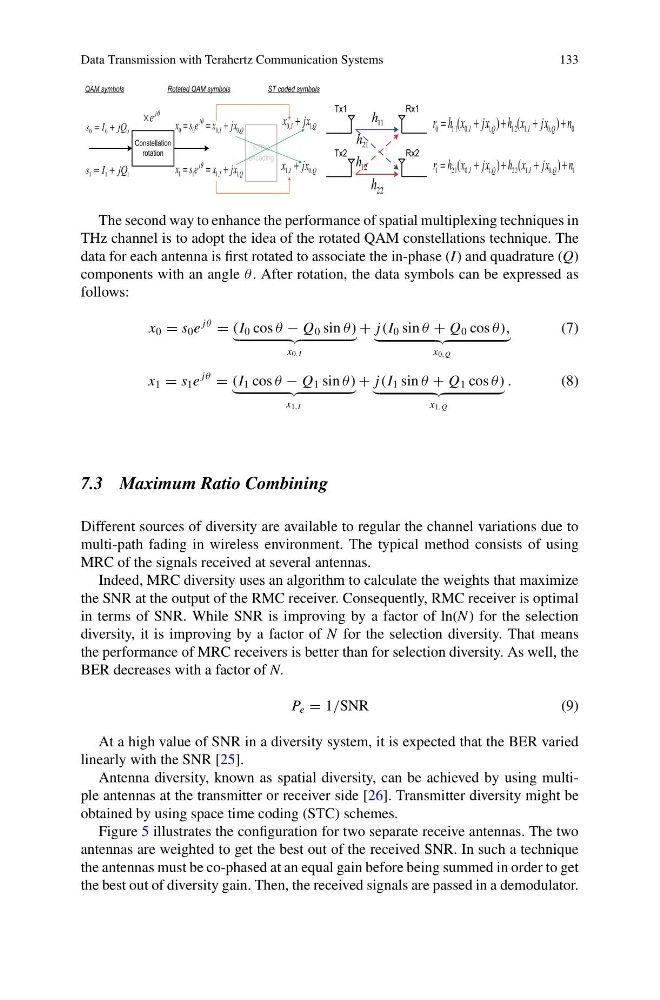
The second way to enhance the performance of spatial multiplexing techniques in
THz channel is to adopt the idea of the rotated QAM constellations technique. The
data for each antenna is first rotated to associate the in-phase (I) and quadrature (Q)
components with an angle θ . After rotation, the data symbols can be expressed as
follows:
x 0 = s 0 e
jθ
= (I 0 cos θ − Q 0 sin θ)
x 0,I
+ j(I 0 sin θ + Q 0 cos θ),
x 0,Q
(7)
x 1 = s 1 e
jθ
= (I 1 cos θ − Q 1 sin θ)
x 1,I
+ j(I 1 sin θ + Q 1 cos θ)
x 1,Q
.
(8)
7.3 Maximum Ratio Combining
Different sources of diversity are available to regular the channel variations due to
multi-path fading in wireless environment. The typical method consists of using
MRC of the signals received at several antennas.
Indeed, MRC diversity uses an algorithm to calculate the weights that maximize
the SNR at the output of the RMC receiver. Consequently, RMC receiver is optimal
in terms of SNR. While SNR is improving by a factor of ln(N) for the selection
diversity, it is improving by a factor of N for the selection diversity. That means
the performance of MRC receivers is better than for selection diversity. As well, the
BER decreases with a factor of N.
P e = 1/SNR
(9)
At a high value of SNR in a diversity system, it is expected that the BER varied
linearly with the SNR [25].
Antenna diversity, known as spatial diversity, can be achieved by using multiple antennas at the transmitter or receiver side [26]. Transmitter diversity might be
obtained by using space time coding (STC) schemes.
Figure 5 illustrates the configuration for two separate receive antennas. The two
antennas are weighted to get the best out of the received SNR. In such a technique
the antennas must be co-phased at an equal gain before being summed in order to get
the best out of diversity gain. Then, the received signals are passed in a demodulator.
133
The second way to enhance the performance of spatial multiplexing techniques in
THz channel is to adopt the idea of the rotated QAM constellations technique. The
data for each antenna is first rotated to associate the in-phase (I) and quadrature (Q)
components with an angle θ . After rotation, the data symbols can be expressed as
follows:
x 0 = s 0 e
jθ
= (I 0 cos θ − Q 0 sin θ)
x 0,I
+ j(I 0 sin θ + Q 0 cos θ),
x 0,Q
(7)
x 1 = s 1 e
jθ
= (I 1 cos θ − Q 1 sin θ)
x 1,I
+ j(I 1 sin θ + Q 1 cos θ)
x 1,Q
.
(8)
7.3 Maximum Ratio Combining
Different sources of diversity are available to regular the channel variations due to
multi-path fading in wireless environment. The typical method consists of using
MRC of the signals received at several antennas.
Indeed, MRC diversity uses an algorithm to calculate the weights that maximize
the SNR at the output of the RMC receiver. Consequently, RMC receiver is optimal
in terms of SNR. While SNR is improving by a factor of ln(N) for the selection
diversity, it is improving by a factor of N for the selection diversity. That means
the performance of MRC receivers is better than for selection diversity. As well, the
BER decreases with a factor of N.
P e = 1/SNR
(9)
At a high value of SNR in a diversity system, it is expected that the BER varied
linearly with the SNR [25].
Antenna diversity, known as spatial diversity, can be achieved by using multiple antennas at the transmitter or receiver side [26]. Transmitter diversity might be
obtained by using space time coding (STC) schemes.
Figure 5 illustrates the configuration for two separate receive antennas. The two
antennas are weighted to get the best out of the received SNR. In such a technique
the antennas must be co-phased at an equal gain before being summed in order to get
the best out of diversity gain. Then, the received signals are passed in a demodulator.