

Data Transmission with Terahertz Communication Systems
129
0
5
10
15
20
25
1
2
3
4
5
6
7
8
9
10
Eb/No dB
Spectral efficiency, bit/sec/Hz
QPSK/4-QAM
8-PSK
32-QAP
128-QAM
BPSK
Channon Limit
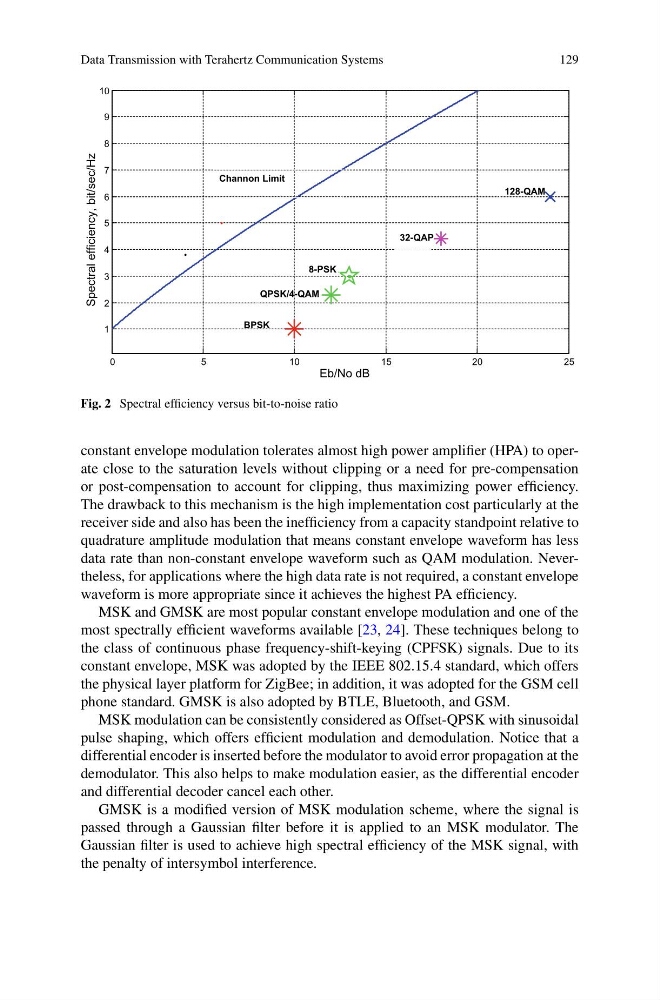
Fig. 2 Spectral efficiency versus bit-to-noise ratio
constant envelope modulation tolerates almost high power amplifier (HPA) to operate close to the saturation levels without clipping or a need for pre-compensation
or post-compensation to account for clipping, thus maximizing power efficiency.
The drawback to this mechanism is the high implementation cost particularly at the
receiver side and also has been the inefficiency from a capacity standpoint relative to
quadrature amplitude modulation that means constant envelope waveform has less
data rate than non-constant envelope waveform such as QAM modulation. Nevertheless, for applications where the high data rate is not required, a constant envelope
waveform is more appropriate since it achieves the highest PA efficiency.
MSK and GMSK are most popular constant envelope modulation and one of the
most spectrally efficient waveforms available [23, 24]. These techniques belong to
the class of continuous phase frequency-shift-keying (CPFSK) signals. Due to its
constant envelope, MSK was adopted by the IEEE 802.15.4 standard, which offers
the physical layer platform for ZigBee; in addition, it was adopted for the GSM cell
phone standard. GMSK is also adopted by BTLE, Bluetooth, and GSM.
MSK modulation can be consistently considered as Offset-QPSK with sinusoidal
pulse shaping, which offers efficient modulation and demodulation. Notice that a
differential encoder is inserted before the modulator to avoid error propagation at the
demodulator. This also helps to make modulation easier, as the differential encoder
and differential decoder cancel each other.
GMSK is a modified version of MSK modulation scheme, where the signal is
passed through a Gaussian filter before it is applied to an MSK modulator. The
Gaussian filter is used to achieve high spectral efficiency of the MSK signal, with
the penalty of intersymbol interference.
129
0
5
10
15
20
25
1
2
3
4
5
6
7
8
9
10
Eb/No dB
Spectral efficiency, bit/sec/Hz
QPSK/4-QAM
8-PSK
32-QAP
128-QAM
BPSK
Channon Limit
Fig. 2 Spectral efficiency versus bit-to-noise ratio
constant envelope modulation tolerates almost high power amplifier (HPA) to operate close to the saturation levels without clipping or a need for pre-compensation
or post-compensation to account for clipping, thus maximizing power efficiency.
The drawback to this mechanism is the high implementation cost particularly at the
receiver side and also has been the inefficiency from a capacity standpoint relative to
quadrature amplitude modulation that means constant envelope waveform has less
data rate than non-constant envelope waveform such as QAM modulation. Nevertheless, for applications where the high data rate is not required, a constant envelope
waveform is more appropriate since it achieves the highest PA efficiency.
MSK and GMSK are most popular constant envelope modulation and one of the
most spectrally efficient waveforms available [23, 24]. These techniques belong to
the class of continuous phase frequency-shift-keying (CPFSK) signals. Due to its
constant envelope, MSK was adopted by the IEEE 802.15.4 standard, which offers
the physical layer platform for ZigBee; in addition, it was adopted for the GSM cell
phone standard. GMSK is also adopted by BTLE, Bluetooth, and GSM.
MSK modulation can be consistently considered as Offset-QPSK with sinusoidal
pulse shaping, which offers efficient modulation and demodulation. Notice that a
differential encoder is inserted before the modulator to avoid error propagation at the
demodulator. This also helps to make modulation easier, as the differential encoder
and differential decoder cancel each other.
GMSK is a modified version of MSK modulation scheme, where the signal is
passed through a Gaussian filter before it is applied to an MSK modulator. The
Gaussian filter is used to achieve high spectral efficiency of the MSK signal, with
the penalty of intersymbol interference.