

Both packages of theories, i.e. Extreme Value Theories and theories on
Adaptionism and Anti-Adaptionism represent general considerations of different
disciplines. They form a general frame of the theory outlined here. The following
theories are more concrete and are normally discussed within natural sciences.
In ecology and biogeography there is a critical discussion about the feedbacks
between environmental, ecological and evolutionary processes (Adaptive Dynamics
Theory, Maynard Smith 1978; Wilson and Agnew 1992; Nowak and Sigmund 2004;
Tilman 2004). The meaning of optimization in biological systems is increasingly
recognized since modern evolutionary theory is introduced (Ferriere and Legendre
2013; van der Ploeg et al. 1999; Parker and Maynard Smith 1990; Reiss 1987; Gould
and Lewontin 1979; Walters and Hilborn 1978; Maynard Smith 1978; Cody and
Diamond 1975; MacArthur and Wilson 1967; Darwin 1839, 1859).
The Resource-Ratio Theory, going back to MacArthur (1972) and Tilman (1980,
1982, 1985), focuses on growth rates and population dynamics of competing species
which use the same resources and environment. Most of the related experiments
were conducted in aquatic ecosystems or aquariums (Miller et al. 2005). Tilman
(2004) later on discussed niche tradeoffs with respect to resource competition,
species invasion and stochasticity.
However, we want to focus on biomass/structure, productivity and species
diversity as important properties of ecosystems, and assume that processes
and conditions of the relationship between resource availability, population growth
and competition alone cannot adequately explain the assembly because mutualism
and facilitation are also so important and competition seems to be overinterpretated
(Stachowicz 2001; Tilman 2004). Figure 1 shows the position of the context in a
theoretical framework.
Research about important processes within ecosystems like primary productivity,
community assembly rules and filter models (Fig. 2), and the influence of the
environment and species pool on the local species diversity, has stimulated discussion and promoted our understanding during recent years (e.g., Feßel et al. 2016;
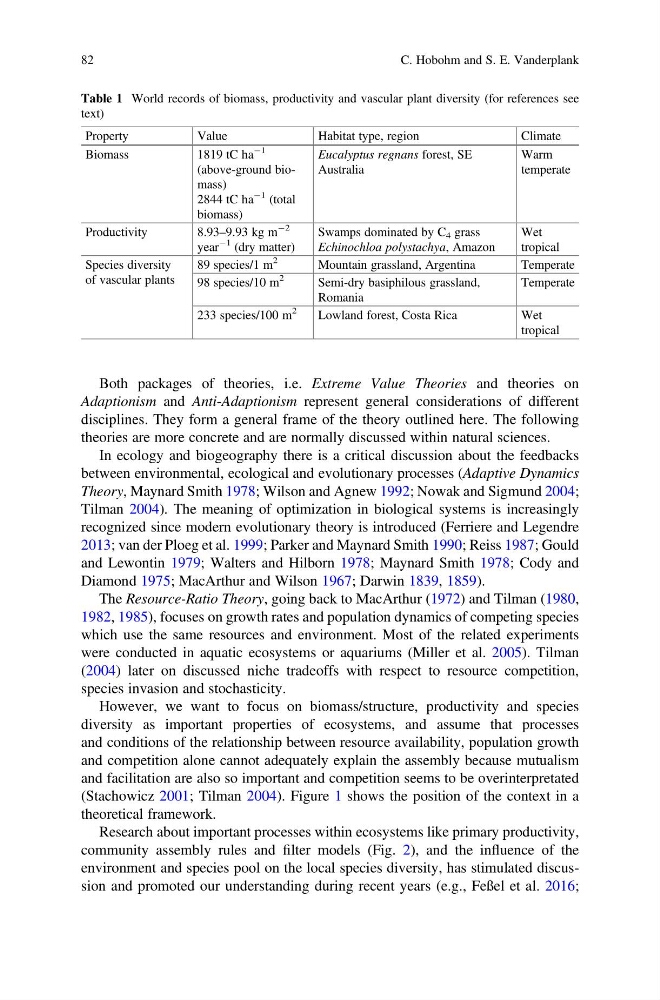
Table 1 World records of biomass, productivity and vascular plant diversity (for references see
text)
Property
Value
Habitat type, region
Climate
Biomass
1819 tC ha
À1
(above-ground biomass)
2844 tC ha
À1 (total
biomass)
Eucalyptus regnans forest, SE
Australia
Warm
temperate
Productivity
8.93–9.93 kg m
À2
year
À1 (dry matter)
Swamps dominated by C 4 grass
Echinochloa polystachya, Amazon
Wet
tropical
Species diversity
of vascular plants
89 species/1 m
2
Mountain grassland, Argentina
Temperate
98 species/10 m
2
Semi-dry basiphilous grassland,
Romania
Temperate
233 species/100 m
2
Lowland forest, Costa Rica
Wet
tropical
82
C. Hobohm and S. E. Vanderplank
Adaptionism and Anti-Adaptionism represent general considerations of different
disciplines. They form a general frame of the theory outlined here. The following
theories are more concrete and are normally discussed within natural sciences.
In ecology and biogeography there is a critical discussion about the feedbacks
between environmental, ecological and evolutionary processes (Adaptive Dynamics
Theory, Maynard Smith 1978; Wilson and Agnew 1992; Nowak and Sigmund 2004;
Tilman 2004). The meaning of optimization in biological systems is increasingly
recognized since modern evolutionary theory is introduced (Ferriere and Legendre
2013; van der Ploeg et al. 1999; Parker and Maynard Smith 1990; Reiss 1987; Gould
and Lewontin 1979; Walters and Hilborn 1978; Maynard Smith 1978; Cody and
Diamond 1975; MacArthur and Wilson 1967; Darwin 1839, 1859).
The Resource-Ratio Theory, going back to MacArthur (1972) and Tilman (1980,
1982, 1985), focuses on growth rates and population dynamics of competing species
which use the same resources and environment. Most of the related experiments
were conducted in aquatic ecosystems or aquariums (Miller et al. 2005). Tilman
(2004) later on discussed niche tradeoffs with respect to resource competition,
species invasion and stochasticity.
However, we want to focus on biomass/structure, productivity and species
diversity as important properties of ecosystems, and assume that processes
and conditions of the relationship between resource availability, population growth
and competition alone cannot adequately explain the assembly because mutualism
and facilitation are also so important and competition seems to be overinterpretated
(Stachowicz 2001; Tilman 2004). Figure 1 shows the position of the context in a
theoretical framework.
Research about important processes within ecosystems like primary productivity,
community assembly rules and filter models (Fig. 2), and the influence of the
environment and species pool on the local species diversity, has stimulated discussion and promoted our understanding during recent years (e.g., Feßel et al. 2016;
Table 1 World records of biomass, productivity and vascular plant diversity (for references see
text)
Property
Value
Habitat type, region
Climate
Biomass
1819 tC ha
À1
(above-ground biomass)
2844 tC ha
À1 (total
biomass)
Eucalyptus regnans forest, SE
Australia
Warm
temperate
Productivity
8.93–9.93 kg m
À2
year
À1 (dry matter)
Swamps dominated by C 4 grass
Echinochloa polystachya, Amazon
Wet
tropical
Species diversity
of vascular plants
89 species/1 m
2
Mountain grassland, Argentina
Temperate
98 species/10 m
2
Semi-dry basiphilous grassland,
Romania
Temperate
233 species/100 m
2
Lowland forest, Costa Rica
Wet
tropical
82
C. Hobohm and S. E. Vanderplank