

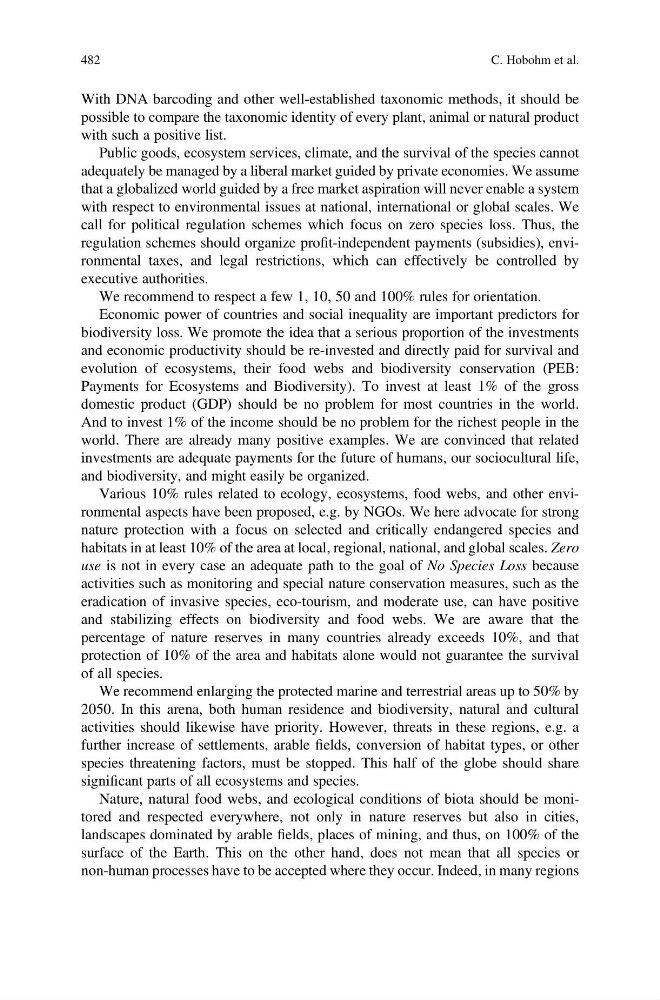
With DNA barcoding and other well-established taxonomic methods, it should be
possible to compare the taxonomic identity of every plant, animal or natural product
with such a positive list.
Public goods, ecosystem services, climate, and the survival of the species cannot
adequately be managed by a liberal market guided by private economies. We assume
that a globalized world guided by a free market aspiration will never enable a system
with respect to environmental issues at national, international or global scales. We
call for political regulation schemes which focus on zero species loss. Thus, the
regulation schemes should organize profit-independent payments (subsidies), environmental taxes, and legal restrictions, which can effectively be controlled by
executive authorities.
We recommend to respect a few 1, 10, 50 and 100% rules for orientation.
Economic power of countries and social inequality are important predictors for
biodiversity loss. We promote the idea that a serious proportion of the investments
and economic productivity should be re-invested and directly paid for survival and
evolution of ecosystems, their food webs and biodiversity conservation (PEB:
Payments for Ecosystems and Biodiversity). To invest at least 1% of the gross
domestic product (GDP) should be no problem for most countries in the world.
And to invest 1% of the income should be no problem for the richest people in the
world. There are already many positive examples. We are convinced that related
investments are adequate payments for the future of humans, our sociocultural life,
and biodiversity, and might easily be organized.
Various 10% rules related to ecology, ecosystems, food webs, and other environmental aspects have been proposed, e.g. by NGOs. We here advocate for strong
nature protection with a focus on selected and critically endangered species and
habitats in at least 10% of the area at local, regional, national, and global scales. Zero
use is not in every case an adequate path to the goal of No Species Loss because
activities such as monitoring and special nature conservation measures, such as the
eradication of invasive species, eco-tourism, and moderate use, can have positive
and stabilizing effects on biodiversity and food webs. We are aware that the
percentage of nature reserves in many countries already exceeds 10%, and that
protection of 10% of the area and habitats alone would not guarantee the survival
of all species.
We recommend enlarging the protected marine and terrestrial areas up to 50% by
2050. In this arena, both human residence and biodiversity, natural and cultural
activities should likewise have priority. However, threats in these regions, e.g. a
further increase of settlements, arable fields, conversion of habitat types, or other
species threatening factors, must be stopped. This half of the globe should share
significant parts of all ecosystems and species.
Nature, natural food webs, and ecological conditions of biota should be monitored and respected everywhere, not only in nature reserves but also in cities,
landscapes dominated by arable fields, places of mining, and thus, on 100% of the
surface of the Earth. This on the other hand, does not mean that all species or
non-human processes have to be accepted where they occur. Indeed, in many regions
482
C. Hobohm et al.
possible to compare the taxonomic identity of every plant, animal or natural product
with such a positive list.
Public goods, ecosystem services, climate, and the survival of the species cannot
adequately be managed by a liberal market guided by private economies. We assume
that a globalized world guided by a free market aspiration will never enable a system
with respect to environmental issues at national, international or global scales. We
call for political regulation schemes which focus on zero species loss. Thus, the
regulation schemes should organize profit-independent payments (subsidies), environmental taxes, and legal restrictions, which can effectively be controlled by
executive authorities.
We recommend to respect a few 1, 10, 50 and 100% rules for orientation.
Economic power of countries and social inequality are important predictors for
biodiversity loss. We promote the idea that a serious proportion of the investments
and economic productivity should be re-invested and directly paid for survival and
evolution of ecosystems, their food webs and biodiversity conservation (PEB:
Payments for Ecosystems and Biodiversity). To invest at least 1% of the gross
domestic product (GDP) should be no problem for most countries in the world.
And to invest 1% of the income should be no problem for the richest people in the
world. There are already many positive examples. We are convinced that related
investments are adequate payments for the future of humans, our sociocultural life,
and biodiversity, and might easily be organized.
Various 10% rules related to ecology, ecosystems, food webs, and other environmental aspects have been proposed, e.g. by NGOs. We here advocate for strong
nature protection with a focus on selected and critically endangered species and
habitats in at least 10% of the area at local, regional, national, and global scales. Zero
use is not in every case an adequate path to the goal of No Species Loss because
activities such as monitoring and special nature conservation measures, such as the
eradication of invasive species, eco-tourism, and moderate use, can have positive
and stabilizing effects on biodiversity and food webs. We are aware that the
percentage of nature reserves in many countries already exceeds 10%, and that
protection of 10% of the area and habitats alone would not guarantee the survival
of all species.
We recommend enlarging the protected marine and terrestrial areas up to 50% by
2050. In this arena, both human residence and biodiversity, natural and cultural
activities should likewise have priority. However, threats in these regions, e.g. a
further increase of settlements, arable fields, conversion of habitat types, or other
species threatening factors, must be stopped. This half of the globe should share
significant parts of all ecosystems and species.
Nature, natural food webs, and ecological conditions of biota should be monitored and respected everywhere, not only in nature reserves but also in cities,
landscapes dominated by arable fields, places of mining, and thus, on 100% of the
surface of the Earth. This on the other hand, does not mean that all species or
non-human processes have to be accepted where they occur. Indeed, in many regions
482
C. Hobohm et al.