

depending on the region called (in the Netherlands) essen, enken or engen. These
were large complexes, located in the immediate vicinity of the farms, which were
surrounded by vast heathlands. The heath had two important functions: first as
grazing grounds for the flocks of sheep, who returned home in the evening and
spent the night in the so-called potstal (potting stable), and furthermore as a supplier
of raw plant material that was spread in the stable to be mixed with the sheep’s
faeces. The resulting fertilizer was then spread on the fields, where grains and other
crops were grown. Due to the mineral components, these fields became higher and
higher, and in this way they are still recognizable as elevations in the landscape
today.
Rye (Triticum secale) was an excellent cereal to cultivate on these fields, as the
species is able to grow on acidic sands that were too poor to grow other cereals.
Cultivated Rye derived from the wild species Secale montanum and Secale vavilovii,
which are endemic to forest clearings and field margins of South Asia, up to 2500 m
above sea level (Schlegel 2014). The fields are known as eternal rye fields, but this
image has been nuanced in recent years: the use was much more varied and in any
case, they turned out not to be eternal. All sorts of annual herbals grew among the tall
grain, many of which are now on the Red List of Vascular Plants in the Netherlands.
Think of species such as Arnoseris minima, Scleranthus annuus, Hypochaeris
glabra and Anthoxanthum aristatum. The latter species is called slofhak in Dutch,
as the stalks of this grass contain a lot of silica, making the axes rapidly blunt
(hak ¼ ax, slof ¼ blunt).
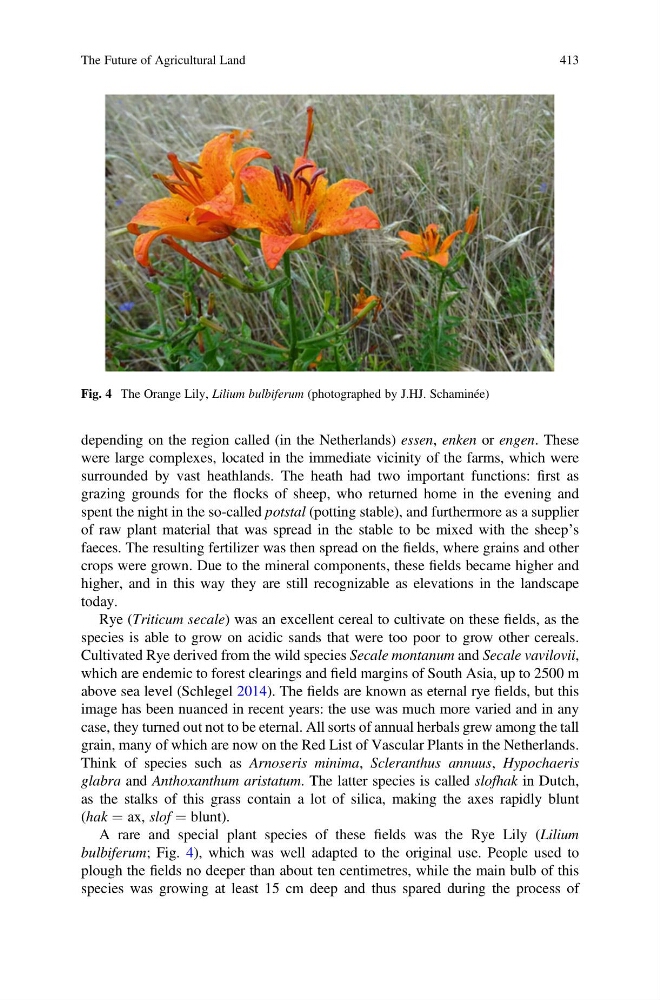
A rare and special plant species of these fields was the Rye Lily (Lilium
bulbiferum; Fig. 4), which was well adapted to the original use. People used to
plough the fields no deeper than about ten centimetres, while the main bulb of this
species was growing at least 15 cm deep and thus spared during the process of
Fig. 4 The Orange Lily, Lilium bulbiferum (photographed by J.HJ. Schaminée)
The Future of Agricultural Land
413
were large complexes, located in the immediate vicinity of the farms, which were
surrounded by vast heathlands. The heath had two important functions: first as
grazing grounds for the flocks of sheep, who returned home in the evening and
spent the night in the so-called potstal (potting stable), and furthermore as a supplier
of raw plant material that was spread in the stable to be mixed with the sheep’s
faeces. The resulting fertilizer was then spread on the fields, where grains and other
crops were grown. Due to the mineral components, these fields became higher and
higher, and in this way they are still recognizable as elevations in the landscape
today.
Rye (Triticum secale) was an excellent cereal to cultivate on these fields, as the
species is able to grow on acidic sands that were too poor to grow other cereals.
Cultivated Rye derived from the wild species Secale montanum and Secale vavilovii,
which are endemic to forest clearings and field margins of South Asia, up to 2500 m
above sea level (Schlegel 2014). The fields are known as eternal rye fields, but this
image has been nuanced in recent years: the use was much more varied and in any
case, they turned out not to be eternal. All sorts of annual herbals grew among the tall
grain, many of which are now on the Red List of Vascular Plants in the Netherlands.
Think of species such as Arnoseris minima, Scleranthus annuus, Hypochaeris
glabra and Anthoxanthum aristatum. The latter species is called slofhak in Dutch,
as the stalks of this grass contain a lot of silica, making the axes rapidly blunt
(hak ¼ ax, slof ¼ blunt).
A rare and special plant species of these fields was the Rye Lily (Lilium
bulbiferum; Fig. 4), which was well adapted to the original use. People used to
plough the fields no deeper than about ten centimetres, while the main bulb of this
species was growing at least 15 cm deep and thus spared during the process of
Fig. 4 The Orange Lily, Lilium bulbiferum (photographed by J.HJ. Schaminée)
The Future of Agricultural Land
413