

relatively wet eastern half of these plains are a major corn and soybean producing
region, known as the Corn Belt, whereas the drier western parts, known as the Wheat
Belt, produce high rates of wheat. Currently, the yearly production of corn (maize) in
the United States is more than 400 million tons, which counts for about one-third the
worldwide production, more than the production of any other grain in the world
(International Grains Council 2019). Approximately 40% of the crop is used for corn
ethanol (The New York Times, 11-02-2011). The percentage of genetically modified
corn (Zea mays) planted in the United States is increasing exponentially, from less
than 10% in 1999 to more than 85% in 2009 (www.gmo-compass.org).
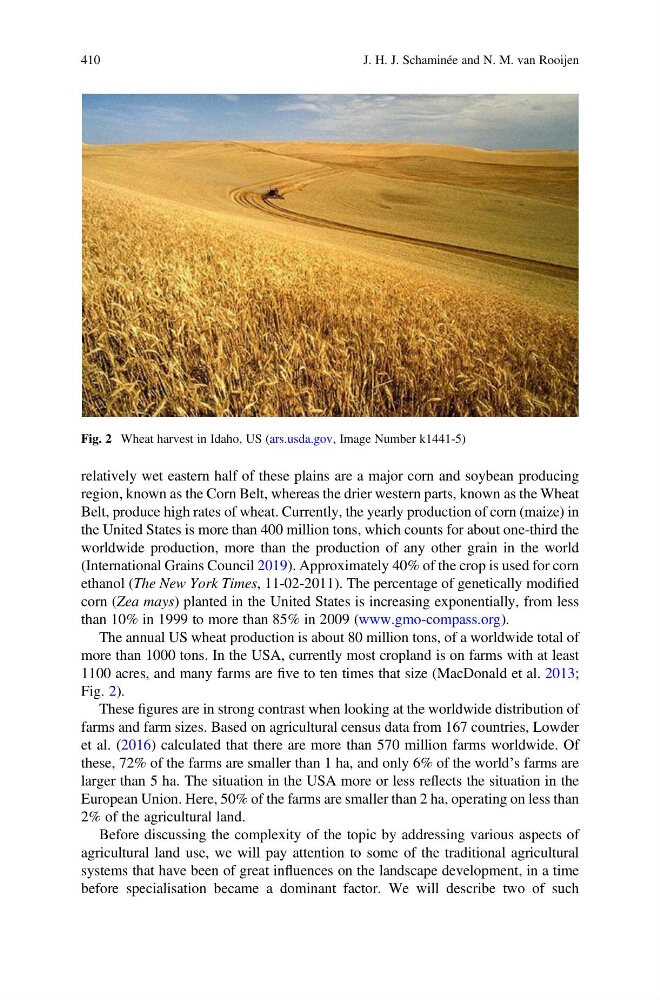
The annual US wheat production is about 80 million tons, of a worldwide total of
more than 1000 tons. In the USA, currently most cropland is on farms with at least
1100 acres, and many farms are five to ten times that size (MacDonald et al. 2013;
Fig. 2).
These figures are in strong contrast when looking at the worldwide distribution of
farms and farm sizes. Based on agricultural census data from 167 countries, Lowder
et al. (2016) calculated that there are more than 570 million farms worldwide. Of
these, 72% of the farms are smaller than 1 ha, and only 6% of the world’s farms are
larger than 5 ha. The situation in the USA more or less reflects the situation in the
European Union. Here, 50% of the farms are smaller than 2 ha, operating on less than
2% of the agricultural land.
Before discussing the complexity of the topic by addressing various aspects of
agricultural land use, we will pay attention to some of the traditional agricultural
systems that have been of great influences on the landscape development, in a time
before specialisation became a dominant factor. We will describe two of such
Fig. 2 Wheat harvest in Idaho, US (ars.usda.gov, Image Number k1441-5)
410
J. H. J. Schaminée and N. M. van Rooijen
region, known as the Corn Belt, whereas the drier western parts, known as the Wheat
Belt, produce high rates of wheat. Currently, the yearly production of corn (maize) in
the United States is more than 400 million tons, which counts for about one-third the
worldwide production, more than the production of any other grain in the world
(International Grains Council 2019). Approximately 40% of the crop is used for corn
ethanol (The New York Times, 11-02-2011). The percentage of genetically modified
corn (Zea mays) planted in the United States is increasing exponentially, from less
than 10% in 1999 to more than 85% in 2009 (www.gmo-compass.org).
The annual US wheat production is about 80 million tons, of a worldwide total of
more than 1000 tons. In the USA, currently most cropland is on farms with at least
1100 acres, and many farms are five to ten times that size (MacDonald et al. 2013;
Fig. 2).
These figures are in strong contrast when looking at the worldwide distribution of
farms and farm sizes. Based on agricultural census data from 167 countries, Lowder
et al. (2016) calculated that there are more than 570 million farms worldwide. Of
these, 72% of the farms are smaller than 1 ha, and only 6% of the world’s farms are
larger than 5 ha. The situation in the USA more or less reflects the situation in the
European Union. Here, 50% of the farms are smaller than 2 ha, operating on less than
2% of the agricultural land.
Before discussing the complexity of the topic by addressing various aspects of
agricultural land use, we will pay attention to some of the traditional agricultural
systems that have been of great influences on the landscape development, in a time
before specialisation became a dominant factor. We will describe two of such
Fig. 2 Wheat harvest in Idaho, US (ars.usda.gov, Image Number k1441-5)
410
J. H. J. Schaminée and N. M. van Rooijen