

Europe today are fragmented, isolated and often surrounded by agricultural land
(Webb 1998).
In Australia 30% of the heathlands are now serve other land use purposes (Keith
et al. 2014).
Savanna and shrubland face similar threats globally (Tscharntke et al. 2005;
Mckinney 2002; Richardson et al. 1995). According to the (IUCN 2019, assessed
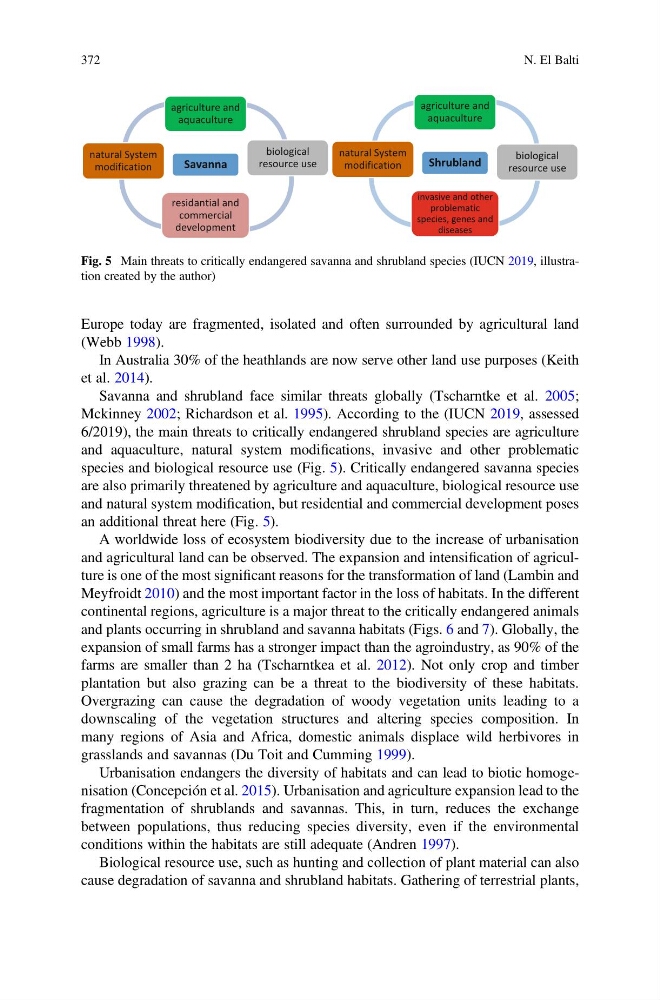
6/2019), the main threats to critically endangered shrubland species are agriculture
and aquaculture, natural system modifications, invasive and other problematic
species and biological resource use (Fig. 5). Critically endangered savanna species
are also primarily threatened by agriculture and aquaculture, biological resource use
and natural system modification, but residential and commercial development poses
an additional threat here (Fig. 5).
A worldwide loss of ecosystem biodiversity due to the increase of urbanisation
and agricultural land can be observed. The expansion and intensification of agriculture is one of the most significant reasons for the transformation of land (Lambin and
Meyfroidt 2010) and the most important factor in the loss of habitats. In the different
continental regions, agriculture is a major threat to the critically endangered animals
and plants occurring in shrubland and savanna habitats (Figs. 6 and 7). Globally, the
expansion of small farms has a stronger impact than the agroindustry, as 90% of the
farms are smaller than 2 ha (Tscharntkea et al. 2012). Not only crop and timber
plantation but also grazing can be a threat to the biodiversity of these habitats.
Overgrazing can cause the degradation of woody vegetation units leading to a
downscaling of the vegetation structures and altering species composition. In
many regions of Asia and Africa, domestic animals displace wild herbivores in
grasslands and savannas (Du Toit and Cumming 1999).
Urbanisation endangers the diversity of habitats and can lead to biotic homogenisation (Concepción et al. 2015). Urbanisation and agriculture expansion lead to the
fragmentation of shrublands and savannas. This, in turn, reduces the exchange
between populations, thus reducing species diversity, even if the environmental
conditions within the habitats are still adequate (Andren 1997).
Biological resource use, such as hunting and collection of plant material can also
cause degradation of savanna and shrubland habitats. Gathering of terrestrial plants,
Savanna
agriculture and
aquaculture
biological
resource use
residantial and
commercial
development
natural System
modification
Shrubland
agriculture and
aquaculture
biological
resource use
invasive and other
problematic
species, genes and
diseases
natural System
modification
Fig. 5 Main threats to critically endangered savanna and shrubland species (IUCN 2019, illustration created by the author)
372
N. El Balti
(Webb 1998).
In Australia 30% of the heathlands are now serve other land use purposes (Keith
et al. 2014).
Savanna and shrubland face similar threats globally (Tscharntke et al. 2005;
Mckinney 2002; Richardson et al. 1995). According to the (IUCN 2019, assessed
6/2019), the main threats to critically endangered shrubland species are agriculture
and aquaculture, natural system modifications, invasive and other problematic
species and biological resource use (Fig. 5). Critically endangered savanna species
are also primarily threatened by agriculture and aquaculture, biological resource use
and natural system modification, but residential and commercial development poses
an additional threat here (Fig. 5).
A worldwide loss of ecosystem biodiversity due to the increase of urbanisation
and agricultural land can be observed. The expansion and intensification of agriculture is one of the most significant reasons for the transformation of land (Lambin and
Meyfroidt 2010) and the most important factor in the loss of habitats. In the different
continental regions, agriculture is a major threat to the critically endangered animals
and plants occurring in shrubland and savanna habitats (Figs. 6 and 7). Globally, the
expansion of small farms has a stronger impact than the agroindustry, as 90% of the
farms are smaller than 2 ha (Tscharntkea et al. 2012). Not only crop and timber
plantation but also grazing can be a threat to the biodiversity of these habitats.
Overgrazing can cause the degradation of woody vegetation units leading to a
downscaling of the vegetation structures and altering species composition. In
many regions of Asia and Africa, domestic animals displace wild herbivores in
grasslands and savannas (Du Toit and Cumming 1999).
Urbanisation endangers the diversity of habitats and can lead to biotic homogenisation (Concepción et al. 2015). Urbanisation and agriculture expansion lead to the
fragmentation of shrublands and savannas. This, in turn, reduces the exchange
between populations, thus reducing species diversity, even if the environmental
conditions within the habitats are still adequate (Andren 1997).
Biological resource use, such as hunting and collection of plant material can also
cause degradation of savanna and shrubland habitats. Gathering of terrestrial plants,
Savanna
agriculture and
aquaculture
biological
resource use
residantial and
commercial
development
natural System
modification
Shrubland
agriculture and
aquaculture
biological
resource use
invasive and other
problematic
species, genes and
diseases
natural System
modification
Fig. 5 Main threats to critically endangered savanna and shrubland species (IUCN 2019, illustration created by the author)
372
N. El Balti