

3 Degradation and Threats to Heathland, Shrub
and Savanna Habitats
The large number of critically endangered species in heath, shrubland and savanna
highlight how important it is to protect and preserve these habitats.
According to the IUCN Red List, shrublands worldwide harbour 293 animal and
333 plant species that are classified as critically endangered. Savannas are the
habitats of 62 critically endangered plants and 39 critically endangered animal
species (IUCN 2019; assessed 6/2019). Both vertebrates and numerous invertebrates
are among the critically endangered animals of these habitats.
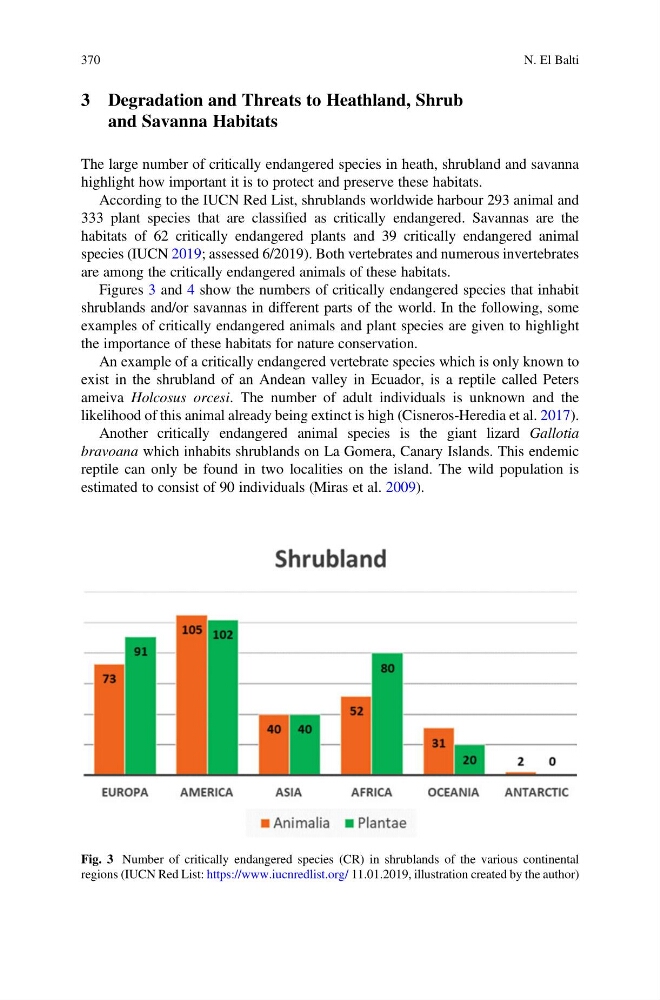
Figures 3 and 4 show the numbers of critically endangered species that inhabit
shrublands and/or savannas in different parts of the world. In the following, some
examples of critically endangered animals and plant species are given to highlight
the importance of these habitats for nature conservation.
An example of a critically endangered vertebrate species which is only known to
exist in the shrubland of an Andean valley in Ecuador, is a reptile called Peters
ameiva Holcosus orcesi. The number of adult individuals is unknown and the
likelihood of this animal already being extinct is high (Cisneros-Heredia et al. 2017).
Another critically endangered animal species is the giant lizard Gallotia
bravoana which inhabits shrublands on La Gomera, Canary Islands. This endemic
reptile can only be found in two localities on the island. The wild population is
estimated to consist of 90 individuals (Miras et al. 2009).
Fig. 3 Number of critically endangered species (CR) in shrublands of the various continental
regions (IUCN Red List: https://www.iucnredlist.org/ 11.01.2019, illustration created by the author)
370
N. El Balti
and Savanna Habitats
The large number of critically endangered species in heath, shrubland and savanna
highlight how important it is to protect and preserve these habitats.
According to the IUCN Red List, shrublands worldwide harbour 293 animal and
333 plant species that are classified as critically endangered. Savannas are the
habitats of 62 critically endangered plants and 39 critically endangered animal
species (IUCN 2019; assessed 6/2019). Both vertebrates and numerous invertebrates
are among the critically endangered animals of these habitats.
Figures 3 and 4 show the numbers of critically endangered species that inhabit
shrublands and/or savannas in different parts of the world. In the following, some
examples of critically endangered animals and plant species are given to highlight
the importance of these habitats for nature conservation.
An example of a critically endangered vertebrate species which is only known to
exist in the shrubland of an Andean valley in Ecuador, is a reptile called Peters
ameiva Holcosus orcesi. The number of adult individuals is unknown and the
likelihood of this animal already being extinct is high (Cisneros-Heredia et al. 2017).
Another critically endangered animal species is the giant lizard Gallotia
bravoana which inhabits shrublands on La Gomera, Canary Islands. This endemic
reptile can only be found in two localities on the island. The wild population is
estimated to consist of 90 individuals (Miras et al. 2009).
Fig. 3 Number of critically endangered species (CR) in shrublands of the various continental
regions (IUCN Red List: https://www.iucnredlist.org/ 11.01.2019, illustration created by the author)
370
N. El Balti