

5 Grasslands Types
Schimper (1898), Ellenberg and Mueller-Dombois (1967), Laycock (1979), Gibson
(2009), and Janssen et al. (2016), for example, distinguished different grassland
types and ordered them in relation to soil conditions (wet, dry, eutrophic, oligotrophic, etc.), climate (arctic, boreal, temperate, subtropical, tropical, arid, humid),
structure (tallgrass, shortgrass, shrub steppe), use (pasture, meadow, fertilized,
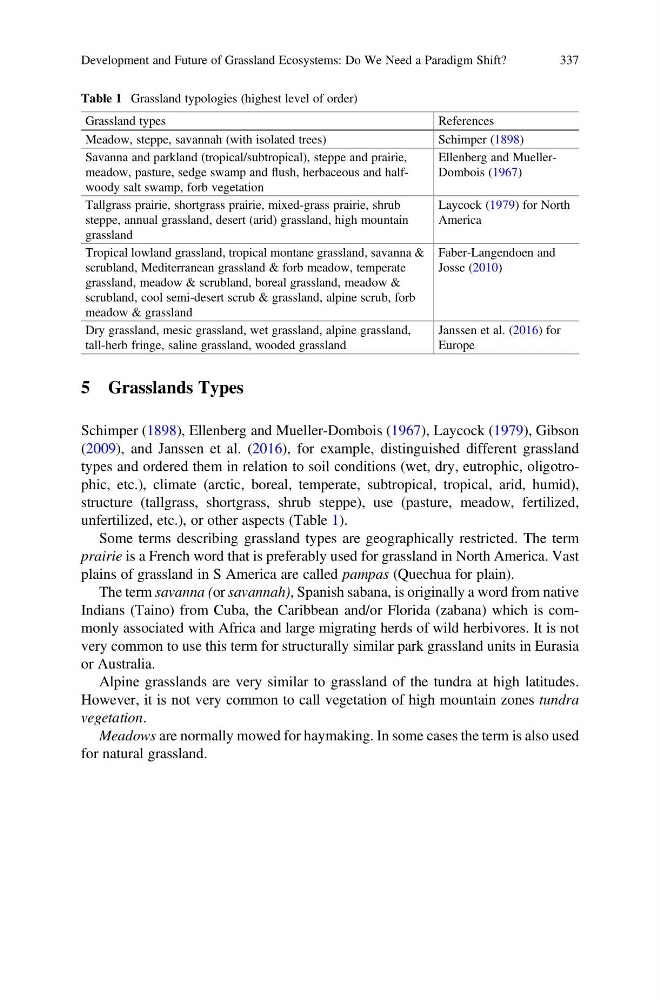
unfertilized, etc.), or other aspects (Table 1).
Some terms describing grassland types are geographically restricted. The term
prairie is a French word that is preferably used for grassland in North America. Vast
plains of grassland in S America are called pampas (Quechua for plain).
The term savanna (or savannah), Spanish sabana, is originally a word from native
Indians (Taino) from Cuba, the Caribbean and/or Florida (zabana) which is commonly associated with Africa and large migrating herds of wild herbivores. It is not
very common to use this term for structurally similar park grassland units in Eurasia
or Australia.
Alpine grasslands are very similar to grassland of the tundra at high latitudes.
However, it is not very common to call vegetation of high mountain zones tundra
vegetation.
Meadows are normally mowed for haymaking. In some cases the term is also used
for natural grassland.
Table 1 Grassland typologies (highest level of order)
Grassland types
References
Meadow, steppe, savannah (with isolated trees)
Schimper (1898)
Savanna and parkland (tropical/subtropical), steppe and prairie,
meadow, pasture, sedge swamp and flush, herbaceous and halfwoody salt swamp, forb vegetation
Ellenberg and MuellerDombois (1967)
Tallgrass prairie, shortgrass prairie, mixed-grass prairie, shrub
steppe, annual grassland, desert (arid) grassland, high mountain
grassland
Laycock (1979) for North
America
Tropical lowland grassland, tropical montane grassland, savanna &
scrubland, Mediterranean grassland & forb meadow, temperate
grassland, meadow & scrubland, boreal grassland, meadow &
scrubland, cool semi-desert scrub & grassland, alpine scrub, forb
meadow & grassland
Faber-Langendoen and
Josse (2010)
Dry grassland, mesic grassland, wet grassland, alpine grassland,
tall-herb fringe, saline grassland, wooded grassland
Janssen et al. (2016) for
Europe
Development and Future of Grassland Ecosystems: Do We Need a Paradigm Shift?
337
Schimper (1898), Ellenberg and Mueller-Dombois (1967), Laycock (1979), Gibson
(2009), and Janssen et al. (2016), for example, distinguished different grassland
types and ordered them in relation to soil conditions (wet, dry, eutrophic, oligotrophic, etc.), climate (arctic, boreal, temperate, subtropical, tropical, arid, humid),
structure (tallgrass, shortgrass, shrub steppe), use (pasture, meadow, fertilized,
unfertilized, etc.), or other aspects (Table 1).
Some terms describing grassland types are geographically restricted. The term
prairie is a French word that is preferably used for grassland in North America. Vast
plains of grassland in S America are called pampas (Quechua for plain).
The term savanna (or savannah), Spanish sabana, is originally a word from native
Indians (Taino) from Cuba, the Caribbean and/or Florida (zabana) which is commonly associated with Africa and large migrating herds of wild herbivores. It is not
very common to use this term for structurally similar park grassland units in Eurasia
or Australia.
Alpine grasslands are very similar to grassland of the tundra at high latitudes.
However, it is not very common to call vegetation of high mountain zones tundra
vegetation.
Meadows are normally mowed for haymaking. In some cases the term is also used
for natural grassland.
Table 1 Grassland typologies (highest level of order)
Grassland types
References
Meadow, steppe, savannah (with isolated trees)
Schimper (1898)
Savanna and parkland (tropical/subtropical), steppe and prairie,
meadow, pasture, sedge swamp and flush, herbaceous and halfwoody salt swamp, forb vegetation
Ellenberg and MuellerDombois (1967)
Tallgrass prairie, shortgrass prairie, mixed-grass prairie, shrub
steppe, annual grassland, desert (arid) grassland, high mountain
grassland
Laycock (1979) for North
America
Tropical lowland grassland, tropical montane grassland, savanna &
scrubland, Mediterranean grassland & forb meadow, temperate
grassland, meadow & scrubland, boreal grassland, meadow &
scrubland, cool semi-desert scrub & grassland, alpine scrub, forb
meadow & grassland
Faber-Langendoen and
Josse (2010)
Dry grassland, mesic grassland, wet grassland, alpine grassland,
tall-herb fringe, saline grassland, wooded grassland
Janssen et al. (2016) for
Europe
Development and Future of Grassland Ecosystems: Do We Need a Paradigm Shift?
337