

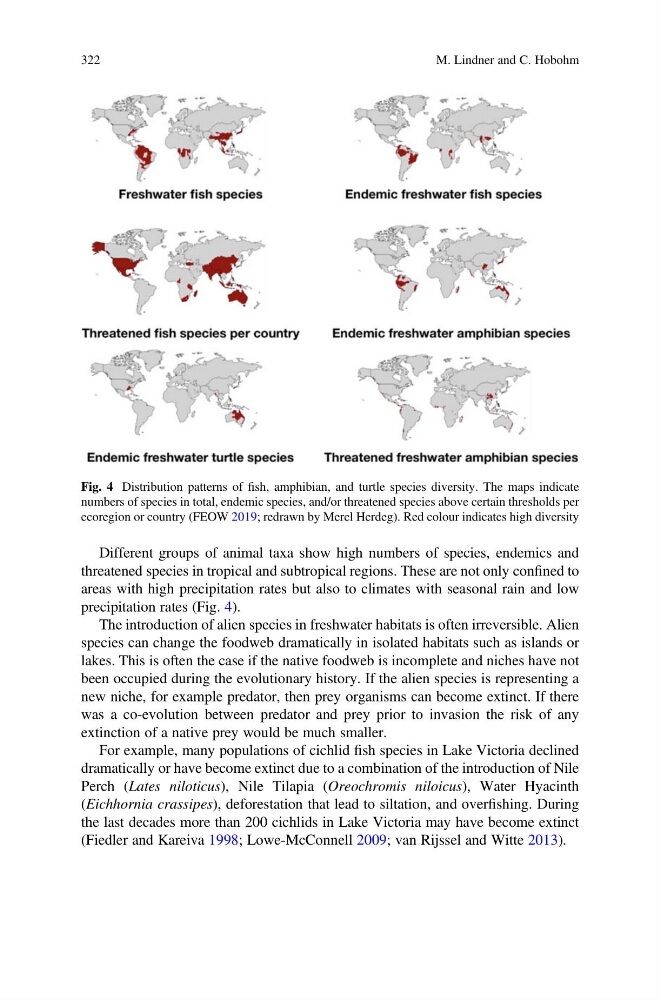
Different groups of animal taxa show high numbers of species, endemics and
threatened species in tropical and subtropical regions. These are not only confined to
areas with high precipitation rates but also to climates with seasonal rain and low
precipitation rates (Fig. 4).
The introduction of alien species in freshwater habitats is often irreversible. Alien
species can change the foodweb dramatically in isolated habitats such as islands or
lakes. This is often the case if the native foodweb is incomplete and niches have not
been occupied during the evolutionary history. If the alien species is representing a
new niche, for example predator, then prey organisms can become extinct. If there
was a co-evolution between predator and prey prior to invasion the risk of any
extinction of a native prey would be much smaller.
For example, many populations of cichlid fish species in Lake Victoria declined
dramatically or have become extinct due to a combination of the introduction of Nile
Perch (Lates niloticus), Nile Tilapia (Oreochromis niloicus), Water Hyacinth
(Eichhornia crassipes), deforestation that lead to siltation, and overfishing. During
the last decades more than 200 cichlids in Lake Victoria may have become extinct
(Fiedler and Kareiva 1998; Lowe-McConnell 2009; van Rijssel and Witte 2013).
Fig. 4 Distribution patterns of fish, amphibian, and turtle species diversity. The maps indicate
numbers of species in total, endemic species, and/or threatened species above certain thresholds per
ecoregion or country (FEOW 2019; redrawn by Merel Herdeg). Red colour indicates high diversity
322
M. Lindner and C. Hobohm
threatened species in tropical and subtropical regions. These are not only confined to
areas with high precipitation rates but also to climates with seasonal rain and low
precipitation rates (Fig. 4).
The introduction of alien species in freshwater habitats is often irreversible. Alien
species can change the foodweb dramatically in isolated habitats such as islands or
lakes. This is often the case if the native foodweb is incomplete and niches have not
been occupied during the evolutionary history. If the alien species is representing a
new niche, for example predator, then prey organisms can become extinct. If there
was a co-evolution between predator and prey prior to invasion the risk of any
extinction of a native prey would be much smaller.
For example, many populations of cichlid fish species in Lake Victoria declined
dramatically or have become extinct due to a combination of the introduction of Nile
Perch (Lates niloticus), Nile Tilapia (Oreochromis niloicus), Water Hyacinth
(Eichhornia crassipes), deforestation that lead to siltation, and overfishing. During
the last decades more than 200 cichlids in Lake Victoria may have become extinct
(Fiedler and Kareiva 1998; Lowe-McConnell 2009; van Rijssel and Witte 2013).
Fig. 4 Distribution patterns of fish, amphibian, and turtle species diversity. The maps indicate
numbers of species in total, endemic species, and/or threatened species above certain thresholds per
ecoregion or country (FEOW 2019; redrawn by Merel Herdeg). Red colour indicates high diversity
322
M. Lindner and C. Hobohm