

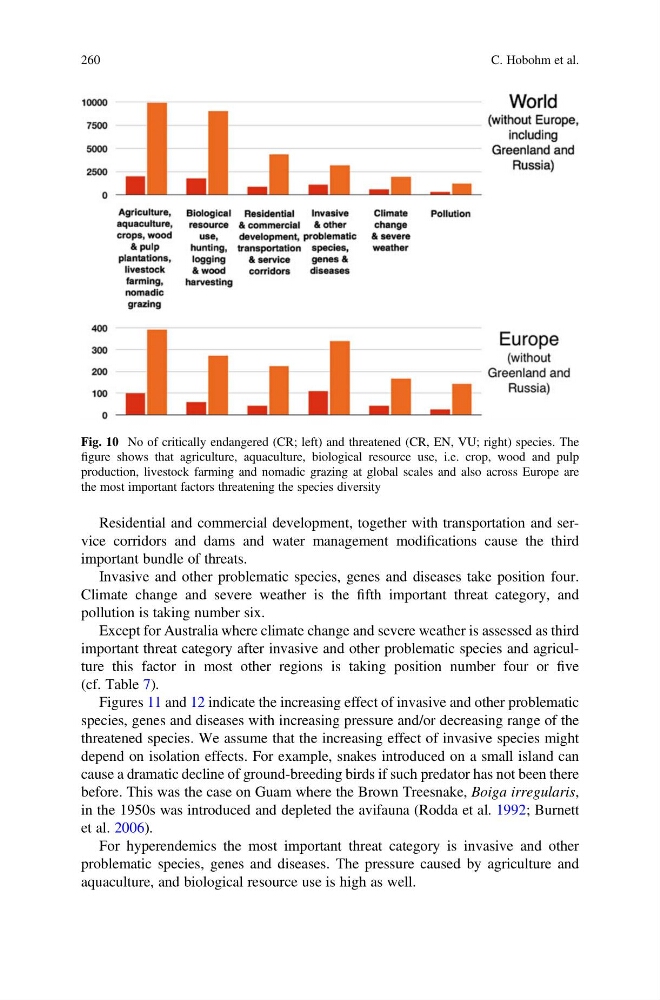
Residential and commercial development, together with transportation and service corridors and dams and water management modifications cause the third
important bundle of threats.
Invasive and other problematic species, genes and diseases take position four.
Climate change and severe weather is the fifth important threat category, and
pollution is taking number six.
Except for Australia where climate change and severe weather is assessed as third
important threat category after invasive and other problematic species and agriculture this factor in most other regions is taking position number four or five
(cf. Table 7).
Figures 11 and 12 indicate the increasing effect of invasive and other problematic
species, genes and diseases with increasing pressure and/or decreasing range of the
threatened species. We assume that the increasing effect of invasive species might
depend on isolation effects. For example, snakes introduced on a small island can
cause a dramatic decline of ground-breeding birds if such predator has not been there
before. This was the case on Guam where the Brown Treesnake, Boiga irregularis,
in the 1950s was introduced and depleted the avifauna (Rodda et al. 1992; Burnett
et al. 2006).
For hyperendemics the most important threat category is invasive and other
problematic species, genes and diseases. The pressure caused by agriculture and
aquaculture, and biological resource use is high as well.
Fig. 10 No of critically endangered (CR; left) and threatened (CR, EN, VU; right) species. The
figure shows that agriculture, aquaculture, biological resource use, i.e. crop, wood and pulp
production, livestock farming and nomadic grazing at global scales and also across Europe are
the most important factors threatening the species diversity
260
C. Hobohm et al.
important bundle of threats.
Invasive and other problematic species, genes and diseases take position four.
Climate change and severe weather is the fifth important threat category, and
pollution is taking number six.
Except for Australia where climate change and severe weather is assessed as third
important threat category after invasive and other problematic species and agriculture this factor in most other regions is taking position number four or five
(cf. Table 7).
Figures 11 and 12 indicate the increasing effect of invasive and other problematic
species, genes and diseases with increasing pressure and/or decreasing range of the
threatened species. We assume that the increasing effect of invasive species might
depend on isolation effects. For example, snakes introduced on a small island can
cause a dramatic decline of ground-breeding birds if such predator has not been there
before. This was the case on Guam where the Brown Treesnake, Boiga irregularis,
in the 1950s was introduced and depleted the avifauna (Rodda et al. 1992; Burnett
et al. 2006).
For hyperendemics the most important threat category is invasive and other
problematic species, genes and diseases. The pressure caused by agriculture and
aquaculture, and biological resource use is high as well.
Fig. 10 No of critically endangered (CR; left) and threatened (CR, EN, VU; right) species. The
figure shows that agriculture, aquaculture, biological resource use, i.e. crop, wood and pulp
production, livestock farming and nomadic grazing at global scales and also across Europe are
the most important factors threatening the species diversity
260
C. Hobohm et al.