

One single juvenile and a freshly dead adult of the mollusc Partula emersoni was
recorded on Pohnpei Island, Micronesia, in 2011.
Many observations and records are already a couple of years if not two decades
old, and it is questionable if all these species still exist. On the other hand, especially
vascular plant species such as Euphorbia margalidiana or Wollemia nobilis are
cultivated in certain botanical gardens and are an object of related breeding
programmes. Today it is possible to buy Wollemia via internet. Thus, it can be
assumed that the survival of these species at least in horticulture is guaranteed.
Choleva septentrionis subsp. holsatica is an insect living in a cave in Bad
Segeberg, Germany. Because of the geology and history of this cave and because
of genetic analysis it must be assumed that this insect is an evolutionary relatively
young taxon (Heun 1955; Ipsen and Tolasch 1997; Ruzicka and Vavra 2003). The
same can be assumed for plant species of genera with many apomict species such as
Alchemilla, Taraxacum, Sorbus, Rubus, Hieracium and others in Europe.
Wollemia nobilis is representing the opposite, a putative old and monotypic taxon
or living fossil which was discovered in Australia in 1994 (Jones et al. 1995;
Chambers et al. 1998; Woodford 2000).
The plant family of the Euphorbiaceae is relatively old and hybridization between
species is rarely observed, with the exception of succulent Euphorbias on Canary
Islands (Borgen 1979; Izquierdo et al. 2004; Molero and Rovira 2005). However,
Euphorbia margalidiana, synonymous to Euphorbia squamigera subsp.
margalidiana is not very different from Euphorbia squamigera subsp. squamigera
which is also native to the Balearic Islands. Thus, the hyperendemic on Ses
Margalides might have been evolved via genetic drift, and it can be assumed that
this taxon is of intermediate age (Castroviejo et al. 1997).
3.2 Threats
With respect to predefined threat categories of the IUCN (2019c), agriculture and
aquaculture including tree plantations and nomadic grazing, and biological resource
use including illegal hunting and collection of roots, fruits, herbs, etc. are the most
important threats to endangered species of the IUCN Red List (Table 7, Fig. 10).
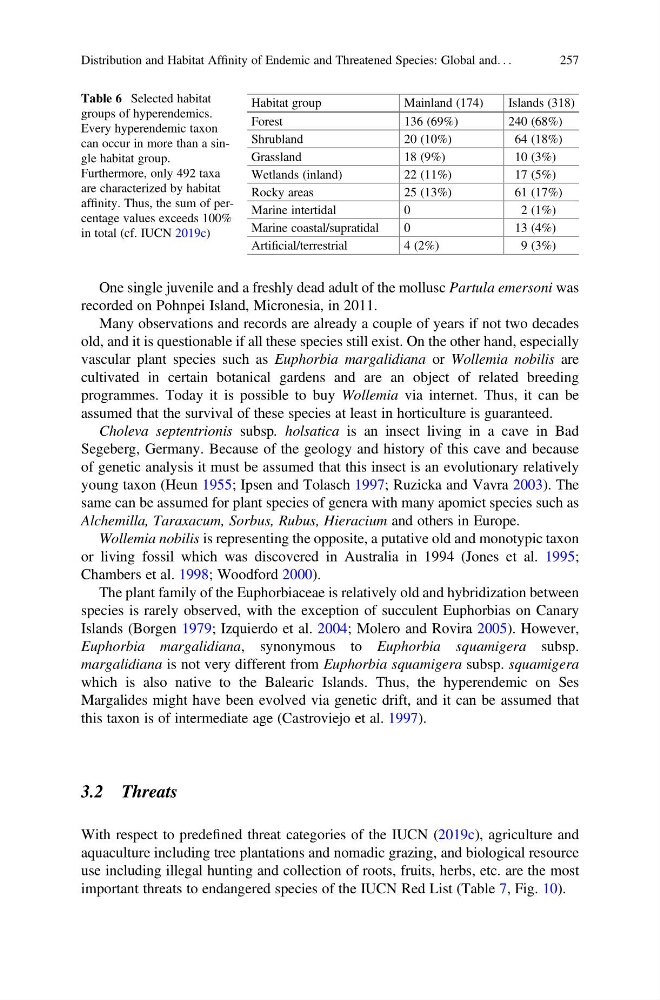
Table 6 Selected habitat
groups of hyperendemics.
Every hyperendemic taxon
can occur in more than a single habitat group.
Furthermore, only 492 taxa
are characterized by habitat
affinity. Thus, the sum of percentage values exceeds 100%
in total (cf. IUCN 2019c)
Habitat group
Mainland (174)
Islands (318)
Forest
136 (69%)
240 (68%)
Shrubland
20 (10%)
64 (18%)
Grassland
18 (9%)
10 (3%)
Wetlands (inland)
22 (11%)
17 (5%)
Rocky areas
25 (13%)
61 (17%)
Marine intertidal
0
2 (1%)
Marine coastal/supratidal
0
13 (4%)
Artificial/terrestrial
4 (2%)
9 (3%)
Distribution and Habitat Affinity of Endemic and Threatened Species: Global and. . .
257
recorded on Pohnpei Island, Micronesia, in 2011.
Many observations and records are already a couple of years if not two decades
old, and it is questionable if all these species still exist. On the other hand, especially
vascular plant species such as Euphorbia margalidiana or Wollemia nobilis are
cultivated in certain botanical gardens and are an object of related breeding
programmes. Today it is possible to buy Wollemia via internet. Thus, it can be
assumed that the survival of these species at least in horticulture is guaranteed.
Choleva septentrionis subsp. holsatica is an insect living in a cave in Bad
Segeberg, Germany. Because of the geology and history of this cave and because
of genetic analysis it must be assumed that this insect is an evolutionary relatively
young taxon (Heun 1955; Ipsen and Tolasch 1997; Ruzicka and Vavra 2003). The
same can be assumed for plant species of genera with many apomict species such as
Alchemilla, Taraxacum, Sorbus, Rubus, Hieracium and others in Europe.
Wollemia nobilis is representing the opposite, a putative old and monotypic taxon
or living fossil which was discovered in Australia in 1994 (Jones et al. 1995;
Chambers et al. 1998; Woodford 2000).
The plant family of the Euphorbiaceae is relatively old and hybridization between
species is rarely observed, with the exception of succulent Euphorbias on Canary
Islands (Borgen 1979; Izquierdo et al. 2004; Molero and Rovira 2005). However,
Euphorbia margalidiana, synonymous to Euphorbia squamigera subsp.
margalidiana is not very different from Euphorbia squamigera subsp. squamigera
which is also native to the Balearic Islands. Thus, the hyperendemic on Ses
Margalides might have been evolved via genetic drift, and it can be assumed that
this taxon is of intermediate age (Castroviejo et al. 1997).
3.2 Threats
With respect to predefined threat categories of the IUCN (2019c), agriculture and
aquaculture including tree plantations and nomadic grazing, and biological resource
use including illegal hunting and collection of roots, fruits, herbs, etc. are the most
important threats to endangered species of the IUCN Red List (Table 7, Fig. 10).
Table 6 Selected habitat
groups of hyperendemics.
Every hyperendemic taxon
can occur in more than a single habitat group.
Furthermore, only 492 taxa
are characterized by habitat
affinity. Thus, the sum of percentage values exceeds 100%
in total (cf. IUCN 2019c)
Habitat group
Mainland (174)
Islands (318)
Forest
136 (69%)
240 (68%)
Shrubland
20 (10%)
64 (18%)
Grassland
18 (9%)
10 (3%)
Wetlands (inland)
22 (11%)
17 (5%)
Rocky areas
25 (13%)
61 (17%)
Marine intertidal
0
2 (1%)
Marine coastal/supratidal
0
13 (4%)
Artificial/terrestrial
4 (2%)
9 (3%)
Distribution and Habitat Affinity of Endemic and Threatened Species: Global and. . .
257